The Nalbound Object of the Week this week is a small fragment of vegetal fiber found in Chile. The fragment has two types of Loop & Twist, both Z-crossed.
Please note that sharing to other venues will likely be intermittent. If you wish to receive these each week, please remember to follow the blog. Patrons on Patreon receive early access previews, occasional extra details, and priority requests.
I hope everyone’s winter holiday season is going well and that the new year be all you need it to be. For this week’s Nalbound Object of the Week we got a viscacha figure/effigy. I love these because viscachas are sooo cute! (I’ve included a picture of a live viscacha below for those of us less familiar with what exactly one looks like.)
Description: Worked in yellow and dark brown yarn, the figure includes the pointed ears, nose, and long tail of a viscacha. Overall: 7.5 x 1 x 1.7 cm (2 15/16 x 3/8 x 11/16 in.)1
Stitch(es) used: Looping.5 S-crossed and Z-crossed Simple Looping depending on which part of the viscacha (as determined by Anne Marie Decker based on the photograph)
Please note that sharing to other venues will likely be intermittent. If you wish to receive these each week, please remember to follow the blog. Patrons on Patreon receive early access previews, occasional extra details, and priority requests.
For a person that has spent a lot of time examining stockings, this is an excellent time of the year. The Museum der Kulturen Basel has the largest collection of Egyptian nalbinding1 and they just recently put their entire collection online. So this week’s Nalbound Object of the Week is one of my favorite of the children’s socks.
Object: Child’s sock with orange, blue and yellow stripes – III 15474
Description: The sock is striped with blue, orange, and yellow stripes and a natural (now cream) base that shows mostly in the wedge heel. It has a relatively short, undifferentiated, toe box with a rather large wedge heel. The ankle is damaged and its true height unknown. Length 17 cm2
Dated to: 4th century ?3 CE (This is a very old art historical based dating. There has been no scientific dating of compound Egyptian nalbound socks. More recent excavations are finding compound nalbound socks in 11th century layers. I would dearly love to have a few of these radiocarbon dated as exactly when compound nalbinding began cannot be determined without solid dating.)
Some sources in which more information can be found:
Böttcher, Gudrun. “Koptische Nadelbindungstextilien im Museum der Kulturen Basel” in Experimentelle Archäologie in Europa: Bilanz 2004 Heft 3. edited by Corinna Endlich. Oldenburg: Isensee Verlag, 2004: 211-214. ISBN 3-89995-204-9.
Please note that sharing to other venues will likely be intermittent. If you wish to receive these each week, please remember to follow the blog. Patrons on Patreon receive early access previews, occasional extra details, and priority requests.
That we know of so far because I am certain there are more socks out there in boxes and the backs of drawers that haven’t been opened in a century. ↩︎
Böttcher writes it as Stitch Type: III and Stitch Variant: F(L) 2 UOO/UUOO. Böttcher, Gudrun. “Koptische Nadelbindungstextilien im Museum der Kulturen Basel” in Experimentelle Archäologie in Europa: Bilanz 2004 Heft 3. edited by Corinna Endlich. Oldenburg: Isensee Verlag, 2004: 211-214. ISBN 3-89995-204-9. pg 213. ↩︎
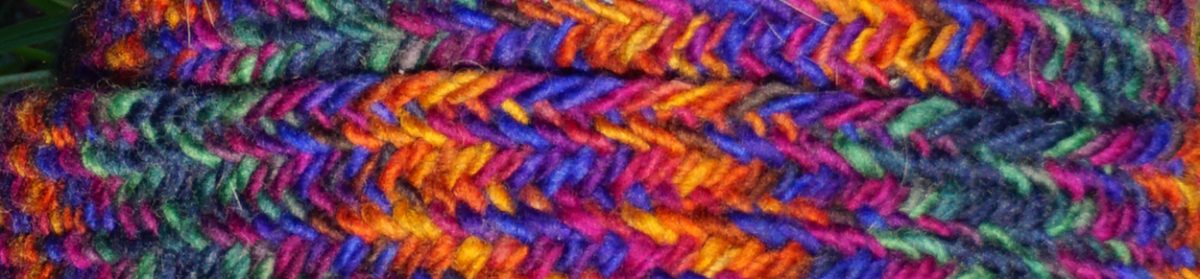
This week’s Nalbound Object of the Week is a striking Peruvian hat worked in Cross-knit Looping in a distinctive chevron pattern. While there are quite a few hats found in Peru, both in Simple Looping and in Cross-knit Looping, this is the first I’ve come across with this Chevron patterning.
Please note that sharing to other venues will likely be intermittent. If you wish to receive these each week, please remember to follow the blog. Patrons on Patreon receive early access previews, occasional extra details, and priority requests.
This week I get to share with you the excitement of finding out about a rare find in a church I once visited. Some regions have preserved many finds, but textiles in Ireland are relatively rare and nalbound ones more so. Thus this week’s Nalbound Object of the Week is the second known nalbound artifact from Ireland. The fragments were found in the 12th century occupational debris. Photos have been published this year in Textiles of Ireland: Archaeology, Craft, Art by Elizabeth Wincott Heckett if you would like to see them. There’s also a nice diagram in 2006 Archeological Monograph on the excavations.
St Audoen’s Church & Visitor center when we visited on April 27, 2014. Photo credit: Anne Marie Decker
Object: Two main fragments. Usage unknown, but possibly a sock or cap.
Description: The larger fragment is 30 cm long by 8 cm high1 showing the remains of 6 rows. The smaller fragment is 6 cm long by 5 cm high2 with remains of 3+ rows. The thickness of both is c. 2mm.3 Original use as a mitten was ruled out as the length of the larger fragment would exceed the circumference appropriate for a mitten and is more suitable for a sock or a piece of a cap.4 There is no evidence of either intentional or wear fulling.5
Find location: Found in the 12th century occupation debris associated with timber structures during excavation of St. Audoen’s church, Cornmarket, Dublin, Ireland.7
Material: A dark brown, naturally colored, coarse, perhaps kemp-like, wool. No dye detected. The yarn has been combed and worsted spun in a medium to loose Z spin then two-plied with an S twist. The yarn is 1.5 mm in diameter.8
Stitch(es) used: uo o/u uoo F1 based on analysis of one of the outermost rows of loops.9 (Korgen)
Inventory number: E497:2428.325
Current location: Still tracking that down. The detailed catalog was lodged with the excavation archive in the Department of the Environment, Heritage and Local Government. Some of the items excavated at St Audoen’s remain there on display in their Visitor’s Centre.
Link to museum catalog or other data: none known
Some sources in which more information can be found:
Wincott Heckett, Elizabeth. “Textiles” in the Archaeological Finds chapter of St Audoen’s Church, Cornmarket, Dublin: Archaeology and Architecture by Mary McMahon. Dublin: The Stationary Office, Government of Ireland, 2006. ISBN 0-7557-7315-2
Wincott Heckett, Elizabeth. Textiles of Ireland: Archaeology, Craft, Art. Edited by Mary Ann Williams. Cork: Cork University Press, 2025. ISBN 9781782055716
There is also an archeological drawing contained the the archeological monograph, St Audoen’s Church, Cornmarket, Dublin: Archaeology and Architecture, by Mary McMahon: Fig. 6.9 on page 74.
If you find this type of content interesting, please remember to follow the blog. You can also give one time donation at the link on this site or join my Patreon to support further research. Patrons on Patreon receive early access previews, occasional extra details, and priority requests.
300 x 80mm. Wincott Heckett, Elizabeth. “Textiles” in the Archaeological Finds chapter of St Audoen’s Church, Cornmarket, Dublin: Archaeology and Architecture by Mary McMahon. Dublin: The Stationary Office, Government of Ireland, 2006. ISBN 0-7557-7315-2 page 74 and republished in Wincott Heckett, Elizabeth. Textiles of Ireland: Archaeology, Craft, Art. Edited by Mary Ann Williams. Cork: Cork University Press, 2025. ISBN 9781782055716. pg. 230 ↩︎
60 x 50mm. Wincott Heckett, Elizabeth. “Textiles” in the Archaeological Finds chapter of St Audoen’s Church, Cornmarket, Dublin: Archaeology and Architecture by Mary McMahon. Dublin: The Stationary Office, Government of Ireland, 2006. ISBN 0-7557-7315-2 page 74 and republished in Wincott Heckett, Elizabeth. Textiles of Ireland: Archaeology, Craft, Art. Edited by Mary Ann Williams. Cork: Cork University Press, 2025. ISBN 9781782055716. pg. 230 ↩︎
Wincott Heckett, Elizabeth. “Textiles” in the Archaeological Finds chapter of St Audoen’s Church, Cornmarket, Dublin: Archaeology and Architecture by Mary McMahon. Dublin: The Stationary Office, Government of Ireland, 2006. ISBN 0-7557-7315-2 page 75 and republished in Wincott Heckett, Elizabeth. Textiles of Ireland: Archaeology, Craft, Art. Edited by Mary Ann Williams. Cork: Cork University Press, 2025. ISBN 9781782055716. pg. 232 ↩︎
The figural work found in the decorative borders made by the Nazca people is stunningly beautiful and detailed. This week’s Nalbound Object of the Week is a beautiful sample of their cross-knit looped borders. This fragment has three very distinct figures. The Art Institute of Chicago’s website has very nice closeups of both sides and a very good zoom function if you’d like to see more.
Nazca. Fragment of a Decorative Border, 100 BCE-200 CE. The Art Institute of Chicago® CC0 Public Domain
Object: Fragment of a Decorative Border 1956.405
Description: A border fragment with three figures. The figures are about 2.5 inches tall. The piece is 11.4 × 6.7 cm (4 1/2 × 2 5/8 in.)1
Stitch(es) used: The band’s ground support is plain weave and the extension supports are simple looping. The ground is encased in the decorative cross-knit looping6
Some sources in which more information can be found:
Sawyer, Alan R. Early Nasca Needlework. London: Laurence King Publishing, 1997. pg. 149, fig. 119 and 120 (ill.).
Melo, Alipio, María José Murillo, and Danitza Willka. “The Heartbeat of Andean Weaving,” in On Loss and Absence: Textiles of Mourning and Survival, eds. Isaac Facio, Nneka Kai, L Vinebaum, and Anne Wilson, exh. cat. Chicago: Art Institute of Chicago, 2025. pg. 164, fig. 3 (ill.).
Photographs (if permissions allow):
Please note that sharing to other venues will likely be intermittent. If you wish to receive these each week, please remember to follow the blog. Patrons on Patreon receive early access previews, occasional extra details, and priority requests.
This week’s Nalbound Object of the Week is a beautiful cross-knit looping example. A border of warriors and their sacrifice, originally intended to be attached to a piece of fabric. If you go to the The Art Institute of Chicago’s website there is a very good zoom function and some close-ups showing the underlying support worked in Simple Looping.
Nazca. Warrior Fragments, 100 BCE-200 CE. The Art Institute of Chicago® CC0 Public Domain
Object: Border of warriors
Description: A border of warriors and a sacrifice. The figures are about 2.5 inches tall. More details on The Art Institute of Chicago’s website.
Some sources in which more information can be found:
Sawyer, Alan R. Early Nasca Needlework. London: Laurence King Publishing, 1997. pg. 148, color fig. 117.
Photographs (if permissions allow):
Please note that sharing to other venues will likely be intermittent. If you wish to receive these each week, please remember to follow the blog. Patrons on Patreon receive early access previews, occasional extra details, and priority requests.
Fresh off the presses, we’ve got a new article that includes quite a few nalbound examples; including one I hadn’t seen before!
“Icelandic mittens from archaeological contexts” by Charlotte Rimstad, Ulla Mannering, Joe W. Walser III, Freyja H. Ó. Sesseljudóttir and Susanne Mueller includes some very nice photographs of several nalbound mittens; the one found in Iceland and several comparables from Norway, Sweden, and Denmark.
When they say click on the image, they mean click on the orange cover image with the pair of mittens on it. That is the only place where the download link is located. I have heard there are some issues with the image loading on some mobile devices.
For this week’s Nalbound Object of the Week, I’m delighted to be able to bring you evidence of the current tradition of nalbinding in Northern Ghana. I’d had hints that the technique might be found in West Africa, but nothing Ghanaian specific. Thus, imagine my excitement when I came across an example in the Accra Arts Center. I was initially concerned it might be an import, but seeing several others in Cape Coast and with some additional information obtained during bargaining, we’ve confirmed they are a product of Northern Ghana.
Object: Ghanaian bag with coiled base
Description: A cross-body bag with a solid bottom. All the versions I saw were various stripes of natural color, deep purple, and dark blue. This one had some purple going around the mouth and up the strap.
Dated to: 2024. Collected on 21 October, 2024 in the Accra Art Center
Find location: Accra Arts Center, in a stall selling goods from Northern Ghana. The sellers spoke Degaare, which indicates they are of the Dagaaba/Dagaati people. Additional examples were also spotted in a market stall in Cape Coast.
Material: a plant fiber, possibly jute, in natural, purple, and deep blue. The purple is water soluble and can transfer.
Stitch(es) used: Main body is Z-crossed Simple Looping, F1 O. There’s a bit of Cross-knit Looping at the center base and Coiling: Z-crossed Simple Looping around a bundle of carried sticks. Further examination is needed for the stitch around the mouth. (Stitch determinations by Anne Marie Decker)
Inventory number: N/A
Current location: Anne Marie Decker’s personal collection
Photographs:
View of the stripes and connections. Photo credit: Anne Marie DeckerCloseup of the base showing the carried stiffener material. Photo credit: Anne Marie DeckerThe base of the bag is stiffened. Photo credit: Anne Marie DeckerAdditional details of the bag in Anne Marie Decker’s collection. Another bag seen in Cape Coast. Photo credit: Anne Marie DeckerMore bags seen in Cape Coast. Photo credit: Anne Marie DeckerThe handles of the bags in Cape Coast. Photo credit: Anne Marie DeckerThe cross-knit looping start before the stiffened section. Photo credit: Anne Marie DeckerMouth and handle attachment. Photo credit: Anne Marie DeckerDetails of the four similar bags seen in a market stall in Cape Coast.
Please note that sharing to other venues will likely be intermittent. If you wish to receive these each week, please remember to follow the blog. Patrons on Patreon receive early access previews, occasional extra details, and priority requests. They also support explorations to find nalbinding around the world.
The shape of the cuff of this week’s Nalbound Object of the Week never really fit with the 10th century dating assigned to it when it was found in the late 19th century. Recent radiocarbon dating reveals that the mitten from Iceland is dated to between the late 15th to early 17th centuries CE which makes much more sense given its shaping. As more research is conducted on nalbinding, we begin to get a clearer picture of its usage, distribution, and dating.
Arnheiðarstöðum Iceland mitten Þjms. 3405 back on display after I examined it. Photo credit: Anne Marie Decker – 1 Sept 2022
Object: Iceland Mitten
Description: The mitten is densely nalbound of a two ply yarn made of wool fibers of two colors and crimps. Overall the mitten is currently a lovely reddish brown, but close examination shows that there are some darker smoother fibers intermittently mixed with lighter brown crimpier fibers bringing to mind the two coated sheep of Iceland. There is some damage to the cuff and a bit near the base of the pinky finger, but overall the mitten is in good condition. The thumb is rather large in comparison to the size of the fingers and lays flat with an extremely neatly worked connection. It is worked from the tip to the cuff. The direction of work spirals in an S slant fashion which gives the appearance of a right to left working direction when observing the current exterior. However, the stitch itself belies the thought that it might have been worked left handed and more likely it has been turned inside out leaving the technical front currently inside.
Dated to: Recently radiocarbon dated to 1480-1640 CE.1 The original dating of the 10th century had been estimated when the mitten was found in the late 19th century and was based on jewelry found nearby.2
Find location: The mitten was found in 1889 when they were digging to build a new house at the farm at Arnheiðarstaðir in the east of Fljótsdalshérað, Iceland.3
Material: Wool4 Two-ply with a diameter of just under 1/8th inch (3mm).5
Stitch(es) used: Oslo F1, F1 UO/UOO6 (Stitch determination by Margrethe Hald. Confirmed by Anne Marie Decker during her examination of the mitten on 1 September 2022)
Gauge: 6 stitches to the inch. 1 and 3/4 rows to the inch.7
Pálsson, Pálmi. 4. Tveir hanzkar in “Um myndir af gripum í forngripa-safninu.” Árbók Hins íslenzka fornleifafélags10. Reykjavik 1895. pgs. 34-35.
Rimstad, Charlotte, Ulla Mannering, Joe Wallace Walser III, and Susanne Mueller. “ICELANDIC MITTENS” Oral Presentation at the European Association of Archaeologists 29th EAA Annual Meeting in Belfast, Northern Ireland, 30 August – 2 September 2023 https://www.e-a-a.org/EAA2023/Programme.aspx?Program=3 click on the Abstract Book (30 Aug) link to find the abstract.
Photographs:
Arnheiðarstöðum Iceland mitten Þjms. 3405 Photo credit: Anne Marie Decker – 24 Jan 2019Display including the Arnheiðarstöðum Iceland mitten Þjms. 3405 Photo credit: Anne Marie Decker – 24 Jan 2019 Anne Marie Decker’s hand comparing size with the Arnheiðarstöðum Iceland mitten Þjms. 3405 Photo credit: Anne Marie Decker – 24 Jan 2019Tip of Arnheiðarstöðum Iceland mitten Þjms. 3405 and thumb. Photo credit: Anne Marie Decker – 24 Jan 2019Arnheiðarstöðum Iceland mitten Þjms. 3405 taken from above to better show the damage to the outer edge. Photo credit: Anne Marie Decker – 24 Jan 2019Photos taken when I first saw the mitten on display in January 2019.
Please note that sharing to other venues will likely be intermittent. If you wish to receive these each week, please remember to follow the blog. Patrons on Patreon receive early access previews, occasional extra details, and priority requests.
The museum made the decision to post the recent radiocarbon dating in the online catalog entry for the mitten https://sarpur.is/Adfang.aspx?AdfangID=323304 Accessed 27 May 2024. The online catalog entry also contains a link to the testing laboratory’s Report of Radiocarbon Dating Analyses: https://sarpur.is/Uploads/Files/2290209.pdf (Accessed 23 June 2024). The dating was presented in the Icelandic Mittens presentation given by Charlotte Rimstad et. al. at the European Association of Archaeologists 29th annual meeting in Belfast in 2023 which was apparently not recorded, but the dating is noted in the Abstract for the presentation (pg. 1079 of linked pdf). Apparently an article will be forthcoming in an issue of the Norwegian Textile Review this summer or fall. ↩︎
Hald, Margrethe. “Vötturin fra Arnheidar-Stödum” in Arbok Hins islenzka fornleifafélags, 50. årgang, 1949-1950, Island, pgs. 73-78 ↩︎