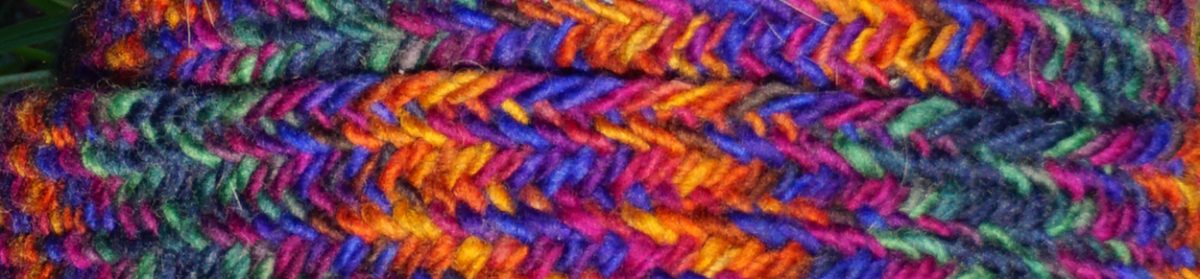
NOW: Child’s sock with orange, blue and yellow stripes – III 15474

For a person that has spent a lot of time examining stockings, this is an excellent time of the year. The Museum der Kulturen Basel has the largest collection of Egyptian nalbinding1 and they just recently put their entire collection online. So this week’s Nalbound Object of the Week is one of my favorite of the children’s socks.

©Museum der Kulturen Basel CC BY 4.0

Object: Child’s sock with orange, blue and yellow stripes – III 15474

Description: The sock is striped with blue, orange, and yellow stripes and a natural (now cream) base that shows mostly in the wedge heel. It has a relatively short, undifferentiated, toe box with a rather large wedge heel. The ankle is damaged and its true height unknown. Length 17 cm2

Dated to: 4th century ?3 CE (This is a very old art historical based dating. There has been no scientific dating of compound Egyptian nalbound socks. More recent excavations are finding compound nalbound socks in 11th century layers. I would dearly love to have a few of these radiocarbon dated as exactly when compound nalbinding began cannot be determined without solid dating.)

Culture: Coptic4

Find location: Egypt5

Material: Wool6

Stitch(es) used: F2 UOO/UUOO,7 Mammen

Inventory number: III 154748

Current location: Museum der Kulturen Basel, Switzerland

Link to museum catalog or other data: The Museum der Kulturen database does not have permalinks. Search for the Inventory number in https://onlinecollection.mkb.ch/#/query/f901c9da-5de6-4bea-819e-39e4464051be

Some sources in which more information can be found:

Böttcher, Gudrun. “Koptische Nadelbindungstextilien im Museum der Kulturen Basel” in Experimentelle Archäologie in Europa: Bilanz 2004 Heft 3. edited by Corinna Endlich. Oldenburg: Isensee Verlag, 2004: 211-214. ISBN 3-89995-204-9.

Please note that sharing to other venues will likely be intermittent. If you wish to receive these each week, please remember to follow the blog.
Patrons on Patreon receive early access previews, occasional extra details, and priority requests.

  1. That we know of so far because I am certain there are more socks out there in boxes and the backs of drawers that haven’t been opened in a century. ↩︎
  2. Museum der Kulturen Basel dataset published under the license CC BY 4.0 https://onlinecollection.mkb.ch/#/query/f901c9da-5de6-4bea-819e-39e4464051be ↩︎
  3. Museum der Kulturen Basel dataset published under the license CC BY 4.0 https://onlinecollection.mkb.ch/#/query/f901c9da-5de6-4bea-819e-39e4464051be ↩︎
  4. Museum der Kulturen Basel dataset published under the license CC BY 4.0 https://onlinecollection.mkb.ch/#/query/f901c9da-5de6-4bea-819e-39e4464051be ↩︎
  5. Museum der Kulturen Basel dataset published under the license CC BY 4.0 https://onlinecollection.mkb.ch/#/query/f901c9da-5de6-4bea-819e-39e4464051be ↩︎
  6. Museum der Kulturen Basel dataset published under the license CC BY 4.0 https://onlinecollection.mkb.ch/#/query/f901c9da-5de6-4bea-819e-39e4464051be ↩︎
  7. Böttcher writes it as Stitch Type: III and Stitch Variant: F(L) 2 UOO/UUOO. Böttcher, Gudrun. “Koptische Nadelbindungstextilien im Museum der Kulturen Basel” in Experimentelle Archäologie in Europa: Bilanz 2004 Heft 3. edited by Corinna Endlich. Oldenburg: Isensee Verlag, 2004: 211-214. ISBN 3-89995-204-9. pg 213. ↩︎
  8. Museum der Kulturen Basel dataset published under the license CC BY 4.0 https://onlinecollection.mkb.ch/#/query/f901c9da-5de6-4bea-819e-39e4464051be ↩︎

NOW: Chevron patterned hat – 46-77-30/10427

This week’s Nalbound Object of the Week is a striking Peruvian hat worked in Cross-knit Looping in a distinctive chevron pattern. While there are quite a few hats found in Peru, both in Simple Looping and in Cross-knit Looping, this is the first I’ve come across with this Chevron patterning.

Cap, looped, circular. Object number: 46-77-30/10427
Courtesy of the Peabody Museum of Archaeology and Ethnology, Harvard University. https://peabody.harvard.edu/
Request reproduction rights from https://peabody.harvard.edu/rights-and-reproductions

Object: Chevron patterned hat

Description: A dark brown and tan chevron patterned hat broken into 4 quarters with alternating chevrons. Overall: 16 x 17 cm (6 5/16 x 6 11/16 in.)1

Dated to: Chancay? culture2

Find location: Zapallan, Peru3

Material: camelid4

Stitch(es) used: Z-crossed5 Cross-knit Looping6

Object number: 46-77-30/10427

Current location: Peabody Museum of Archaeology & Ethnology, Harvard University

Link to museum catalog or other data: https://collections.peabody.harvard.edu/objects/details/90463?ctx=3895f836dffa87d819a31a9db21ff30320b3e15c&idx=72

Please note that sharing to other venues will likely be intermittent. If you wish to receive these each week, please remember to follow the blog.
Patrons on Patreon receive early access previews, occasional extra details, and priority requests.

  1. https://collections.peabody.harvard.edu/objects/details/90463?ctx=3895f836dffa87d819a31a9db21ff30320b3e15c&idx=72 ↩︎
  2. https://collections.peabody.harvard.edu/objects/details/90463?ctx=3895f836dffa87d819a31a9db21ff30320b3e15c&idx=72. Chancey culture would put this hat in the Late Intermediate Period, 1000 CE – 1476 CE, https://en.wikipedia.org/wiki/Periodization_of_pre-Columbian_Peru ↩︎
  3. https://collections.peabody.harvard.edu/objects/details/90463?ctx=3895f836dffa87d819a31a9db21ff30320b3e15c&idx=72 ↩︎
  4. https://collections.peabody.harvard.edu/objects/details/90463?ctx=3895f836dffa87d819a31a9db21ff30320b3e15c&idx=72 ↩︎
  5. As determined from the photograph by Anne Marie Decker ↩︎
  6. https://collections.peabody.harvard.edu/objects/details/90463?ctx=3895f836dffa87d819a31a9db21ff30320b3e15c&idx=72 ↩︎

NOW: Fragment from St. Audoen’s church, Dublin – E497:2428.325

This week I get to share with you the excitement of finding out about a rare find in a church I once visited. Some regions have preserved many finds, but textiles in Ireland are relatively rare and nalbound ones more so. Thus this week’s Nalbound Object of the Week is the second known nalbound artifact from Ireland. The fragments were found in the 12th century occupational debris. Photos have been published this year in Textiles of Ireland: Archaeology, Craft, Art by Elizabeth Wincott Heckett if you would like to see them. There’s also a nice diagram in 2006 Archeological Monograph on the excavations.

St Audoen’s Church & Visitor center when we visited on April 27, 2014. Photo credit: Anne Marie Decker

Object: Two main fragments. Usage unknown, but possibly a sock or cap.

Description: The larger fragment is 30 cm long by 8 cm high1 showing the remains of 6 rows. The smaller fragment is 6 cm long by 5 cm high2 with remains of 3+ rows. The thickness of both is c. 2mm.3 Original use as a mitten was ruled out as the length of the larger fragment would exceed the circumference appropriate for a mitten and is more suitable for a sock or a piece of a cap.4 There is no evidence of either intentional or wear fulling.5

Dated to: 12th century6 CE

Find location: Found in the 12th century occupation debris associated with timber structures during excavation of St. Audoen’s church, Cornmarket, Dublin, Ireland.7

Material: A dark brown, naturally colored, coarse, perhaps kemp-like, wool. No dye detected. The yarn has been combed and worsted spun in a medium to loose Z spin then two-plied with an S twist. The yarn is 1.5 mm in diameter.8

Stitch(es) used: uo o/u uoo F1 based on analysis of one of the outermost rows of loops.9 (Korgen)

Inventory number: E497:2428.325

Current location: Still tracking that down. The detailed catalog was lodged with the excavation archive in the Department of the Environment, Heritage and Local Government. Some of the items excavated at St Audoen’s remain there on display in their Visitor’s Centre.

Link to museum catalog or other data: none known

Some sources in which more information can be found:

Wincott Heckett, Elizabeth. “Textiles” in the Archaeological Finds chapter of St Audoen’s Church, Cornmarket, Dublin: Archaeology and Architecture by Mary McMahon. Dublin: The Stationary Office, Government of Ireland, 2006. ISBN 0-7557-7315-2

Wincott Heckett, Elizabeth. Textiles of Ireland: Archaeology, Craft, Art. Edited by Mary Ann Williams. Cork: Cork University Press, 2025. ISBN 9781782055716

Photographs:

There are two photos by Peter Maloney © The Estate of Elizabeth Wincott Heckett included in Textiles of Ireland: Archaeology, Craft, Art: Fig. 15.1 on page 228 and Fig. 15.2 on page 231.

There is also an archeological drawing contained the the archeological monograph, St Audoen’s Church, Cornmarket, Dublin: Archaeology and Architecture, by Mary McMahon: Fig. 6.9 on page 74.

If you find this type of content interesting, please remember to follow the blog. You can also give one time donation at the link on this site or join my Patreon to support further research.
Patrons on Patreon receive early access previews, occasional extra details, and priority requests.

  1. 300 x 80mm. Wincott Heckett, Elizabeth. “Textiles” in the Archaeological Finds chapter of St Audoen’s Church, Cornmarket, Dublin: Archaeology and Architecture by Mary McMahon. Dublin: The Stationary Office, Government of Ireland, 2006. ISBN 0-7557-7315-2 page 74 and republished in Wincott Heckett, Elizabeth. Textiles of Ireland: Archaeology, Craft, Art. Edited by Mary Ann Williams. Cork: Cork University Press, 2025. ISBN 9781782055716. pg. 230 ↩︎
  2. 60 x 50mm. Wincott Heckett, Elizabeth. “Textiles” in the Archaeological Finds chapter of St Audoen’s Church, Cornmarket, Dublin: Archaeology and Architecture by Mary McMahon. Dublin: The Stationary Office, Government of Ireland, 2006. ISBN 0-7557-7315-2 page 74 and republished in Wincott Heckett, Elizabeth. Textiles of Ireland: Archaeology, Craft, Art. Edited by Mary Ann Williams. Cork: Cork University Press, 2025. ISBN 9781782055716. pg. 230 ↩︎
  3. Wincott Heckett, Elizabeth. “Textiles” in the Archaeological Finds chapter of St Audoen’s Church, Cornmarket, Dublin: Archaeology and Architecture by Mary McMahon. Dublin: The Stationary Office, Government of Ireland, 2006. ISBN 0-7557-7315-2 page 75 and republished in Wincott Heckett, Elizabeth. Textiles of Ireland: Archaeology, Craft, Art. Edited by Mary Ann Williams. Cork: Cork University Press, 2025. ISBN 9781782055716. pg. 232 ↩︎
  4. Ibid. pg. 75, and republished in Ibid. pg. 233 ↩︎
  5. Ibid. pg. 75, and republished in Ibid. pg. 231 ↩︎
  6. Ibid. pg. 74, and republished in Ibid. pg. 229 ↩︎
  7. Ibid. pg. 74, and republished in Ibid. pg. 229 ↩︎
  8. Ibid. pg. 75, and republished in Ibid. pg. 232 ↩︎
  9. Ibid. pg. 75, and republished in Ibid. pg. 232 ↩︎

NOW: Border fragment with three figures – 1956.405

The figural work found in the decorative borders made by the Nazca people is stunningly beautiful and detailed. This week’s Nalbound Object of the Week is a beautiful sample of their cross-knit looped borders. This fragment has three very distinct figures. The Art Institute of Chicago’s website has very nice closeups of both sides and a very good zoom function if you’d like to see more.

Nazca. Fragment of a Decorative Border, 100 BCE-200 CE. The Art Institute of Chicago®
CC0 Public Domain

Object: Fragment of a Decorative Border 1956.405

Description: A border fragment with three figures. The figures are about 2.5 inches tall. The piece is 11.4 × 6.7 cm (4 1/2 × 2 5/8 in.)1

Dated to: 100 BCE-200 CE2

Culture: Nazca3

Find location: Possibly Coyungo, Nasca Valley, south coast, Peru4

Material: Cotton (plain woven ground), Camelid wool5

Stitch(es) used: The band’s ground support is plain weave and the extension supports are simple looping. The ground is encased in the decorative cross-knit looping6

Inventory number: 1956.405

Current location: The Art Institute of Chicago®

Link to museum catalog or other data: https://www.artic.edu/artworks/3000/fragment-of-a-decorative-border

Some sources in which more information can be found:

Sawyer, Alan R. Early Nasca Needlework. London: Laurence King Publishing, 1997. pg. 149, fig. 119 and 120 (ill.).

Melo, Alipio, María José Murillo, and Danitza Willka. “The Heartbeat of Andean Weaving,” in On Loss and Absence: Textiles of Mourning and Survival, eds. Isaac Facio, Nneka Kai, L Vinebaum, and Anne Wilson, exh. cat. Chicago: Art Institute of Chicago, 2025. pg. 164, fig. 3 (ill.).

Photographs (if permissions allow):

Please note that sharing to other venues will likely be intermittent. If you wish to receive these each week, please remember to follow the blog.
Patrons on Patreon receive early access previews, occasional extra details, and priority requests.

  1. The Art Institute of Chicago® https://www.artic.edu/artworks/3000/fragment-of-a-decorative-border ↩︎
  2. The Art Institute of Chicago® https://www.artic.edu/artworks/3000/fragment-of-a-decorative-border ↩︎
  3. The Art Institute of Chicago® https://www.artic.edu/artworks/3000/fragment-of-a-decorative-border ↩︎
  4. The Art Institute of Chicago® https://www.artic.edu/artworks/3000/fragment-of-a-decorative-border ↩︎
  5. The Art Institute of Chicago® https://www.artic.edu/artworks/3000/fragment-of-a-decorative-border ↩︎
  6. The Art Institute of Chicago® https://www.artic.edu/artworks/3000/fragment-of-a-decorative-border ↩︎

NOW: Border of warriors – 1956.1267.3a-h

This week’s Nalbound Object of the Week is a beautiful cross-knit looping example. A border of warriors and their sacrifice, originally intended to be attached to a piece of fabric. If you go to the The Art Institute of Chicago’s website there is a very good zoom function and some close-ups showing the underlying support worked in Simple Looping.

Nazca. Warrior Fragments, 100 BCE-200 CE. The Art Institute of Chicago®
CC0 Public Domain

Object: Border of warriors

Description: A border of warriors and a sacrifice. The figures are about 2.5 inches tall. More details on The Art Institute of Chicago’s website.

Dated to: 100 BCE–200 CE1

Culture: Nazca2

Find location: South coast, Peru3

Material: Cotton (ground), Camelid wool4

Stitch(es) used: Simple Looping for the ground support, cross-knit looping and cross-knit loop stitch embroidery5

Inventory number: 1956.1267.3a-h

Current location: The Art Institute of Chicago®

Link to museum catalog or other data: https://www.artic.edu/artworks/148858/warrior-fragments

Some sources in which more information can be found:

Sawyer, Alan R. Early Nasca Needlework. London: Laurence King Publishing, 1997. pg. 148, color fig. 117.

Photographs (if permissions allow):

Please note that sharing to other venues will likely be intermittent. If you wish to receive these each week, please remember to follow the blog.
Patrons on Patreon receive early access previews, occasional extra details, and priority requests.

  1. The Art Institute of Chicago® https://www.artic.edu/artworks/148858/warrior-fragments ↩︎
  2. The Art Institute of Chicago® https://www.artic.edu/artworks/148858/warrior-fragments ↩︎
  3. The Art Institute of Chicago® https://www.artic.edu/artworks/148858/warrior-fragments ↩︎
  4. The Art Institute of Chicago® https://www.artic.edu/artworks/148858/warrior-fragments ↩︎
  5. The Art Institute of Chicago® https://www.artic.edu/artworks/148858/warrior-fragments ↩︎

Nalbinding in ATN 66

Fresh off the presses, we’ve got a new article that includes quite a few nalbound examples; including one I hadn’t seen before!

“Icelandic mittens from archaeological contexts” by Charlotte Rimstad, Ulla Mannering, Joe W. Walser III, Freyja H. Ó. Sesseljudóttir and Susanne Mueller includes some very nice photographs of several nalbound mittens; the one found in Iceland and several comparables from Norway, Sweden, and Denmark.

When they say click on the image, they mean click on the orange cover image with the pair of mittens on it. That is the only place where the download link is located. I have heard there are some issues with the image loading on some mobile devices.

NOW: Ghanaian Bag 1

For this week’s Nalbound Object of the Week, I’m delighted to be able to bring you evidence of the current tradition of nalbinding in Northern Ghana. I’d had hints that the technique might be found in West Africa, but nothing Ghanaian specific. Thus, imagine my excitement when I came across an example in the Accra Arts Center. I was initially concerned it might be an import, but seeing several others in Cape Coast and with some additional information obtained during bargaining, we’ve confirmed they are a product of Northern Ghana.

Object: Ghanaian bag with coiled base

Description: A cross-body bag with a solid bottom. All the versions I saw were various stripes of natural color, deep purple, and dark blue. This one had some purple going around the mouth and up the strap.

Dated to: 2024. Collected on 21 October, 2024 in the Accra Art Center

Find location: Accra Arts Center, in a stall selling goods from Northern Ghana. The sellers spoke Degaare, which indicates they are of the Dagaaba/Dagaati people. Additional examples were also spotted in a market stall in Cape Coast.

Material: a plant fiber, possibly jute, in natural, purple,  and deep blue. The purple is water soluble and can transfer.

Stitch(es) used: Main body is Z-crossed Simple Looping,  F1 O. There’s a bit of Cross-knit Looping at the center base and Coiling: Z-crossed Simple Looping around a bundle of carried sticks. Further examination is needed for the stitch around the mouth. (Stitch determinations by Anne Marie Decker)

Inventory number: N/A

Current location: Anne Marie Decker’s personal collection

Photographs:

Please note that sharing to other venues will likely be intermittent. If you wish to receive these each week, please remember to follow the blog.
Patrons on Patreon receive early access previews, occasional extra details, and priority requests. They also support explorations to find nalbinding around the world.

NOW: Arnheiðarstöðum Iceland mitten Þjms. 3405

The shape of the cuff of this week’s Nalbound Object of the Week never really fit with the 10th century dating assigned to it when it was found in the late 19th century. Recent radiocarbon dating reveals that the mitten from Iceland is dated to between the late 15th to early 17th centuries CE which makes much more sense given its shaping. As more research is conducted on nalbinding, we begin to get a clearer picture of its usage, distribution, and dating.

Arnheiðarstöðum Iceland mitten Þjms. 3405 back on display after I examined it.
Photo credit: Anne Marie Decker – 1 Sept 2022

Object: Iceland Mitten

Description: The mitten is densely nalbound of a two ply yarn made of wool fibers of two colors and crimps. Overall the mitten is currently a lovely reddish brown, but close examination shows that there are some darker smoother fibers intermittently mixed with lighter brown crimpier fibers bringing to mind the two coated sheep of Iceland. There is some damage to the cuff and a bit near the base of the pinky finger, but overall the mitten is in good condition. The thumb is rather large in comparison to the size of the fingers and lays flat with an extremely neatly worked connection. It is worked from the tip to the cuff. The direction of work spirals in an S slant fashion which gives the appearance of a right to left working direction when observing the current exterior. However, the stitch itself belies the thought that it might have been worked left handed and more likely it has been turned inside out leaving the technical front currently inside.

Dated to: Recently radiocarbon dated to 1480-1640 CE.1 The original dating of the 10th century had been estimated when the mitten was found in the late 19th century and was based on jewelry found nearby.2

Find location: The mitten was found in 1889 when they were digging to build a new house at the farm at Arnheiðarstaðir in the east of Fljótsdalshérað, Iceland.3

Material: Wool4 Two-ply with a diameter of just under 1/8th inch (3mm).5

Stitch(es) used: Oslo F1, F1 UO/UOO6 (Stitch determination by Margrethe Hald. Confirmed by Anne Marie Decker during her examination of the mitten on 1 September 2022)

Gauge: 6 stitches to the inch. 1 and 3/4 rows to the inch.7

Inventory number: Þjms. 3405

Current location: Þjóðminjasafn Íslands (National Museum of Iceland)

Link to museum catalog or other data: https://sarpur.is/Adfang.aspx?AdfangID=323304

Some sources in which more information can be found:

Eldjárn, Kristján. “Að sauma síl og sía mjólk.” Árbók Hins íslenzka fornleifafélags 1960. Reykjavík 1960, pgs. 48-63.

Eldjárn, Kristján. “Vattarsaumur.” Hugur og hönd. 1. tbl. 1974, bls. 40-42.

Eldjárn, Kristján. “Vöttur frá Arnheiðarstöðum.” Hundrað ár í Þjóðminjasafni. Reykjavík 1962, pg. 27.

Hald, Margrethe. “Vötturin fra Arnheidar-Stödum” in Arbok Hins islenzka fornleifafélags, 50. årgang, 1949-1950, Island, pgs. 73-78 ISSN 0256-8462.

Lehmann-Filhés, Margarethe. “Zwei Isländische Handschuhe” in Zeitschrift für Ethnologie. pgs. 29-30.

Lucas, Rebecca. Two Icelandic Mittens (1896). https://www.medieval-baltic.us/lehmann-filhes-palsson.html Accessed 24 June 2024. Provides an English translation of Margarethe Lehmann-Filhés’ “Zwei Isländische Handschuhe.”

Pálsson, Pálmi. 4. Tveir hanzkar in “Um myndir af gripum í forngripa-safninu.” Árbók Hins íslenzka fornleifafélags 10. Reykjavik 1895. pgs. 34-35.

Rimstad, Charlotte, Ulla Mannering, Joe Wallace Walser III, and Susanne Mueller. “ICELANDIC MITTENS” Oral Presentation at the European Association of Archaeologists 29th EAA Annual Meeting in Belfast, Northern Ireland,
30 August – 2 September 2023 https://www.e-a-a.org/EAA2023/Programme.aspx?Program=3 click on the Abstract Book (30 Aug) link to find the abstract.

Photographs:

Please note that sharing to other venues will likely be intermittent. If you wish to receive these each week, please remember to follow the blog.
Patrons on Patreon receive early access previews, occasional extra details, and priority requests.

  1. The museum made the decision to post the recent radiocarbon dating in the online catalog entry for the mitten https://sarpur.is/Adfang.aspx?AdfangID=323304 Accessed 27 May 2024. The online catalog entry also contains a link to the testing laboratory’s Report of Radiocarbon Dating Analyses: https://sarpur.is/Uploads/Files/2290209.pdf (Accessed 23 June 2024). The dating was presented in the Icelandic Mittens presentation given by Charlotte Rimstad et. al. at the European Association of Archaeologists 29th annual meeting in Belfast in 2023 which was apparently not recorded, but the dating is noted in the Abstract for the presentation (pg. 1079 of linked pdf). Apparently an article will be forthcoming in an issue of the Norwegian Textile Review this summer or fall. ↩︎
  2. Hald, Margrethe. “Vötturin fra Arnheidar-Stödum” in Arbok Hins islenzka fornleifafélags, 50. årgang, 1949-1950, Island, pgs. 73-78 ↩︎
  3. https://sarpur.is/Adfang.aspx?AdfangID=323304 Accessed 27 May 2024 ↩︎
  4. https://sarpur.is/Adfang.aspx?AdfangID=323304 Accessed 27 May 2024 ↩︎
  5. Wool diameter determined by Anne Marie Decker during her examination on 1 Sept 2022. ↩︎
  6. Hald, Margrethe. “Vötturin fra Arnheidar-Stödum” in Arbok Hins islenzka fornleifafélags, 50. årgang, 1949-1950, Island, pg. 75. ISSN 0256-8462. ↩︎
  7. Stitch gauge determined by Anne Marie Decker during her examination on 1 Sept 2022. ↩︎

NOW: Namur Reliquary Purse 229F

After a brief hiatus due to surgery, I bring you another Nalbound Object of the Week. This artifact was mentioned as an aside in an article about Pierre de Courpalay’s gloves (which will be a later post) and for the longest time I could find no more information about it other than it was supposedly an early 14th century green silk reliquary pouch from Namur, Belgium worked in space patterned Simple Looping with a carried thread. There was a stitch diagram, but no picture. My friend Ann Moreau took up the quest to track down more information and was able to provide me with a photograph and a couple of very interesting sources: a master’s thesis and the conservation report.

Photo credit: Bazzo, Stéphane, IRPA
CC BY 4.0 KIK-IRPA, Brussels (Belgium), cliché X142949

Object: Namur Reliquary Purse

Description: The purse measures approximately 6.5 inches by 6.3 inches (16.5 x 16cm) not inclusive of the tassels or ties.1 The main body is worked in a pattern of diamonds enclosing four smaller diamonds that is regular on the face, but shows an error in the pattern at the top of the reverse turning it into chevrons.2 There’s a strip of plain green on each side and a green eyelet band at the opening.

The pictures show that the main body of the purse was not worked in the round. Had it been worked around the purse, the slits in the space patterned Simple Looping would have been horizontal like those seen making eyelets on the green eyelet band. However, the slits in the main body are vertical, indicating that the fabric orientation has the base row along the right side of the face (left side of the reverse) and the fabric was built up to the left side. There is no noticeable seam showing at the bottom. All of which may indicate that the face and reverse were worked as one rectangle, sewn up the sides, and then the eyelet band worked around the opening.

The relic purse was classified as a Treasure by the Commission consultative du Patrimoine culturel mobilier [Consultative Commission for Movable Cultural Heritage] on October 4, 2021.3

Dated to: radiocarbon dated to ca 1260-1390 CE4 (77.4% certainty between 1260 and 1310)5

Find location: prieuré de Hastière [Priory of Hastière], Belgium.6 Donated in 1885 by M. Perpète Sarton and recorded as register number 16166 along with another purse.7

Material: Silk. The tassels include gilded silver metallic threads.8 “The beige and pink threads of the lining are colored with safflower and a dye containing traces of flavonoids, the green thread of the fringes with woad or indigo, and the beige thread of the boucle network with red wood.”9

Stitch(es) used: le réseau bouclé simple10 The opening is worked horizontally in Z-crossed Simple Looping, F1 O, with a carried thread leaving holes for the drawstring. The main body is worked vertically, also in Z-crossed Simple Looping, F1 O, with a carried thread worked with space patterning to make the diamond/chevron pattern of holes. (Stitch determination verified via photograph by Anne Marie Decker)

Inventory number: 229F

Current location: Owned by the Société Archéologique de Namur (SAN). Exhibited in the Musée Provincial des Arts Anciens Namurois (TreM.a).11

Link to museum catalog or other data: https://balat.kikirpa.be/object/11045822

Some sources in which more information can be found:

Damen, Emma, Griet Kockelkoren, Judith Goris, Ina Vanden Berghe, Marina Van Bos, and Mathieu Boudin. “Étude technico-matérielle et traitement de conservation, préservation et présentation de 7 bourses à reliques de la Société Archéologique de Namur (SAN).” Report on IRPS dossier 2017.13760 dated 9 September 2021.

De Ceuninck, Emmeline. “Étude historique, artistique et technologique de sept bourses conservées à la Société archéologique de Namur (SAN) et récemment restaurées à l’Institut royal du Patrimoine artistique (IRPA). Volume 1 et 2.”Master en Histoire de l’Art et Archéologie Mémoire [Master’s thesis], Université Libre de Bruxelles, Année académique 2022-2023.

Desrosiers, Sophie, Patricia Dal-Pra, and Isabelle Bédat. “On medieval pontifical gloves and glove medallions and wristbands found in France,” In [Archäologische Textilfunde/Archaeological Textiles] NESAT IX. ed. Antoinette Rast-Eicher and Renata Windler, p. 159-165. Ennenda: Archeo Tex, 2007. ISBN 978-3-033-01267-7.

Gagneux-Granade, Marguerite. L’Homme et les Mailles: histoire critique des mailles textiles : filets, réseaux, tricot, crochet. Bordeaux: Éditions INsensées, 2016. ISBN 978-2-9558095-0-1.

Photographs:

Desrosiers’ “On medieval pontifical gloves and glove medallions and wristbands found in France” has a diagram of the stitches making the pattern of a portion of the diamond in Fig. 2b on page 160. The diagram is flawed as it shows a whip stitch instead of the Z-crossed Simple Looping. It is showing a B1 O which makes a whip stitch instead of the F1 O that makes Z-crossed Simple Looping. The loops have also been regularized to the top which does not match the direction of work.

De Ceuninck’s “Étude historique, artistique et technologique de sept bourses conservées à la Société archéologique de Namur (SAN) et récemment restaurées à l’Institut royal du Patrimoine artistique (IRPA). Volume 2.” includes some lovely photos and schematics of the purse in Figs. 11, 12, 80 & Schéma 33, 34, 35, 36, 37.

Please note that sharing to other venues will likely be intermittent. If you wish to receive these each week, please remember to follow the blog.
Patrons on Patreon receive early access previews, occasional extra details, and priority requests.

  1. Emmeline De Ceuninck,”Étude historique, artistique et technologique de sept bourses conservées à la Société archéologique de Namur (SAN) et récemment restaurées à l’Institut royal du Patrimoine artistique (IRPA). Volume 2.” (Master en Histoire de l’Art et Archéologie Mémoire [Master’s thesis], Université Libre de Bruxelles, Année académique 2022-2023), pg. 1. and Damen, Emma, et al. “Étude technico-matérielle et traitement de conservation, préservation et présentation de 7 bourses à reliques de la Société Archéologique de Namur (SAN).” Report on IRPS dossier 2017.13760 dated 9 September 2021. Pg. 10. ↩︎
  2. De Ceuninck, “Étude historique, artistique et technologique de sept bourses conservées à la Société archéologique de Namur (SAN) et récemment restaurées à l’Institut royal du Patrimoine artistique (IRPA). Volume 1,” pg. 76. and Damen, Emma, et al. “Étude technico-matérielle et traitement de conservation, préservation et présentation de 7 bourses à reliques de la Société Archéologique de Namur (SAN).” Report on IRPS dossier 2017.13760 dated 9 September 2021. Pg. 10. ↩︎
  3. https://www.museedesartsanciens.be/wp-content/uploads/2023/01/TreM.a-MAAN_Rapport_Activites_2021.pdf III.5. Accessed 16 September 2024. ↩︎
  4. De Ceuninck, “Étude historique, artistique et technologique de sept bourses conservées à la Société archéologique de Namur (SAN) et récemment restaurées à l’Institut royal du Patrimoine artistique (IRPA). Volume 2,” pg. 108. ↩︎
  5. De Ceuninck, “Étude historique, artistique et technologique de sept bourses conservées à la Société archéologique de Namur (SAN) et récemment restaurées à l’Institut royal du Patrimoine artistique (IRPA). Volume 1,” pg. 74. ↩︎
  6. De Ceuninck, “Étude historique, artistique et technologique de sept bourses conservées à la Société archéologique de Namur (SAN) et récemment restaurées à l’Institut royal du Patrimoine artistique (IRPA). Volume 1,” pg. 28. See also page 79. ↩︎
  7. De Ceuninck, “Étude historique, artistique et technologique de sept bourses conservées à la Société archéologique de Namur (SAN) et récemment restaurées à l’Institut royal du Patrimoine artistique (IRPA). Volume 1,” pg. 28. ↩︎
  8. De Ceuninck, “Étude historique, artistique et technologique de sept bourses conservées à la Société archéologique de Namur (SAN) et récemment restaurées à l’Institut royal du Patrimoine artistique (IRPA). Volume 1,” pg. 76. ↩︎
  9. Translated from De Ceuninck, “Étude historique, artistique et technologique de sept bourses conservées à la Société archéologique de Namur (SAN) et récemment restaurées à l’Institut royal du Patrimoine artistique (IRPA). Volume 1,” pg. 74. See also pages 78-79. ↩︎
  10. De Ceuninck, “Étude historique, artistique et technologique de sept bourses conservées à la Société archéologique de Namur (SAN) et récemment restaurées à l’Institut royal du Patrimoine artistique (IRPA). Volume 1,” pg. 75. and Damen, Emma, et al. “Étude technico-matérielle et traitement de conservation, préservation et présentation de 7 bourses à reliques de la Société Archéologique de Namur (SAN).” Report on IRPS dossier 2017.13760 dated 9 September 2021. Pg. 10. ↩︎
  11. Damen, Emma, et al. “Étude technico-matérielle et traitement de conservation, préservation et présentation de 7 bourses à reliques de la Société Archéologique de Namur (SAN).” Report on IRPS dossier 2017.13760 dated 9 September 2021. Pg. 3. ↩︎

NOW: Australian String Bag

For the Nalbound Object of the Week, we head to Australia where there is a strong nalbinding tradition amongst the aboriginal peoples. Most commonly we see this in their string bags. This bag was collected in 1896 and is now in the Ethnographic collections of the Peabody Museum of Archaeology and Ethnology.

Object Number: 96-25-70/49494
Courtesy of the Peabody Museum of Archaeology and
Ethnology, Harvard University. https://peabody.harvard.edu/ Request reproduction rights from https://peabody.harvard.edu/rights-and-reproductions

Object: Australian String Bag

Description: A rectangular bag with alternating light and darker brown stripes. Not quite 11 1/2 inches tall and 6 1/2 inches wide (29 x 16.5 cm)1 The body of the bag and string around the mouth are both Z twist. The carrying string is S-twist.

Dated to: Collected in 18962

Find location: Queensland, Australia

Material: Plant Fiber3

Stitch(es) used: Hourglass (As determined by Anne Marie Decker from photograph)

Inventory number: Object Number 96-25-70/49494

Current location: Peabody Museum of Archaeology & Ethnology, Harvard University

Link to museum catalog or other data:

https://collections.peabody.harvard.edu/objects/86397

Some sources in which more information can be found:

This first source includes a photo of one, very similar to the bag above, being worked.

Aboriginal string bags, nets and cordage by Alan West https://search.worldcat.org/title/225344552

https://en.wikipedia.org/wiki/Dillybag

Please note that sharing to other venues will likely be intermittent. If you wish to receive these each week, please remember to follow the blog.
Patrons on Patreon receive early access previews, occasional extra details, and priority requests.

  1. https://collections.peabody.harvard.edu/objects/86397 Accessed 3 September 2024 ↩︎
  2. https://collections.peabody.harvard.edu/objects/86397 Accessed 3 September 2024 ↩︎
  3. https://collections.peabody.harvard.edu/objects/86397 Accessed 3 September 2024 ↩︎