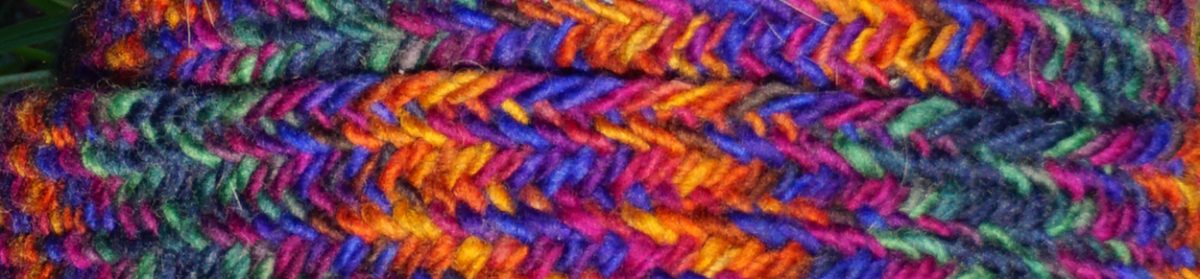

In 2019, my mother and I were able to travel to Leicester for a chance to see this week’s Nalbound Object of the Week; a small child’s sock from 3rd-5th century CE Antinoë/Antinoupolis. It was one of nearly a dozen found during John de Monins Johnson‘s excavations for the Egypt Exploration Fund1 in the 1913-14 season.

Photo credit: Anne Marie Decker 2019
Object: Leicester child’s sock
Description: Small child’s left split toed sock in many colors: green, red, purple, yellow, and blue. Comparables can be seen in my Charting the Nalbinding of the Nile presentation from 2019. At 9:39 in the recording linked in https://nalbound.com/2019/04/06/charting-the-nalbinding-of-the-nile /
Note: At the time of the excavations, the socks were presumed to be knitted as the differences between the crossed knitting and cross-knit nalbinding techniques had not yet been described.
Dated to: 300-500 CE2 (possibly earlier around the 3rd-4th centuries based on the radiocarbon dating of other socks found during the same excavation3)
Find location: Excavated from a rubbish pit at Sheikh Abada (ancient Antinoopolis), Egypt4
Material: wool5
Stitch(es) used: S-crossed Cross-knit Looping6
Inventory number: L.A63.1914.0.0
Current location: Leicester Museum and Art Gallery (formerly New Walk)
Link to museum catalog or other data:
Leicester Museum and Art Gallery does not have an online catalog. The sock is noted in their Collections Development Policy 2019-2024, section 3.5.2. “Although intended to be a representative selection, it includes at least one rarity, a Coptic knitted sock from Antinoe, the only example in this country outside of London.” This unfortunately reflects out of date information; the technique having been recognized as nalbinding, not knitting, in the last quarter of the last century and several examples from the same excavation are located in Britain, but outside of London. This does not, however, in any way negate its rarity and importance.
Some sources in which more information can be found:
Köstner, Barbara. “Roman and Late Roman nalbinding socks from Egypt: Bringing ‘Egyptian fashion’ to the North” in Excavating, analysing, reconstructing Textiles of the 1st millennium AD from Egypt and neighbouring countries: Proceeding of the 9th conference of the research group ‘Textiles from the Nile Valley’ Antwerp, 27-29 November 2015, edited by Antoine De Moor, Cäcilia Fluck, and Petra Linscheid. Tielt, Belgium: Lannoo Publishers, 2017. ISBN 978 94 014 4399 9.
O’Connell, Elisabeth R. “John de Monins Johnson’s 1913/14 Egypt Exploration Fund expedition to Antinoupolis (Antinoë)” In Antinoupolis II: Scavi e materiali III, ed. R. Pintaudi, 415–66. Florence: Istituto Papirologico G. Vitelli, 2014.
Pritchard, Frances. “A survey of textiles in the UK from the 1913-14 Egypt Exploration Fund season at Antinoupolis” in Drawing the Threads Together: Textiles and Footwear of the 1st Millenium AD from Egypt. Proceedings of the 7th Meeting of the Study Group ‘Textiles from the Nile Valley”, Antwerp, 7-9 October 2011, edited by Antoine De Moor, Cäcilia Fluck, and Petra Linscheid, 34-55. Tielt: Lannoo, 2013. ISBN 9789401410830.
Rutt, Richard. A History of Hand Knitting. London: B T Batsford Ltd, 1987 ISBN 0713451181
Photographs (if permissions allow):
A photo of the bottom of the sock was published illustrating everyday life of The Nile Valley AD 395-642 Coptic when The British Museum partnered with other British museums to share Worldtimelines.org.uk which placed 2,000 artifacts from museums around the British Isles in their geographical and chronological context. Unfortunately, Worldtimelines.org.uk is no longer active, but you can see it in the Wayback Machine of the Internet Archive. https://web.archive.org/web/20101228003015/http://worldtimelines.org.uk/world/africa/nile_valley/AD395-642/everyday
A similar photo can be seen in Richard Rutt’s A History of Hand Knitting Fig. 23 on page 32 in the 1987 edition.
The Leicester sock was one of 4 included in the original excavation photographs taken in 1914. I was granted permission by the Griffith Institute to share a modified version of that photo in https://nalbound.com/2019/06/21/have-you-seen-this-sock-part-2/. The Leicester sock is the one on the left, number 1.
The photo from the John de Monins Johnson’s excavation is also included in Elisabeth O’Connell’s article “John de Monins Johnson’s 1913/14 Egypt Exploration Fund expedition to Antinoupolis (Antinoë)” along with the photographs of other finds and a sketch of the dig sites.

Photo credit: Ruth Decker 2019

Photo credit: Anne Marie Decker 2019
Please note that sharing to other venues will likely be intermittent. If you wish to receive these each week, please remember to follow the blog.
Patrons on Patreon receive early access previews, occasional extra details, and priority requests.
- Now the Egypt Exploration Society https://www.ees.ac.uk/ ↩︎
- https://web.archive.org/web/20101228003015/http://worldtimelines.org.uk/world/africa/nile_valley/AD395-642/everyday ↩︎
- British Museum EA53913 was radiocarbon dated to between 100-350 CE. EA53913 was radiocarbon dated to 200-400 CE. ACO Tx2497 in the Royal Museums of Art and History in Brussels was dated to 240-400 CE. See De Moor, Antoine, Cäcilia Fluck, M. Van Strydonck, and M. Boudin. “Radiocarbon dating of Late Roman woolen socks from Egypt,” In Textiles, tools and techniques of the 1st millennium AD from Egypt and neighbouring countries. Proceedings of the 8th conference of the research group ‘Textiles from the Nile Valley,’ Antwerp, 4-6 October 2013,] ed. Antoine De Moor, Cäcilia Fluck, and Petra Linscheid, p. 131-136. Tielt: Lannoo Publishers, 2015. ISBN 9789401432405. ↩︎
- https://web.archive.org/web/20101228003015/http://worldtimelines.org.uk/world/africa/nile_valley/AD395-642/everyday ↩︎
- Köstner, Table 1, Pgs. 190-191. ↩︎
- Köstner, Table 1, Pgs. 190-191. ↩︎

I was asked in a different forum: “How can one tell Nalbound from knit in a picture like this? I’d like to know for curiosity’s sake.”
Visually, the angle in this photo isn’t good for seeing the most definitive characteristics. Unfortunately the display had the multi-toe with the increases to the back of the display so I was unable to capture an image from that angle.
So the next thing we look at can tell us that nalbinding is a possible answer. Are the loops crossed? If they are open, it can’t be nalbinding. But here they are crossed so it would have to be either crossed knitting or nalbinding.
The crosses are on the cuff side of the row and loops to the toes. That is consistent with being either knit cuff down or nalbound toe up. So far all examined nalbinding (~50 out of ~70) and the later knitted (open loop) socks are all worked toe up. Knitting cuff down seems to come much much later.
And then there is the dating. A crossed-knit structure during this timeframe and location has many comparables that have been examined in detail and confirmed to be nalbinding.
The only knitted artifacts of this timeframe are not well known, but they are not the knitting we think of. They are narrow tubes of 1 over 2 open loop knitting. Knitting as we think of it doesn’t appear for over another 500+ years.
So there is nothing absolutely definitive showing in the image. However, the crossed-knit structure combined with the dating and especially as it’s a split toed sock lean consideringly more towards nalbinding as the technique when looking at a photo like this.
I do go more in depth about how to tell the difference between the two techniques in my NESAT presentation. A recording of which can be accessed here: https://nalbound.com/2021/09/03/but-it-looks-like/
Thank you Linnie Gates for an excellent question.