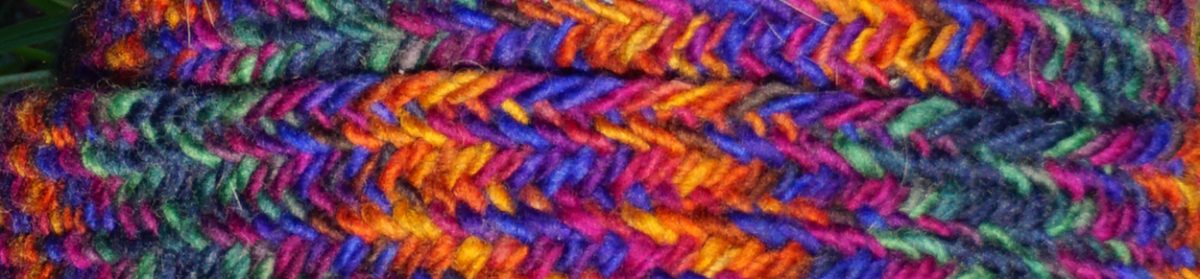
The patterned fragment from Dura-Europos has always fascinated me, so today it too joins the Nalbound Object of the Week collection. The fragment was excavated by the Yale-French Excavations at Dura-Europos sometime between 1928–37. It is only 5 7/8 by 6 11/16 in. (15 × 17 cm). Given the standard ratios of socks of this type and analysis of the fragment itself, what remains is 3/4 of the original circumference of the sock ankle.

Object: Patterned fragment from Dura-Europos
Description: The patterned heel cup and ankle of a fancy Cross-knit Looping sock. The pattern consists of a vertical column of knit wales followed by a purl background with two pomegranate shapes placed one over the other (one is missing). Then another vertical column, a tree of life pattern that goes up the center back of the sock, and another vertical column. This is followed by another purl background with two pomegranates and ending with a final vertical column. The fragment has a few perpendicular stitches on the bottom right that are the remains of the mid-foot section. On the same side, a few lacing loops are preserved indicating that this sock likely had a tongue flap and lacing closure similar to that seen in the contemporaneous sock from Egypt currently in the V&A collections in London.
Dated to: pre-256 CE1
Find location: Dura-Europos, in modern day Syria
Material: Wool
Stitch(es) used: Z-crossed Cross-knit Looping, F1B1 O & B1F1 O, knit & purl stitch patterned
Inventory number: Accession Number 1933.483
Current location: Yale University Art Gallery
Link to museum catalog or other data: https://artgallery.yale.edu/collections/objects/5962
Some sources in which more information can be found:
Rutt, Richard. A History of Hand Knitting. London: B T Batsford Ltd, 1987 ISBN 0713451181; reprinted Loveland, Colorado: Interweave Press, 1989 ISBN 0-934026-35-1, Library of Congress Catalog Number 87-46353; pgs. 28-30.
Pfister, Rudolf and Bellinger, Louisa. “The textiles: Knitting,” Rostovtzeff, M.I., et al. The excavations at Dura-Europos Final Report IV, Part II. New Haven: Yale University Press, 1945, 54-5.
Photograph:

Please note that sharing to other venues will likely be intermittent. If you wish to receive these each week, please remember to follow the blog.
Patrons on Patreon receive early access previews, occasional extra details, and priority requests.
- The Yale Univeristy Art Gallery dates the fragment to c. AD 200-256 https://artgallery.yale.edu/collections/objects/5962. Dura Europos was sacked and never reoccupied, so we are fairly certain the sock pre-dates 256 CE when that occurred. The only other example of a sock with lacing loops in the corpus has been carbon dated to a very similar timeframe. ↩︎

I am woefully naive about nalbinding. I get the basics, I know several stitches, but, I don’t understand how to get patterned detail like the above sock reproduction. Is it done with a single needle, i.e. nalbinding, or is there knitting involved as well. I would love to add these decretive elements to my nalbinding, but I can’t get my head around how to do it with the stitches and techniques I know. Is there a tutorial, or explanation/description I can be directed to to help me?
There is no knitting involved. It is all nalbound with a single needle. I show several of the various increases and decreases possible in my earlier post https://nalbound.com/2019/05/08/dura-europos-fragments/
Note the images are regularized with the loops up, but I find they work easier with loops down.
This detailed exploration of the Dura Europos patterned fragment is fascinating and enriches our understanding of historical textile techniques. Your work in bringing these ancient crafts to light is incredibly valuable for both scholars and enthusiasts!