The Nalbound Object of the Week this week is a small fragment of vegetal fiber found in Chile. The fragment has two types of Loop & Twist, both Z-crossed.
Please note that sharing to other venues will likely be intermittent. If you wish to receive these each week, please remember to follow the blog. Patrons on Patreon receive early access previews, occasional extra details, and priority requests.
I hope everyone’s winter holiday season is going well and that the new year be all you need it to be. For this week’s Nalbound Object of the Week we got a viscacha figure/effigy. I love these because viscachas are sooo cute! (I’ve included a picture of a live viscacha below for those of us less familiar with what exactly one looks like.)
Description: Worked in yellow and dark brown yarn, the figure includes the pointed ears, nose, and long tail of a viscacha. Overall: 7.5 x 1 x 1.7 cm (2 15/16 x 3/8 x 11/16 in.)1
Stitch(es) used: Looping.5 S-crossed and Z-crossed Simple Looping depending on which part of the viscacha (as determined by Anne Marie Decker based on the photograph)
Please note that sharing to other venues will likely be intermittent. If you wish to receive these each week, please remember to follow the blog. Patrons on Patreon receive early access previews, occasional extra details, and priority requests.
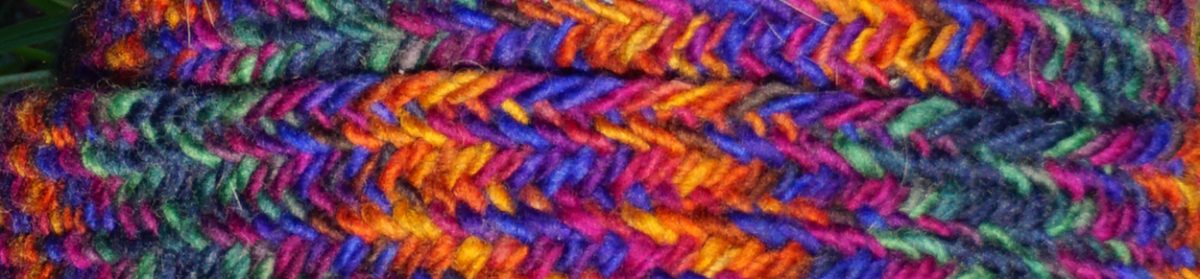
This week’s Nalbound Object of the Week is a striking Peruvian hat worked in Cross-knit Looping in a distinctive chevron pattern. While there are quite a few hats found in Peru, both in Simple Looping and in Cross-knit Looping, this is the first I’ve come across with this Chevron patterning.
Please note that sharing to other venues will likely be intermittent. If you wish to receive these each week, please remember to follow the blog. Patrons on Patreon receive early access previews, occasional extra details, and priority requests.
The figural work found in the decorative borders made by the Nazca people is stunningly beautiful and detailed. This week’s Nalbound Object of the Week is a beautiful sample of their cross-knit looped borders. This fragment has three very distinct figures. The Art Institute of Chicago’s website has very nice closeups of both sides and a very good zoom function if you’d like to see more.
Nazca. Fragment of a Decorative Border, 100 BCE-200 CE. The Art Institute of Chicago® CC0 Public Domain
Object: Fragment of a Decorative Border 1956.405
Description: A border fragment with three figures. The figures are about 2.5 inches tall. The piece is 11.4 × 6.7 cm (4 1/2 × 2 5/8 in.)1
Stitch(es) used: The band’s ground support is plain weave and the extension supports are simple looping. The ground is encased in the decorative cross-knit looping6
Some sources in which more information can be found:
Sawyer, Alan R. Early Nasca Needlework. London: Laurence King Publishing, 1997. pg. 149, fig. 119 and 120 (ill.).
Melo, Alipio, María José Murillo, and Danitza Willka. “The Heartbeat of Andean Weaving,” in On Loss and Absence: Textiles of Mourning and Survival, eds. Isaac Facio, Nneka Kai, L Vinebaum, and Anne Wilson, exh. cat. Chicago: Art Institute of Chicago, 2025. pg. 164, fig. 3 (ill.).
Photographs (if permissions allow):
Please note that sharing to other venues will likely be intermittent. If you wish to receive these each week, please remember to follow the blog. Patrons on Patreon receive early access previews, occasional extra details, and priority requests.
This week’s Nalbound Object of the Week is an Egyptian Sock that is currently located in the National Museum of Ireland. Early online photos of the sock were taken at such an angle that the toe split was not visible. This led to mistaken impression that this sock was the only adult cross-knit looping (Coptic stitch) nalbound sock with a single toe box. I was lucky enough to come across this sock on display in April of 2014, so I had seen in person that it did have a split toe to accommodate sandals. In fact, out of the 49 or so cross-knit looped nalbound Egyptian socks we have images of and are whole enough to tell, only the tiniest baby socks for not yet mobile infants do not have split toes.
Description: A now light brown wool sock for the left foot with a split at the ankle and ties still remaining. There is a decorative welt around the ankle where the heel cup shifts to the ankle. Height 9cm, width 8cm, Length 22 cm.1 The sock arrived at the National Museum of Ireland as part of the distributions the Egypt Exploration Fund in 1914.2
Rose-Beers, Kristine. (2023). The Threads that Bind: Evidence of the Early Codex Structure in Chester Beatty’s Papyri. DOI 10.1515/9783110781304-009.
Photographs: There are two additional views of the sock available on the National Museum of Ireland’s website. The view that obscures the split toe can be seen on The Global Egyptian Museum.org site.
Please note that sharing to other venues will likely be intermittent. If you wish to receive these each week, please remember to follow the blog. Patrons on Patreon receive early access previews, occasional extra details, and priority requests.
Generally when we talk about nalbinding from the Southwest United States, we are talking about socks or shoe-socks or possibly leggings. This week’s Nalbound Object of the Week is unusual in that it is a cap. When the excavations were published in 1919, it was the only textile cap to have been found in the Southwest.
Description: A natural colored cap worked from the center down.
Dated to: No date provided, but the Cliff-dweller culture is believed to come after the Basket-maker culture. Estimate Pueblo III (1150–1350).
Find location: Cliffhouse 22 / Ruin 2 in Sayodneechee Canyon (“Where the red rocks run under” in Navajo)3
“At g, just outside one of the rooms and beneath 8 inches of closely packed rubbish, lay a cap of yucca yarn.”4
Material: Sometimes referred to as made of yucca cord5 (narrow leaf yucca), but there is also a mention that the cap is likely apocynum (Dogbane/Indian Hemp) fiber6
Stitch(es) used: Z-crossed Simple Looping7 called coiled work without foundation8 in the excavation report. “Near the edge there are 9 coils and 5 loops to the inch, the stitches nearer the top are deeper and wider spaced.”9
Some sources in which more information can be found:
Kidder, Alfred Vincent, and Samuel J. Guernsey. Archeological Explorations in Northeastern Arizona. Smithsonian institution. Bureau of American Ethnology Bulletin 65. Washington D.C.: U.S. Government Printing Office, 1919. https://repository.si.edu/items/14df4b65-e141-4ea1-b541-3b2ac24e7fdf Accessed 13 November 2025.
Photographs (if permissions allow): There is a nice color photo of the cap on the Peabody Museum’s site.
Please note that sharing to other venues will likely be intermittent. If you wish to receive these each week, please remember to follow the blog. Patrons on Patreon receive early access previews, occasional extra details, and priority requests.
Kidder, Alfred Vincent, and Samuel J. Guernsey. Archeological Explorations in Northeastern Arizona. Smithsonian institution. Bureau of American Ethnology Bulletin 65. Washington D.C.: U.S. Government Printing Office, 1919. https://repository.si.edu/items/14df4b65-e141-4ea1-b541-3b2ac24e7fdf pg. 94 ↩︎
Kidder, Alfred Vincent, and Samuel J. Guernsey. Archeological Explorations in Northeastern Arizona. Smithsonian institution. Bureau of American Ethnology Bulletin 65. Washington D.C.: U.S. Government Printing Office, 1919. https://repository.si.edu/items/14df4b65-e141-4ea1-b541-3b2ac24e7fdf pg. 19 ↩︎
As determined by Anne Marie Decker based on the diagram in Kidder & Guernsey’s explorations and examination of the picture provided. ↩︎
Kidder, Alfred Vincent, and Samuel J. Guernsey. Archeological Explorations in Northeastern Arizona. Smithsonian institution. Bureau of American Ethnology Bulletin 65. Washington D.C.: U.S. Government Printing Office, 1919. https://repository.si.edu/items/14df4b65-e141-4ea1-b541-3b2ac24e7fdf pg. 100 ↩︎
This week’s Nalbound Object of the Week is a beautiful cross-knit looping example. A border of warriors and their sacrifice, originally intended to be attached to a piece of fabric. If you go to the The Art Institute of Chicago’s website there is a very good zoom function and some close-ups showing the underlying support worked in Simple Looping.
Nazca. Warrior Fragments, 100 BCE-200 CE. The Art Institute of Chicago® CC0 Public Domain
Object: Border of warriors
Description: A border of warriors and a sacrifice. The figures are about 2.5 inches tall. More details on The Art Institute of Chicago’s website.
Some sources in which more information can be found:
Sawyer, Alan R. Early Nasca Needlework. London: Laurence King Publishing, 1997. pg. 148, color fig. 117.
Photographs (if permissions allow):
Please note that sharing to other venues will likely be intermittent. If you wish to receive these each week, please remember to follow the blog. Patrons on Patreon receive early access previews, occasional extra details, and priority requests.
For this week’s Nalbound Object of the Week, I’m delighted to be able to bring you evidence of the current tradition of nalbinding in Northern Ghana. I’d had hints that the technique might be found in West Africa, but nothing Ghanaian specific. Thus, imagine my excitement when I came across an example in the Accra Arts Center. I was initially concerned it might be an import, but seeing several others in Cape Coast and with some additional information obtained during bargaining, we’ve confirmed they are a product of Northern Ghana.
Object: Ghanaian bag with coiled base
Description: A cross-body bag with a solid bottom. All the versions I saw were various stripes of natural color, deep purple, and dark blue. This one had some purple going around the mouth and up the strap.
Dated to: 2024. Collected on 21 October, 2024 in the Accra Art Center
Find location: Accra Arts Center, in a stall selling goods from Northern Ghana. The sellers spoke Degaare, which indicates they are of the Dagaaba/Dagaati people. Additional examples were also spotted in a market stall in Cape Coast.
Material: a plant fiber, possibly jute, in natural, purple, and deep blue. The purple is water soluble and can transfer.
Stitch(es) used: Main body is Z-crossed Simple Looping, F1 O. There’s a bit of Cross-knit Looping at the center base and Coiling: Z-crossed Simple Looping around a bundle of carried sticks. Further examination is needed for the stitch around the mouth. (Stitch determinations by Anne Marie Decker)
Inventory number: N/A
Current location: Anne Marie Decker’s personal collection
Photographs:
View of the stripes and connections. Photo credit: Anne Marie DeckerCloseup of the base showing the carried stiffener material. Photo credit: Anne Marie DeckerThe base of the bag is stiffened. Photo credit: Anne Marie DeckerAdditional details of the bag in Anne Marie Decker’s collection. Another bag seen in Cape Coast. Photo credit: Anne Marie DeckerMore bags seen in Cape Coast. Photo credit: Anne Marie DeckerThe handles of the bags in Cape Coast. Photo credit: Anne Marie DeckerThe cross-knit looping start before the stiffened section. Photo credit: Anne Marie DeckerMouth and handle attachment. Photo credit: Anne Marie DeckerDetails of the four similar bags seen in a market stall in Cape Coast.
Please note that sharing to other venues will likely be intermittent. If you wish to receive these each week, please remember to follow the blog. Patrons on Patreon receive early access previews, occasional extra details, and priority requests. They also support explorations to find nalbinding around the world.
After a brief hiatus due to surgery, I bring you another Nalbound Object of the Week. This artifact was mentioned as an aside in an article about Pierre de Courpalay’s gloves (which will be a later post) and for the longest time I could find no more information about it other than it was supposedly an early 14th century green silk reliquary pouch from Namur, Belgium worked in space patterned Simple Looping with a carried thread. There was a stitch diagram, but no picture. My friend Ann Moreau took up the quest to track down more information and was able to provide me with a photograph and a couple of very interesting sources: a master’s thesis and the conservation report.
Photo credit: Bazzo, Stéphane, IRPA CC BY 4.0 KIK-IRPA, Brussels (Belgium), cliché X142949
Object: Namur Reliquary Purse
Description: The purse measures approximately 6.5 inches by 6.3 inches (16.5 x 16cm) not inclusive of the tassels or ties.1 The main body is worked in a pattern of diamonds enclosing four smaller diamonds that is regular on the face, but shows an error in the pattern at the top of the reverse turning it into chevrons.2 There’s a strip of plain green on each side and a green eyelet band at the opening.
The pictures show that the main body of the purse was not worked in the round. Had it been worked around the purse, the slits in the space patterned Simple Looping would have been horizontal like those seen making eyelets on the green eyelet band. However, the slits in the main body are vertical, indicating that the fabric orientation has the base row along the right side of the face (left side of the reverse) and the fabric was built up to the left side. There is no noticeable seam showing at the bottom. All of which may indicate that the face and reverse were worked as one rectangle, sewn up the sides, and then the eyelet band worked around the opening.
The relic purse was classified as a Treasure by the Commission consultative du Patrimoine culturel mobilier [Consultative Commission for Movable Cultural Heritage] on October 4, 2021.3
Dated to: radiocarbon dated to ca 1260-1390 CE4 (77.4% certainty between 1260 and 1310)5
Find location: prieuré de Hastière [Priory of Hastière], Belgium.6 Donated in 1885 by M. Perpète Sarton and recorded as register number 16166 along with another purse.7
Material: Silk. The tassels include gilded silver metallic threads.8 “The beige and pink threads of the lining are colored with safflower and a dye containing traces of flavonoids, the green thread of the fringes with woad or indigo, and the beige thread of the boucle network with red wood.”9
Stitch(es) used: le réseau bouclé simple10 The opening is worked horizontally in Z-crossed Simple Looping, F1 O, with a carried thread leaving holes for the drawstring. The main body is worked vertically, also in Z-crossed Simple Looping, F1 O, with a carried thread worked with space patterning to make the diamond/chevron pattern of holes. (Stitch determination verified via photograph by Anne Marie Decker)
Inventory number: 229F
Current location: Owned by the Société Archéologique de Namur (SAN). Exhibited in the Musée Provincial des Arts Anciens Namurois (TreM.a).11
Some sources in which more information can be found:
Damen, Emma, Griet Kockelkoren, Judith Goris, Ina Vanden Berghe, Marina Van Bos, and Mathieu Boudin. “Étude technico-matérielle et traitement de conservation, préservation et présentation de 7 bourses à reliques de la Société Archéologique de Namur (SAN).” Report on IRPS dossier 2017.13760 dated 9 September 2021.
De Ceuninck, Emmeline. “Étude historique, artistique et technologique de sept bourses conservées à la Société archéologique de Namur (SAN) et récemment restaurées à l’Institut royal du Patrimoine artistique (IRPA). Volume 1 et 2.”Master en Histoire de l’Art et Archéologie Mémoire [Master’s thesis], Université Libre de Bruxelles, Année académique 2022-2023.
Desrosiers, Sophie, Patricia Dal-Pra, and Isabelle Bédat. “On medieval pontifical gloves and glove medallions and wristbands found in France,” In [Archäologische Textilfunde/Archaeological Textiles] NESAT IX. ed. Antoinette Rast-Eicher and Renata Windler, p. 159-165. Ennenda: Archeo Tex, 2007. ISBN 978-3-033-01267-7.
Gagneux-Granade, Marguerite. L’Homme et les Mailles: histoire critique des mailles textiles : filets, réseaux, tricot, crochet. Bordeaux: Éditions INsensées, 2016. ISBN 978-2-9558095-0-1.
Photographs:
Cropped close up of eyelet band and body. Photo credit: Bazzo, Stéphane, IRPA CC BY 4.0 KIK-IRPA, Brussels (Belgium), cliché X142949Cropped to show chevron pattern on reverse top. Photo credit: Bazzo, Stéphane, IRPA CC BY 4.0 KIK-IRPA, Brussels (Belgium), cliché X142950Photo credit: Bazzo, Stéphane, IRPA CC BY 4.0 KIK-IRPA, Brussels (Belgium), cliché X142950
Desrosiers’ “On medieval pontifical gloves and glove medallions and wristbands found in France” has a diagram of the stitches making the pattern of a portion of the diamond in Fig. 2b on page 160. The diagram is flawed as it shows a whip stitch instead of the Z-crossed Simple Looping. It is showing a B1 O which makes a whip stitch instead of the F1 O that makes Z-crossed Simple Looping. The loops have also been regularized to the top which does not match the direction of work.
De Ceuninck’s “Étude historique, artistique et technologique de sept bourses conservées à la Société archéologique de Namur (SAN) et récemment restaurées à l’Institut royal du Patrimoine artistique (IRPA). Volume 2.” includes some lovely photos and schematics of the purse in Figs. 11, 12, 80 & Schéma 33, 34, 35, 36, 37.
Please note that sharing to other venues will likely be intermittent. If you wish to receive these each week, please remember to follow the blog. Patrons on Patreon receive early access previews, occasional extra details, and priority requests.
Emmeline De Ceuninck,”Étude historique, artistique et technologique de sept bourses conservées à la Société archéologique de Namur (SAN) et récemment restaurées à l’Institut royal du Patrimoine artistique (IRPA). Volume 2.” (Master en Histoire de l’Art et Archéologie Mémoire [Master’s thesis], Université Libre de Bruxelles, Année académique 2022-2023), pg. 1. and Damen, Emma, et al. “Étude technico-matérielle et traitement de conservation, préservation et présentation de 7 bourses à reliques de la Société Archéologique de Namur (SAN).” Report on IRPS dossier 2017.13760 dated 9 September 2021. Pg. 10. ↩︎
De Ceuninck, “Étude historique, artistique et technologique de sept bourses conservées à la Société archéologique de Namur (SAN) et récemment restaurées à l’Institut royal du Patrimoine artistique (IRPA). Volume 1,” pg. 76. and Damen, Emma, et al. “Étude technico-matérielle et traitement de conservation, préservation et présentation de 7 bourses à reliques de la Société Archéologique de Namur (SAN).” Report on IRPS dossier 2017.13760 dated 9 September 2021. Pg. 10. ↩︎
De Ceuninck, “Étude historique, artistique et technologique de sept bourses conservées à la Société archéologique de Namur (SAN) et récemment restaurées à l’Institut royal du Patrimoine artistique (IRPA). Volume 2,” pg. 108. ↩︎
De Ceuninck, “Étude historique, artistique et technologique de sept bourses conservées à la Société archéologique de Namur (SAN) et récemment restaurées à l’Institut royal du Patrimoine artistique (IRPA). Volume 1,” pg. 74. ↩︎
De Ceuninck, “Étude historique, artistique et technologique de sept bourses conservées à la Société archéologique de Namur (SAN) et récemment restaurées à l’Institut royal du Patrimoine artistique (IRPA). Volume 1,” pg. 28. See also page 79. ↩︎
De Ceuninck, “Étude historique, artistique et technologique de sept bourses conservées à la Société archéologique de Namur (SAN) et récemment restaurées à l’Institut royal du Patrimoine artistique (IRPA). Volume 1,” pg. 28. ↩︎
De Ceuninck, “Étude historique, artistique et technologique de sept bourses conservées à la Société archéologique de Namur (SAN) et récemment restaurées à l’Institut royal du Patrimoine artistique (IRPA). Volume 1,” pg. 76. ↩︎
Translated from De Ceuninck, “Étude historique, artistique et technologique de sept bourses conservées à la Société archéologique de Namur (SAN) et récemment restaurées à l’Institut royal du Patrimoine artistique (IRPA). Volume 1,” pg. 74. See also pages 78-79. ↩︎
De Ceuninck, “Étude historique, artistique et technologique de sept bourses conservées à la Société archéologique de Namur (SAN) et récemment restaurées à l’Institut royal du Patrimoine artistique (IRPA). Volume 1,” pg. 75. and Damen, Emma, et al. “Étude technico-matérielle et traitement de conservation, préservation et présentation de 7 bourses à reliques de la Société Archéologique de Namur (SAN).” Report on IRPS dossier 2017.13760 dated 9 September 2021. Pg. 10. ↩︎
Damen, Emma, et al. “Étude technico-matérielle et traitement de conservation, préservation et présentation de 7 bourses à reliques de la Société Archéologique de Namur (SAN).” Report on IRPS dossier 2017.13760 dated 9 September 2021. Pg. 3. ↩︎
For the Nalbound Object of the Week, we head to Australia where there is a strong nalbinding tradition amongst the aboriginal peoples. Most commonly we see this in their string bags. This bag was collected in 1896 and is now in the Ethnographic collections of the Peabody Museum of Archaeology and Ethnology.
Description: A rectangular bag with alternating light and darker brown stripes. Not quite 11 1/2 inches tall and 6 1/2 inches wide (29 x 16.5 cm)1 The body of the bag and string around the mouth are both Z twist. The carrying string is S-twist.
Please note that sharing to other venues will likely be intermittent. If you wish to receive these each week, please remember to follow the blog. Patrons on Patreon receive early access previews, occasional extra details, and priority requests.