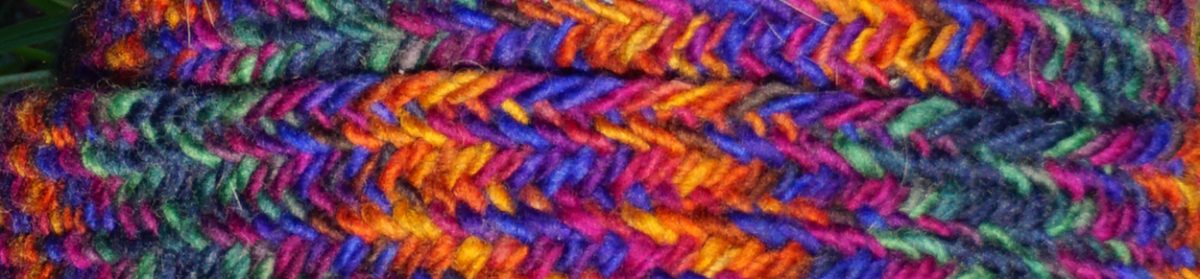
So my most recent examinations brought up an interesting issue. It can be hard to find Z-twist yarns; at all. Not just the specific weight, number of plies, and spinning method (worsted spun instead of woollen1) one might look for when trying to reconstruct an artifact, but just even any Z-twist yarns. When searching online you find that manufacturers often are not providing information on their spin and ply directions. Additionally, even if the photograph is close enough to look, you can’t trust the image hasn’t been reversed because it looks better for marketing purposes.

So why is this important? The final twist direction of a yarn has an impact on how it lays in the final textile. Even the act of winding on and off a ball can affect the yarn twist and have an effect on the final resulting fabric.2 This is markedly more noticeable the more a technique spirals when being worked. Looped textiles inherently spiral the yarn either as they wrap the yarn around the needle or hook, or as the yarn is pulled through the stitches. That wrapping/spiraling can either tighten the twist or loosen it. In the case of single ply, it can loosen it enough the yarn falls apart.
Not all nalbound artifacts are worked in Z-twist yarns, but a significant number are. And combined with certain stitches, Z-twist can help make a tighter, smoother fabric which can be easier to work as the yarn is less likely to split. Other stitches (those ending the stitch on the reverse of the working thread instead of on the technical front or vice versa for left handed) spiral in the other direction and are better suited to S-twist yarns. This is also why S-twist yarns are generally more suited to the wrap direction found in how knitting is currently taught in the Western world and Z-twist yarns are generally more suited to the wraps of modern crochet.
I am clearly not the only person that has noticed this. There are a variety of useful articles on the effect of twist on a fabric available.3 In fact, I have recently run across a website dedicated to yarn substitutions called YarnSub that includes twist direction in its database (although it has some issues in its comparisons matching number of plies to z-ply instead of keeping the twist separate from the number of plies and also includes cabled yarns where the final twist is Z). Here is the search for Z-twist yarns: https://yarnsub.com/search?q=z+plied
I used to get some nice naturally dyed Z-spun yarn from Juuliorg out of Estonia. They are currently on an extended vacation, but the mill is still open.
I have also used some Z-spun yarn from Ullcentrum: https://www.ullcentrum.com/en/yarns-tools/wool-yarn/z-plied-2-ply/
I’ve also run across several other suppliers. Unfortunately, current conditions are restricting postal service here to the US. So while I may not be able to get any soon, perhaps you may find these useful.
Filter on Z-tvinnat: https://bavensspinnhus.se/produkter
So have you found a favorite Z-twist yarn? I would love to hear about it.
Please remember to follow the blog for more interesting nalbinding content.
Your support is greatly appreciated and helps fund future research.
Patrons on Patreon receive early access previews, occasional extra details, and priority requests.
Footnotes:
- The difference between worsted spun and woolen spun yarns is in the preparation and drafting of the fiber. Worsted spun yarns the fibers are combed and drafted so that the fibers all align. This makes for a smooth hard-wearing, but not lofty yarn. For woolen spun yarn, the fibers are carded and drafting is from a rolag or fold so that the fibers are intentionally jumbled. This makes for a lofty yarn that holds a lot of air, but it tends to not be as strong and more likely to pill and full/shrink. ↩︎
- Here is an interesting blog post demonstrating the effect: https://peggyosterkamp.com/2021/08/use-your-s-z-identifier-tool-to-add-or-subtract-twist-to-yarns/ Accessed 11/30/2025 ↩︎
- https://wildwoollys.com/blogs/articles/what-is-z-twist-yarn-and-should-you-care Accessed 11/26/2025
https://spinoffmagazine.com/twist-direction-s-vs-z-twist/ Accessed 11/26/2025
https://sweetgeorgiayarns.com/twist-and-shout-why-twist-direction-matters-in-your-making/ Accessed 11/26/2025
And even how twist direction was used to create patterns in woven textiles: https://brankaontextiles.com/z-s-directions-spinning-textile-how-ancient-women-once-wove-monochrome-patterns-with-light-and-shadows-in-the-beholders-eye/ Accessed 11/26/2025 ↩︎