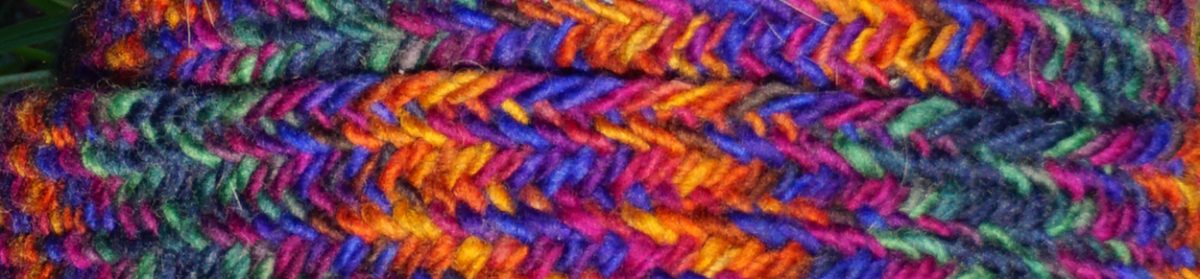
NOW: Child’s sock with orange, blue and yellow stripes – III 15474

For a person that has spent a lot of time examining stockings, this is an excellent time of the year. The Museum der Kulturen Basel has the largest collection of Egyptian nalbinding1 and they just recently put their entire collection online. So this week’s Nalbound Object of the Week is one of my favorite of the children’s socks.

©Museum der Kulturen Basel CC BY 4.0

Object: Child’s sock with orange, blue and yellow stripes – III 15474

Description: The sock is striped with blue, orange, and yellow stripes and a natural (now cream) base that shows mostly in the wedge heel. It has a relatively short, undifferentiated, toe box with a rather large wedge heel. The ankle is damaged and its true height unknown. Length 17 cm2

Dated to: 4th century ?3 CE (This is a very old art historical based dating. There has been no scientific dating of compound Egyptian nalbound socks. More recent excavations are finding compound nalbound socks in 11th century layers. I would dearly love to have a few of these radiocarbon dated as exactly when compound nalbinding began cannot be determined without solid dating.)

Culture: Coptic4

Find location: Egypt5

Material: Wool6

Stitch(es) used: F2 UOO/UUOO,7 Mammen

Inventory number: III 154748

Current location: Museum der Kulturen Basel, Switzerland

Link to museum catalog or other data: The Museum der Kulturen database does not have permalinks. Search for the Inventory number in https://onlinecollection.mkb.ch/#/query/f901c9da-5de6-4bea-819e-39e4464051be

Some sources in which more information can be found:

Böttcher, Gudrun. “Koptische Nadelbindungstextilien im Museum der Kulturen Basel” in Experimentelle Archäologie in Europa: Bilanz 2004 Heft 3. edited by Corinna Endlich. Oldenburg: Isensee Verlag, 2004: 211-214. ISBN 3-89995-204-9.

Please note that sharing to other venues will likely be intermittent. If you wish to receive these each week, please remember to follow the blog.
Patrons on Patreon receive early access previews, occasional extra details, and priority requests.

  1. That we know of so far because I am certain there are more socks out there in boxes and the backs of drawers that haven’t been opened in a century. ↩︎
  2. Museum der Kulturen Basel dataset published under the license CC BY 4.0 https://onlinecollection.mkb.ch/#/query/f901c9da-5de6-4bea-819e-39e4464051be ↩︎
  3. Museum der Kulturen Basel dataset published under the license CC BY 4.0 https://onlinecollection.mkb.ch/#/query/f901c9da-5de6-4bea-819e-39e4464051be ↩︎
  4. Museum der Kulturen Basel dataset published under the license CC BY 4.0 https://onlinecollection.mkb.ch/#/query/f901c9da-5de6-4bea-819e-39e4464051be ↩︎
  5. Museum der Kulturen Basel dataset published under the license CC BY 4.0 https://onlinecollection.mkb.ch/#/query/f901c9da-5de6-4bea-819e-39e4464051be ↩︎
  6. Museum der Kulturen Basel dataset published under the license CC BY 4.0 https://onlinecollection.mkb.ch/#/query/f901c9da-5de6-4bea-819e-39e4464051be ↩︎
  7. Böttcher writes it as Stitch Type: III and Stitch Variant: F(L) 2 UOO/UUOO. Böttcher, Gudrun. “Koptische Nadelbindungstextilien im Museum der Kulturen Basel” in Experimentelle Archäologie in Europa: Bilanz 2004 Heft 3. edited by Corinna Endlich. Oldenburg: Isensee Verlag, 2004: 211-214. ISBN 3-89995-204-9. pg 213. ↩︎
  8. Museum der Kulturen Basel dataset published under the license CC BY 4.0 https://onlinecollection.mkb.ch/#/query/f901c9da-5de6-4bea-819e-39e4464051be ↩︎

NOW: Omani Sand Socks زرابيل TRC 2018.2807a-b

Peru and Egypt have both excellent preservation characteristics and extensive excavation histories, so I often return to these locations for nalbound artifacts. However, for this week’s Nalbound Object of the Week, I’d like to explore an item that reflects a different tradition. While we don’t know much about archeological examples, the Arabian Peninsula has evidence of a very strong traditional usage of nalbinding. زرابيل zarbool,1 or sand socks and camel muzzles2 seem to be the predominant items made with nalbinding there. This particular pair of Omani Sand Socks, I had the pleasure of seeing while they were on display in the Socks & Stockings exhibition at the Textile Research Centre in Leiden, Netherlands in 2019.

Omani Sand Socks as on display in the Socks & Stockings exhibition at the Textile Research Centre, Leiden in October 2019. Photo: Anne Marie Decker

Object: Sand socks زرابيل

Description: The socks are worked from the toe up in alternating stripes of white and black. The stripes are two rows deep and the color is carried from one row up to the next color change. The heel is a wedge heel. There is a slit in the ankle with ties at the top to close it. The bottom showing in this image shows the pads that are worked onto the sock starting from the mid-foot and sewn down on three sides. The socks are 12.6 inches long by 5.5 inches wide (32 cm long by 14 cm wide3).

Dated to: late 20th century CE4

Find location: Oman5

Material: goat hair6

Stitch(es) used: Mammen, F2 UOO/UUOO (Stitch determination based on examination by Anne Marie Decker on 28 October 2019)

Gauge: 8-9 stitches to the inch and 2-2.5 rows to the inch. 4 stitches per cm and 0.75-1 row per cm.7

Inventory number: TRC 2018.2807a-b

Current location: Textile Research Centre, Leiden

Link to museum catalog or other data: https://trc-leiden.nl/collection/?trc=&zoek=sock&cat=&subcat=&g=&s=24&f=0&id=32565

Some sources in which more information can be found:

If you scroll down, there is one of the few images of sand socks being worn at http://turathalarab.blogfa.com/post/405

Another image of sand socks being worn.

Photographs (if permissions allow):

Acknowledgements: My thanks to Diana Lankhof and Lies van de Wege for making it possible for me to visit the Socks & Stockings exhibition at TRC. My timing was soo very tight and they graciously arranged to open an hour early so that I could have time to examine the nalbound sand socks and see the displays.

Please note that sharing to other venues will likely be intermittent. If you wish to receive these each week, please remember to follow the blog.
Patrons on Patreon receive early access previews, occasional extra details, and priority requests

  1. Also transliterated Zarbul ↩︎
  2. The Arabic term for camel muzzles or mouth coverings is possibly transliterated as lisama or lasama according to this video brought to my attention by Susan Elizabeth Aiken: https://youtu.be/YcKxQ0sGpr4?si=G5uO28Y9AR1lD9RY Accessed 7 June 2024 ↩︎
  3. https://trc-leiden.nl/collection/?trc=&zoek=sock&cat=&subcat=&g=&s=24&f=0&id=32565 Accessed 9 June 2024 ↩︎
  4. https://trc-leiden.nl/collection/?trc=&zoek=sock&cat=&subcat=&g=&s=24&f=0&id=32565 Accessed 9 June 2024 ↩︎
  5. https://trc-leiden.nl/collection/?trc=&zoek=sock&cat=&subcat=&g=&s=24&f=0&id=32565 Accessed 9 June 2024 ↩︎
  6. https://trc-leiden.nl/collection/?trc=&zoek=sock&cat=&subcat=&g=&s=24&f=0&id=32565 Accessed 9 June 2024 ↩︎
  7. Gauge determination based on examination by Anne Marie Decker on 28 October 2019 ↩︎

NOW: Oslo mitten C28155

Last week I had the distinct pleasure to go visit a well known mitten that rather recently has been placed on display again in the NOREGR – Medieval Stories exhibition at the Historical Museum in Oslo. And thus, the Oslo mitten joins the Nalbound Object of the Week series.

Anne Marie Decker pointing to the Oslo mitten on display in the Historical Museum in Oslo. Photo Anne Marie Decker 18 April 2024

Object: Oslo Mitten

Description: An adult sized mitten made of wool with damage at the base of the thumb and palm areas.

Dated to: 11th century,1 medieval. Ca. 1025-1125 CE2

The exhibition label for the Oslo mitten in the NOREGR – Medieval Stories exhibition at the Historical Museum in Oslo. Photo: Anne Marie Decker 18 April 2024.

Find location: The mitten was found during the 1926 excavation of the old town of Oslo on a layer of wood chips under the wooden flooring of a narrow passage between houses. This part of town was built in the 11th century.3

Material: wool4

Stitch(es) used: Nordland published the stitch used as 412 in his classification system5 which most likely translates to the stitch commonly known as Oslo and classified in Hansen’s notation as UO/UOO F1. However, further examination is warranted as the surface texture does not match. The surface texture more closely resembles the Mammen stitch, F2 UOO/UUOO.

Inventory number: C28155

Current location: Historical Museum

Link to museum catalog or other data: https://www.unimus.no/portal/#/things/fbbd3006-2407-498e-a527-a18f62fadb2a

Some sources in which more information can be found:

Claßen-Büttner, Ulrike. Nadelbinden – Was ist denn das? Geschichte und Technik einer fast vergessenen Handarbeit. Norderstedt: Books on Demand GmbH, 2012. ISBN 978-3-8482-0124-2.

Claßen-Büttner, Ulrike. Nalbinding – What in the World Is That? History and Technique of an Almost Forgotten Handicraft. Norderstedt: Books on Demand, 2015. ISBN 978-3-7347-7905-3.

Nordland, Odd. Primitive Scandinavian Textiles in Knotless Netting. Studia Norvegica no. 10. Oslo: Oslo University Press, 1961. No ISBN listed in Book.

Photographs:

The museum catalog has 3 very nice zoomable photos. The two color photos are of one side and the black and white of the other.

Photo taken during previous exhibition: https://images.app.goo.gl/jji31ErrTx8A1o739

Please note that sharing to other venues will likely be intermittent. If you wish to receive these each week, please remember to follow the blog.
Patrons on Patreon receive early access previews, occasional extra details, and priority requests.

  1. Nordland 1961, pg 43. ↩︎
  2. Dating listed on the item description for the mitten as on display in the NOREGR exhibition in the Historical Museum. ↩︎
  3. Nordland 1961, pg 43 and https://www.unimus.no/portal/#/things/fbbd3006-2407-498e-a527-a18f62fadb2a Accessed 29 April 2024. ↩︎
  4. Nordland 1961, pg. 43. ↩︎
  5. Nordland 1961, pgs 42 & 43. ↩︎