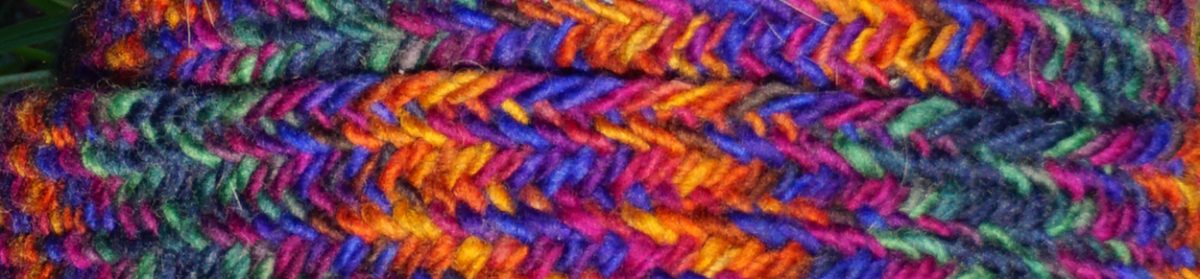
The Walters Art Museum has a lovely example of a border fragment from Peru worked in Z-crossed Cross-knit looping variant that is this week’s Nalbound Object of the Week. The central band has beans worked out of the upper edge and fully haired faces hanging below.
Detail of Tunic Border Piece, 2011.20.5, The Walters Art Museum (CC0)
Object: Tunic Border Piece
Description: Primarily worked in red, yellow, and blue camelid fiber with accents in white and dark brown, this piece is a beautiful example of both the beans and faces motifs that are seen quite a few examples. The “hair” fringe is in very nice condition. The height including fringe is 5 inches. Overall the piece is 64 inches long. (12.7 x 162.56 cm)1
Photographs: There are additional detail photos on The Walters Art Museum’s website.
Tunic Border Piece, 2011.20.5, The Walters Art Museum (CC0)
Please note that sharing to other venues will likely be intermittent. If you wish to receive these each week, please remember to follow the blog. Patrons on Patreon receive early access previews, occasional extra details, and priority requests.
The Nalbound Object of the Week this week is a small fragment of vegetal fiber found in Chile. The fragment has two types of Loop & Twist, both Z-crossed.
Please note that sharing to other venues will likely be intermittent. If you wish to receive these each week, please remember to follow the blog. Patrons on Patreon receive early access previews, occasional extra details, and priority requests.
This week I get to share with you the excitement of finding out about a rare find in a church I once visited. Some regions have preserved many finds, but textiles in Ireland are relatively rare and nalbound ones more so. Thus this week’s Nalbound Object of the Week is the second known nalbound artifact from Ireland. The fragments were found in the 12th century occupational debris. Photos have been published this year in Textiles of Ireland: Archaeology, Craft, Art by Elizabeth Wincott Heckett if you would like to see them. There’s also a nice diagram in 2006 Archeological Monograph on the excavations.
St Audoen’s Church & Visitor center when we visited on April 27, 2014. Photo credit: Anne Marie Decker
Object: Two main fragments. Usage unknown, but possibly a sock or cap.
Description: The larger fragment is 30 cm long by 8 cm high1 showing the remains of 6 rows. The smaller fragment is 6 cm long by 5 cm high2 with remains of 3+ rows. The thickness of both is c. 2mm.3 Original use as a mitten was ruled out as the length of the larger fragment would exceed the circumference appropriate for a mitten and is more suitable for a sock or a piece of a cap.4 There is no evidence of either intentional or wear fulling.5
Find location: Found in the 12th century occupation debris associated with timber structures during excavation of St. Audoen’s church, Cornmarket, Dublin, Ireland.7
Material: A dark brown, naturally colored, coarse, perhaps kemp-like, wool. No dye detected. The yarn has been combed and worsted spun in a medium to loose Z spin then two-plied with an S twist. The yarn is 1.5 mm in diameter.8
Stitch(es) used: uo o/u uoo F1 based on analysis of one of the outermost rows of loops.9 (Korgen)
Inventory number: E497:2428.325
Current location: Still tracking that down. The detailed catalog was lodged with the excavation archive in the Department of the Environment, Heritage and Local Government. Some of the items excavated at St Audoen’s remain there on display in their Visitor’s Centre.
Link to museum catalog or other data: none known
Some sources in which more information can be found:
Wincott Heckett, Elizabeth. “Textiles” in the Archaeological Finds chapter of St Audoen’s Church, Cornmarket, Dublin: Archaeology and Architecture by Mary McMahon. Dublin: The Stationary Office, Government of Ireland, 2006. ISBN 0-7557-7315-2
Wincott Heckett, Elizabeth. Textiles of Ireland: Archaeology, Craft, Art. Edited by Mary Ann Williams. Cork: Cork University Press, 2025. ISBN 9781782055716
There is also an archeological drawing contained the the archeological monograph, St Audoen’s Church, Cornmarket, Dublin: Archaeology and Architecture, by Mary McMahon: Fig. 6.9 on page 74.
If you find this type of content interesting, please remember to follow the blog. You can also give one time donation at the link on this site or join my Patreon to support further research. Patrons on Patreon receive early access previews, occasional extra details, and priority requests.
300 x 80mm. Wincott Heckett, Elizabeth. “Textiles” in the Archaeological Finds chapter of St Audoen’s Church, Cornmarket, Dublin: Archaeology and Architecture by Mary McMahon. Dublin: The Stationary Office, Government of Ireland, 2006. ISBN 0-7557-7315-2 page 74 and republished in Wincott Heckett, Elizabeth. Textiles of Ireland: Archaeology, Craft, Art. Edited by Mary Ann Williams. Cork: Cork University Press, 2025. ISBN 9781782055716. pg. 230 ↩︎
60 x 50mm. Wincott Heckett, Elizabeth. “Textiles” in the Archaeological Finds chapter of St Audoen’s Church, Cornmarket, Dublin: Archaeology and Architecture by Mary McMahon. Dublin: The Stationary Office, Government of Ireland, 2006. ISBN 0-7557-7315-2 page 74 and republished in Wincott Heckett, Elizabeth. Textiles of Ireland: Archaeology, Craft, Art. Edited by Mary Ann Williams. Cork: Cork University Press, 2025. ISBN 9781782055716. pg. 230 ↩︎
Wincott Heckett, Elizabeth. “Textiles” in the Archaeological Finds chapter of St Audoen’s Church, Cornmarket, Dublin: Archaeology and Architecture by Mary McMahon. Dublin: The Stationary Office, Government of Ireland, 2006. ISBN 0-7557-7315-2 page 75 and republished in Wincott Heckett, Elizabeth. Textiles of Ireland: Archaeology, Craft, Art. Edited by Mary Ann Williams. Cork: Cork University Press, 2025. ISBN 9781782055716. pg. 232 ↩︎
The famous sock from Uppsala is not the only nalbinding found in Uppsala. This week’s Nalbound Object of the Week are the fragments of what is believed to be another sock. This one found in the Kransen quarter of Uppsala. I was graciously allowed access to examine these fragments at the Statens Historiska Museet in May of 2023. Some of what you see in the box is moss.
Image of the fragments of 34821, cropped to remove excess background. Upphov: Rosengren, Helena, Historiska museet/SHM (CC BY 4.0)
Object: Kransen sock fragments
Description: Nine fragments of what is believed to be a sock.1
Some sources in which more information can be found:
Gustafsson, Jan Helmer, and Ola Ehn. Kransen: ett medeltida kvarter i Uppsala. Uppsala: Upplands fornminnesfören, 1984. ISBN 91-85618-21-7.
Photographs (if permissions allow):
Please note that sharing to other venues will likely be intermittent. If you wish to receive these each week, please remember to follow the blog. Patrons on Patreon receive early access previews, occasional extra details, and priority requests.
Gustafsson, Jan Helmer, and Ola Ehn. Kransen: ett medeltida kvarter i Uppsala. Uppsala: Upplands fornminnesfören, 1984. Pg. 76. ISBN 91-85618-21-7. ↩︎
Gustafsson, Jan Helmer, and Ola Ehn. Kransen: ett medeltida kvarter i Uppsala. Uppsala: Upplands fornminnesfören, 1984. Pg. 8. ISBN 91-85618-21-7. ↩︎
Sometimes I know very little about an object. This week’s Nalbound Object of the Week appeared in news articles about شهر سوخته Shahr-e-Sookhteh, Iran’s “Burnt City” published in January of 2022. I also discovered that in 2018 there was a multidisciplinary project run by the Iranian Archaeological team during which there was conservation and micro analysis of the textile collection in Shahr i Sokhta. I’d be very interested in learning about the results of those examinations. Periodically I do another search on these fragments to see if more information pops up. Last July a new article turned up on the web with some very interesting references to try to track down.
Object: Fragment from شهر سوخته Shahr-e-Sookhteh
Description: There are apparently several fragments of Simple Looping with large multi-row bands of alternating color, light (cream) and dark (brown). The third & fourth articles linked below show the one fragment that first brought my attention to this artifact. The first and second links, one from the multidisciplinary project, include a photo that looks to be different fragments and a larger section of the same textile. These are some of around 47 fabrics (techniques unspecified but clearly including more than just the nalbound fragments), consisting of 265 fragments, that were found in Shahr-e-Sookhteh.1
Dated to: Shahr-e-Sookhteh was occupied between 3200-1700 BCE (early articles indicated the city was abandoned in 2100 BCE2, but later articles indicate the city was last occupied in 1700 BCE3)
Find location: شهر سوخته Shahr-e-Sookhteh, Iran’s “Burnt City.” شهر سوخته is a UNESCO World Heritage Site.4
Material: unspecified
Stitch(es) used: Z-crossed Simple Looping (analysis based on photograph by AnneMarieDecker), F1 O
Inventory number: unspecified
Current location: likely at the Iranian Cultural Heritage, Handicrafts and Tourism Organization (ICHHTO) multi-disciplinary Base at Shahr-i Sokhta
Link to museum catalog or other data: unknown
Some sources in which more information can be found:
1. https://amordadnews.com/172355 This is the most recent article released and it lists several references that look to be very interesting.
The web pages on which the earlier news articles were published are no longer live. The Internet Archive did save copies as part of their Wayback Machine project.
Photographs: There are a couple of interesting photos that were published, but as I don’t have contacts to request permissions, you’ll need to explore the links above to see them.
Please note that sharing to other venues will likely be intermittent. If you wish to receive these each week, please remember to follow the blog. Patrons on Patreon receive early access previews, occasional extra details, and priority requests.
The patterned fragment from Dura-Europos has always fascinated me, so today it too joins the Nalbound Object of the Week collection. The fragment was excavated by the Yale-French Excavations at Dura-Europos sometime between 1928–37. It is only 5 7/8 by 6 11/16 in. (15 × 17 cm). Given the standard ratios of socks of this type and analysis of the fragment itself, what remains is 3/4 of the original circumference of the sock ankle.
Anne Marie Decker’s theoretical reconstruction of what the Dura-Europos patterned fragment may have looked like when the sock was whole based on standard ratios found in examinations of socks worked in Cross-knit Looping found in Egypt and surrounding regions. The fragment itself is in the background.
Object: Patterned fragment from Dura-Europos
Description: The patterned heel cup and ankle of a fancy Cross-knit Looping sock. The pattern consists of a vertical column of knit wales followed by a purl background with two pomegranate shapes placed one over the other (one is missing). Then another vertical column, a tree of life pattern that goes up the center back of the sock, and another vertical column. This is followed by another purl background with two pomegranates and ending with a final vertical column. The fragment has a few perpendicular stitches on the bottom right that are the remains of the mid-foot section. On the same side, a few lacing loops are preserved indicating that this sock likely had a tongue flap and lacing closure similar to that seen in the contemporaneous sock from Egypt currently in the V&A collections in London.
Rutt, Richard. A History of Hand Knitting. London: B T Batsford Ltd, 1987 ISBN 0713451181; reprinted Loveland, Colorado: Interweave Press, 1989 ISBN 0-934026-35-1, Library of Congress Catalog Number 87-46353; pgs. 28-30.
Pfister, Rudolf and Bellinger, Louisa. “The textiles: Knitting,” Rostovtzeff, M.I., et al. The excavations at Dura-Europos Final Report IV, Part II. New Haven: Yale University Press, 1945, 54-5.
Photograph:
1933.483 Patterned fragment from Dura Europos. Cropped and rotated to show original orientation. Original Photo Credit: The Yale University Art Gallery – Public Domain CC0 1.0 Deed
Please note that sharing to other venues will likely be intermittent. If you wish to receive these each week, please remember to follow the blog. Patrons on Patreon receive early access previews, occasional extra details, and priority requests.
The Yale Univeristy Art Gallery dates the fragment to c. AD 200-256 https://artgallery.yale.edu/collections/objects/5962. Dura Europos was sacked and never reoccupied, so we are fairly certain the sock pre-dates 256 CE when that occurred. The only other example of a sock with lacing loops in the corpus has been carbon dated to a very similar timeframe. ↩︎
@ Medeltidsmuseet Digital visning: Nålbindning [Digital Display: Nalbinding] Nålbindning kan dateras minst tusen år bakåt i tiden i Sverige. Hör vår museipedagog Anna Lilliehöök berätta mer om denna hantverksmetod. [Nalbinding can be dated back at least a thousand years in time in Sweden. Hear our museum educator Anna Lilliehöök tell more about this handwork method.]
Du behöver inte registrera dig eller betala något. Bara att njuta, gilla och dela. [You don’t need to register or pay anything. Just enjoy, like, and share.]
The language is Swedish of course. Anna Lilliehöök gives a bit of a tour of the museum and several of the artifacts therein. At around minute 6:50, she brings out a leather sole with a nalbound fragment stitched to it. She speculates that it might be the remains of an insole or perhaps a sock/stocking to which a leather sole had been applied. She tells us that stitch used is Mammen; which is UOO/UUOO F2 in Hansen’s classification. The dating is 1300-1400 CE.
Edited to add this lovely photo taken by Cary Karp. You can even see the fine sewing thread mentioned.
What I find very interesting is that the row appears to follow the edge of the leather sole. That direction under and along the arch does not match the row direction that I see in contemporaneous nalbound socks. So for now, I think I find the insole theory more plausible. Nonetheless, this is a very interesting find as it appears to have been sewn to the leather when the find was whole and new. The concept of an integral insole sewn into a leather turn-shoe is very intriguing.
On Monday, May 20th, 2019, I was honored to be allowed to examine the cross-knit nalbound fragments found in Dura-Europos, Syria and now housed in the collections of the Yale University Art Gallery as inventory numbers 1933.483 & 1935.556.
935.556 Yale University Art Gallery Photo credit: Anne Marie Decker
1933.483 Yale University Art Gallery Photo credit: Anne Marie Decker
The fragments are dated to pre-256 CE as that is when Dura-Europos was sacked and never re-occupied. As described in Yale’s online catalog, they are both of wool, though the ribbed fragments are of a finer gauge than the patterned fragment. The patterned fragment is currently a kind of beige with some possible staining. The ribbed fragments are also currently primarily beige, but with stripes of red, yellowish tan, blue & purple, and hints of green. Inv. # 1935.556 is actually composed of two separate fragments. They are stored unfixed to their backing boards in glassine wrapping to protect them from the light.
Time will be needed to process the data collected, analyze it, and prepare it for publication in appropriate venues. However, early indications are that there is likely evidence that will tie these examples even closer to the broader Roman Egyptian corpus.
While I generally kept my magnification such that I had approximately 10 welts per photo… I did have a little bit of fun with the endoscope. 933.483 Yale University Art Gallery
I would like to extend my warmest thanks and appreciation to Dr. Lisa Brody, Associate Curator of Ancient Art at the Yale University Art Gallery for her assistance and gracious hospitality giving me the opportunity to examine these exceptional fragments in their collection.
Additional sources that discuss the Dura-Europos finds: (to be updated)
Rutt, Richard. A History of Hand Knitting. London: B T Batsford Ltd, 1987 ISBN 0713451181; reprinted Loveland, Colorado: Interweave Press, 1989 ISBN 0-934026-35-1, Library of Congress Catalog Number 87-46353; pgs. 28-30.
Pfister, Rudolf and Bellinger, Louisa. "The textiles: Knitting," Rostovtzeff, M.I., et al. The excavations at Dura-Europos Final Report IV, Part II. New Haven: Yale University Press, 1945, 54-5.
The most famous of the Dura-Europos fragments is the beautifully stitch patterned cross-knit nalbound fragment, Inv. No. 1933.483, in the Yale University Art Gallery, showing a opposing leaf pattern bordered by repeats of a pomegranate like shape. Its original function is unknown, but the conservation efforts made the three remaining integral lacing loops visible. (Update 1/7/2020: The patterned fragment has evidence that confirms what remains is that of the heel cup/ankle shaft of a sock.)
The particular fragment pictured above initially caught my eye back in the late 1990’s. I had gotten my first copy of Richard Rutt’s A History of Hand Knitting. The chart he included for a knitted simulation did not match the image of the actual object provided on page 30 with the precision that I desired. I spent many many hours pouring over that image and charting out stitch by stitch the nalbinding pattern the year I was in Taiwan (1999/2000). I also spent a good bit of time consolidating a list of references to track down and discovered that the Academia Sinica library had an amazing Humanities and Ethnography collection. This collection included a copy of R. Pfister and Louisa Bellinger’s 1945 article on the “knitting” in The excavations at Dura-Europos Final Report IV, Part II which included a black and white image that was clearly post cleaning/conservation.
Increase/decrease diagrams from my 2000 cross-knit nalbinding handout.
My class handout I initially created in 2000 included not only diagrams of the possible increases and decreases and my chart for the specific pattern found in Inv. N0. 1933.483, it also included my initial attempts at using the images of the Dura-Europos fragment to illustrate the specific increases and decreases used in extant Roman Era cross-knit nalbinding. It continues to be a favorite piece for this purpose as it includes so many examples thereof in the formation of its stitch patterning.
Reviewing surface structure similarities after my presentation at the 39th International Medieval Congress.
In 2004, I was honored to present “Nalbinding or Not?: Some Structural Differences between Nalbinding and other Textile Techniques” at a DISTAFF session during the 39th International Medieval Congress in Kalamazoo, Michigan. The patterned Dura-Europos piece proved to be an excellent example for demonstrating what cross-knit nalbound increases and decreases looked like in an actual object and how they differed from the corresponding shaping of a knitted object.
Here is a copy of the handout from my presentation.
A sample testing out the pattern I charted from Inv. N0. 1933.483 made while listening to presentations at the 39th International Medieval Congress.
Cross-knit looping being produced by both crossed/twisted knitting and the cross-knit nalbinding variant.
The cross-knit looping structure can be produced by two different techniques, either cross-knit nalbinding or crossed/twisted knitting. They both produce a fabric of the same basic structure. However, they are worked in opposite directions. The clues as to which technique produced the fabric are in the shaping (increases/decreases), pick-ups, and mistakes. The preferred spiral working direction also differs between the two.
More information regarding the stitch patterned fragment, Inv. N0. 1933.483, along with a downloadable full size image is available on the Yale University Art Gallery’s site. The record for the two “ribbed” fragments, Inv. No. 1935.556, that were also found at Dura-Europos is available here. The electronic records were created from historic documentation that does not necessarily reflect their current knowledge about the objects, thus they are still listed as having been knitted.
The Yale University Art Gallery also has a permanent exhibition on the Dura-Europos excavations and as part of that has a very nice online feature outlining the historical background and excavation history with images and maps of the excavation: http://media.artgallery.yale.edu/duraeuropos/
I would like to thank the Yale University Art Gallery for providing such excellent photos in their online collections. I am also very much looking forward to, and very grateful for, the opportunity to view the fragments in person later this month. They continue to play a pivotal role in the study of the nalbinding technique and the structures it produces.
This presentation focused on the over 110 extant nalbound artifacts, primarily socks, that have been found in Romano-Coptic Egypt and surrounding areas. They are now located in museums throughout the world. I was honored to be authorized to include photographs of a good number of the extant objects, including photos of some that had not otherwise been published.
This presentation was intended to be an introduction to the breadth of information that can be gleaned from examining the corpus as a whole: the diversity of nalbinding variants, the colors and shapes of the objects, their shaping and construction, the find locations up and down the Nile, along the Eastern desert and in the Western Oases, etc.
Abstract: Extant Romano-Coptic nalbinding from the Nile Valley and surrounding regions provides one of the most statistically significant populations of such material, consisting of over 100 specimens. The technical variant used in approximately half the objects is misleadingly called Coptic or Tarim stitch. A preferred established term is cross-knit looping and personal examination of the Tarim basin finds has not revealed its presence there. The misnomer derives from the misinterpretation of a brief note in a broader work, compounded by unawareness of the variant’s oldest known occurrence from the Nahal Hemar cave. The term Coptic stitch reflects a greater understanding of naming conventions for nalbinding variants. However, recent research indicates that multiple finds labeled as Coptic actually date to the Roman and Late Roman Eras. The nominal association with the Coptic Era is additionally misleading because half of the designated corpus displays a range of more complex variants. This paper addresses the terminological imprecision, confusion about underlying fabric structures, and effects of provenance irregularities. It also presents an initial collation of available images and mapped locations of the Egyptian finds as part of a comprehensive catalog of nalbound objects prior to 1600 currently being compiled.
AMD: Again the value of clear technical illustrations becomes prominent in a field where archaeologists, craftspeople, historians and conservators work together. #TAES
“An acclaimed independent researcher in her element made a marvelous presentation yesterday.” Photo by Ruth Decker
This post was specifically to collate posts regarding the presentation. However, I plan to write up a bit of my experiences leading up to the deciding to do the presentation and the preparation therefore in a future post. I also want to write up one on the trip surrounding the seminar and presentation as I was lucky enough to arrange several visits with museums to see extant items in their collections (reports on which will be forthcoming in their appropriate venues).