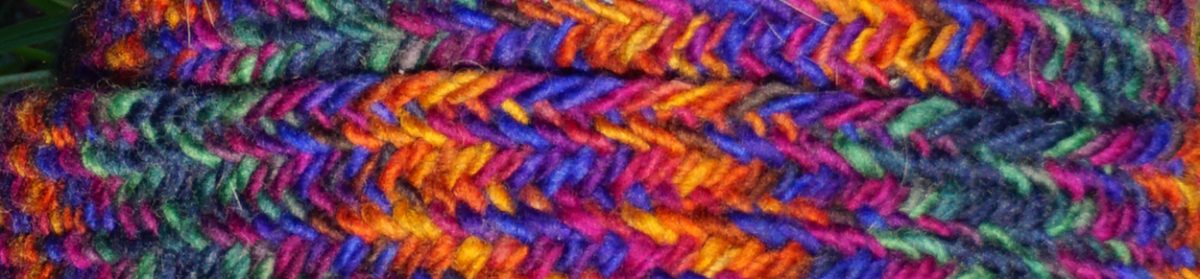
NOW: Child’s sock with orange, blue and yellow stripes – III 15474

For a person that has spent a lot of time examining stockings, this is an excellent time of the year. The Museum der Kulturen Basel has the largest collection of Egyptian nalbinding1 and they just recently put their entire collection online. So this week’s Nalbound Object of the Week is one of my favorite of the children’s socks.

©Museum der Kulturen Basel CC BY 4.0

Object: Child’s sock with orange, blue and yellow stripes – III 15474

Description: The sock is striped with blue, orange, and yellow stripes and a natural (now cream) base that shows mostly in the wedge heel. It has a relatively short, undifferentiated, toe box with a rather large wedge heel. The ankle is damaged and its true height unknown. Length 17 cm2

Dated to: 4th century ?3 CE (This is a very old art historical based dating. There has been no scientific dating of compound Egyptian nalbound socks. More recent excavations are finding compound nalbound socks in 11th century layers. I would dearly love to have a few of these radiocarbon dated as exactly when compound nalbinding began cannot be determined without solid dating.)

Culture: Coptic4

Find location: Egypt5

Material: Wool6

Stitch(es) used: F2 UOO/UUOO,7 Mammen

Inventory number: III 154748

Current location: Museum der Kulturen Basel, Switzerland

Link to museum catalog or other data: The Museum der Kulturen database does not have permalinks. Search for the Inventory number in https://onlinecollection.mkb.ch/#/query/f901c9da-5de6-4bea-819e-39e4464051be

Some sources in which more information can be found:

Böttcher, Gudrun. “Koptische Nadelbindungstextilien im Museum der Kulturen Basel” in Experimentelle Archäologie in Europa: Bilanz 2004 Heft 3. edited by Corinna Endlich. Oldenburg: Isensee Verlag, 2004: 211-214. ISBN 3-89995-204-9.

Please note that sharing to other venues will likely be intermittent. If you wish to receive these each week, please remember to follow the blog.
Patrons on Patreon receive early access previews, occasional extra details, and priority requests.

  1. That we know of so far because I am certain there are more socks out there in boxes and the backs of drawers that haven’t been opened in a century. ↩︎
  2. Museum der Kulturen Basel dataset published under the license CC BY 4.0 https://onlinecollection.mkb.ch/#/query/f901c9da-5de6-4bea-819e-39e4464051be ↩︎
  3. Museum der Kulturen Basel dataset published under the license CC BY 4.0 https://onlinecollection.mkb.ch/#/query/f901c9da-5de6-4bea-819e-39e4464051be ↩︎
  4. Museum der Kulturen Basel dataset published under the license CC BY 4.0 https://onlinecollection.mkb.ch/#/query/f901c9da-5de6-4bea-819e-39e4464051be ↩︎
  5. Museum der Kulturen Basel dataset published under the license CC BY 4.0 https://onlinecollection.mkb.ch/#/query/f901c9da-5de6-4bea-819e-39e4464051be ↩︎
  6. Museum der Kulturen Basel dataset published under the license CC BY 4.0 https://onlinecollection.mkb.ch/#/query/f901c9da-5de6-4bea-819e-39e4464051be ↩︎
  7. Böttcher writes it as Stitch Type: III and Stitch Variant: F(L) 2 UOO/UUOO. Böttcher, Gudrun. “Koptische Nadelbindungstextilien im Museum der Kulturen Basel” in Experimentelle Archäologie in Europa: Bilanz 2004 Heft 3. edited by Corinna Endlich. Oldenburg: Isensee Verlag, 2004: 211-214. ISBN 3-89995-204-9. pg 213. ↩︎
  8. Museum der Kulturen Basel dataset published under the license CC BY 4.0 https://onlinecollection.mkb.ch/#/query/f901c9da-5de6-4bea-819e-39e4464051be ↩︎

NOW: Light brown Egyptian Sock – (A&I)1914:205

This week’s Nalbound Object of the Week is an Egyptian Sock that is currently located in the National Museum of Ireland. Early online photos of the sock were taken at such an angle that the toe split was not visible. This led to mistaken impression that this sock was the only adult cross-knit looping (Coptic stitch) nalbound sock with a single toe box. I was lucky enough to come across this sock on display in April of 2014, so I had seen in person that it did have a split toe to accommodate sandals. In fact, out of the 49 or so cross-knit looped nalbound Egyptian socks we have images of and are whole enough to tell, only the tiniest baby socks for not yet mobile infants do not have split toes.

Woolen Sock (A&I)1914:205 © National Museum of Ireland CC BY-NC-SA 4.0

Object: Woolen Sock

Description: A now light brown wool sock for the left foot with a split at the ankle and ties still remaining. There is a decorative welt around the ankle where the heel cup shifts to the ankle. Height 9cm, width 8cm, Length 22 cm.1 The sock arrived at the National Museum of Ireland as part of the distributions the Egypt Exploration Fund in 1914.2

Dated to: Graeco-Roman Period:  Roman Period3

Find location :  el-Sheikh Ibada/Antinoopolis, Egypt4

Material: Wool5

Stitch(es) used: S-crossed Cross-knit Looping (as determined from photographs by Anne Marie Decker)

Inventory number: (A&I)1914:205

Current location: National Museum of Ireland

Link to museum catalog or other data: https://www.museum.ie/collections/collection/antiquity-203733/?return=%2Fcollections%2Fcollection%2F%3Fterm%3Dsock

Some sources in which more information can be found:

https://www.globalegyptianmuseum.org/record.aspx?id=2619

Rose-Beers, Kristine. (2023). The Threads that Bind: Evidence of the Early Codex Structure in Chester Beatty’s Papyri. DOI 10.1515/9783110781304-009.

Photographs:
There are two additional views of the sock available on the National Museum of Ireland’s website. The view that obscures the split toe can be seen on The Global Egyptian Museum.org site.

Please note that sharing to other venues will likely be intermittent. If you wish to receive these each week, please remember to follow the blog.
Patrons on Patreon receive early access previews, occasional extra details, and priority requests.

  1. https://www.globalegyptianmuseum.org/record.aspx?id=2619 ↩︎
  2. https://www.globalegyptianmuseum.org/record.aspx?id=2619 ↩︎
  3. https://www.globalegyptianmuseum.org/record.aspx?id=2619 ↩︎
  4. https://www.globalegyptianmuseum.org/record.aspx?id=2619 and https://www.museum.ie/collections/collection/antiquity-203733/?return=%2Fcollections%2Fcollection%2F%3Fterm%3Dsock ↩︎
  5. https://www.museum.ie/collections/collection/antiquity-203733/?return=%2Fcollections%2Fcollection%2F%3Fterm%3Dsock ↩︎

Blue and white knit stockings

Nalbinding isn’t the only corpus that is spread out across many institutions. Recently a number of museums have added to their online collection databases and we are now able to see quite a few more blue and white knitted artifacts from Egypt.

So in addition to the ones in The Textile Museum that I posted about in 2020: https://nalbound.com/2020/10/06/the-textile-museum/ I wanted to share a few others that I’ve found or had brought to my attention.

Here are three pieces from the Detroit Institute of the Arts:


The Staatliche Museen zu Berlin, Museum für Islamische Kunst has four pieces:


In 2019 I had the opportunity to go to the Museum der Kulturen Basel to study the nalbinding they have in their collection. While there, they shared a few pieces of their blue and white knitting with me as well. As they were putting it away, I got hints that they had an extensive collection. The Museum der Kulturen Basel has just recently put their collection online and there are some amazing pieces. Their database does not have permalinks to individual artifacts, so you will need to search via the Object Number for more details on each piece: https://www.mkb.ch/en/museum/sammlung.html

This bit of blue and white knitting isn’t in an online catalog, but the article in which it was published is online: https://ejournals.epublishing.ekt.gr/index.php/benaki/article/view/1765/1754

Do you have links to other blue & white knitting from Egypt?

Edit: Thank you Geeske for reminding me of this one in the V&A: https://collections.vam.ac.uk/item/O128882/sock-unknown/

Please note that sharing to other venues will likely be intermittent. If you wish to receive these each week, please remember to follow the blog.
Patrons on Patreon receive early access previews, occasional extra details, and priority requests.

NOW: Leicester sock L.A63.1914.0.0

In 2019, my mother and I were able to travel to Leicester for a chance to see this week’s Nalbound Object of the Week; a small child’s sock from 3rd-5th century CE Antinoë/Antinoupolis. It was one of nearly a dozen found during John de Monins Johnson‘s excavations for the Egypt Exploration Fund1 in the 1913-14 season.

Leicester sock L.A63.1914.0.0
Photo credit: Anne Marie Decker 2019

Object: Leicester child’s sock

Description: Small child’s left split toed sock in many colors: green, red, purple, yellow, and blue. Comparables can be seen in my Charting the Nalbinding of the Nile presentation from 2019. At 9:39 in the recording linked in https://nalbound.com/2019/04/06/charting-the-nalbinding-of-the-nile /

Note: At the time of the excavations, the socks were presumed to be knitted as the differences between the crossed knitting and cross-knit nalbinding techniques had not yet been described.

Dated to: 300-500 CE2 (possibly earlier around the 3rd-4th centuries based on the radiocarbon dating of other socks found during the same excavation3)

Find location: Excavated from a rubbish pit at Sheikh Abada (ancient Antinoopolis), Egypt4

Material: wool5

Stitch(es) used: S-crossed Cross-knit Looping6

Inventory number: L.A63.1914.0.0

Current location: Leicester Museum and Art Gallery (formerly New Walk)

Link to museum catalog or other data:

Leicester Museum and Art Gallery does not have an online catalog. The sock is noted in their Collections Development Policy 2019-2024, section 3.5.2. “Although intended to be a representative selection, it includes at least one rarity, a Coptic knitted sock from Antinoe, the only example in this country outside of London.” This unfortunately reflects out of date information; the technique having been recognized as nalbinding, not knitting, in the last quarter of the last century and several examples from the same excavation are located in Britain, but outside of London. This does not, however, in any way negate its rarity and importance.

Some sources in which more information can be found:

Köstner, Barbara. “Roman and Late Roman nalbinding socks from Egypt: Bringing ‘Egyptian fashion’ to the North” in Excavating, analysing, reconstructing Textiles of the 1st millennium AD from Egypt and neighbouring countries: Proceeding of the 9th conference of the research group ‘Textiles from the Nile Valley’ Antwerp, 27-29 November 2015, edited by Antoine De Moor, Cäcilia Fluck, and Petra Linscheid. Tielt, Belgium: Lannoo Publishers, 2017. ISBN 978 94 014 4399 9.

O’Connell, Elisabeth R. “John de Monins Johnson’s 1913/14 Egypt Exploration Fund expedition to Antinoupolis (Antinoë)” In Antinoupolis II: Scavi e materiali III, ed. R. Pintaudi, 415–66. Florence: Istituto Papirologico G. Vitelli, 2014.

Pritchard, Frances. “A survey of textiles in the UK from the 1913-14 Egypt Exploration Fund season at Antinoupolis” in Drawing the Threads Together: Textiles and Footwear of the 1st Millenium AD from Egypt. Proceedings of the 7th Meeting of the Study Group ‘Textiles from the Nile Valley”, Antwerp, 7-9 October 2011, edited by Antoine De Moor, Cäcilia Fluck, and Petra Linscheid, 34-55. Tielt: Lannoo, 2013. ISBN 9789401410830.

Rutt, Richard. A History of Hand Knitting. London: B T Batsford Ltd, 1987 ISBN 0713451181

Photographs (if permissions allow):

A photo of the bottom of the sock was published illustrating everyday life of The Nile Valley AD 395-642 Coptic when The British Museum partnered with other British museums to share Worldtimelines.org.uk which placed 2,000 artifacts from museums around the British Isles in their geographical and chronological context. Unfortunately, Worldtimelines.org.uk is no longer active, but you can see it in the Wayback Machine of the Internet Archive. https://web.archive.org/web/20101228003015/http://worldtimelines.org.uk/world/africa/nile_valley/AD395-642/everyday

A similar photo can be seen in Richard Rutt’s A History of Hand Knitting Fig. 23 on page 32 in the 1987 edition.

The Leicester sock was one of 4 included in the original excavation photographs taken in 1914. I was granted permission by the Griffith Institute to share a modified version of that photo in https://nalbound.com/2019/06/21/have-you-seen-this-sock-part-2/. The Leicester sock is the one on the left, number 1.

The photo from the John de Monins Johnson’s excavation is also included in Elisabeth O’Connell’s article “John de Monins Johnson’s 1913/14 Egypt Exploration Fund expedition to Antinoupolis (Antinoë)” along with the photographs of other finds and a sketch of the dig sites.

Please note that sharing to other venues will likely be intermittent. If you wish to receive these each week, please remember to follow the blog.
Patrons on Patreon receive early access previews, occasional extra details, and priority requests.

  1. Now the Egypt Exploration Society https://www.ees.ac.uk/ ↩︎
  2. https://web.archive.org/web/20101228003015/http://worldtimelines.org.uk/world/africa/nile_valley/AD395-642/everyday ↩︎
  3. British Museum EA53913 was radiocarbon dated to between 100-350 CE. EA53913 was radiocarbon dated to 200-400 CE. ACO Tx2497 in the Royal Museums of Art and History in Brussels was dated to 240-400 CE. See De Moor, Antoine, Cäcilia Fluck, M. Van Strydonck, and M. Boudin. “Radiocarbon dating of Late Roman woolen socks from Egypt,” In Textiles, tools and techniques of the 1st millennium AD from Egypt and neighbouring countries. Proceedings of the 8th conference of the research group ‘Textiles from the Nile Valley,’ Antwerp, 4-6 October 2013,] ed. Antoine De Moor, Cäcilia Fluck, and Petra Linscheid, p. 131-136. Tielt: Lannoo Publishers, 2015. ISBN 9789401432405. ↩︎
  4. https://web.archive.org/web/20101228003015/http://worldtimelines.org.uk/world/africa/nile_valley/AD395-642/everyday ↩︎
  5. Köstner, Table 1, Pgs. 190-191. ↩︎
  6. Köstner, Table 1, Pgs. 190-191. ↩︎

NOW: Purple tongued sock 1936-1897

Since the purple fragment went over so well last week, I thought that I would share this purple Roman Era Egyptian sock as this week’s Nalbound Object of the Week. It was excavated from the Christian burial grounds of Oxyrhynchus, present-day al-Bahnasa, by the Egypt Exploration Fund in the 1896-71 excavation season.

Accession number 1936-1897. The purple sock from Oxyrhynchus. Left side, showing the increases along the multi-toe. © Victoria and Albert Museum, London. Non-commercial online use, up to 768 pixels, and for up to 5 years

Object: Purple tongued sock

Description: A piece dyed2 purple (red and blue) split-toed sock for the left foot with a tongue and lacing loops closure, currently sewn through the tongue, and knit/purl ribbed patterning on the upper ankle cuff. Measurements on the online catalog record, length approximately 21.5cm, width approximately 8.4cm, and height approximately 10cm,3 reflect a sock that would fit a US Children’s size 3, Women’s 4.5.

Dated to: 50 AD – 220 AD4

Find location: The Christian burial grounds of Late Roman Era Oxyrhynchus.5 The present-day city of al-Bahnasa in Egypt.

Material: S2Z plied wool.6 Originally a light natural color, the sock was piece dyed red and blue, resulting in a purple sock.

Stitch(es) used: S-crossed Cross-knit Looping variant of nalbinding.7 Gauge is reported as 9 stitches per inch by 12 rows per inch8 or 3-4 stitches by 5 rows to the centimeter.9

Inventory number:  ACCESSION NUMBER 1936-1897

Current location: V&A Museum

Link to museum catalog or other data: https://collections.vam.ac.uk/item/O128867/textile-fragment-unknown/

Some sources in which more information can be found:

Burnham, Dorothy K. “Coptic Knitting: An Ancient Technique” in Textile History, Vol. 3 December 1972. edited by K. G. Ponting and Dr S. D. Chapman. The Pasold Research Fund LTD, England, 1972; pgs. 116-124. No ISBN/ISSN provided. DOI: 10.1179/004049672793692237

De Moor, Antoine, Cäcilia Fluck, M. Van Strydonck, and M. Boudin. “Radiocarbon dating of Late Roman woolen socks from Egypt,” In Textiles, tools and techniques of the 1st millennium AD from Egypt and neighbouring countries. Proceedings of the 8th conference of the research group ‘Textiles from the Nile Valley,’ Antwerp, 4-6 October 2013, ed. Antoine De Moor, Cäcilia Fluck, and Petra Linscheid, p. 131-136. Tielt: Lannoo Publishers, 2015. ISBN 9789401432405.

Kendrick, A. F. Catalogue of Textiles From Burying-Grounds in Egypt: Vol. II. Period of Transition and of Christian Emblems. Victoria and Albert Museum, Department of Textiles. London: Publ. under the Authority of His Majesty’s Stationery Office, 1921. No ISBN.

Köstner, Barbara. “Roman and Late Roman nalbinding socks from Egypt: Bringing ‘Egyptian fashion’ to the North” in Excavating, analysing, reconstructing: Textiles of the first millennium AD from Egypt and neighbouring countries. Proceedings of the 9th conference of the research group ‘Textiles from the Nile Valley’, Antwerp, 27-29 November 2015. ed. by Antoine De Moor, Cäcilia Fluck, and Petra Linscheid. Tielt: Lannoo Publishers, 2017. ISBN 9789401443999.

Photographs:

There are a few additional photos in the museum’s online catalog entry.

Accession number 1936-1897. The purple sock from Oxyrhynchus. Right side. This gives a clearer view of the lacing loops. © Victoria and Albert Museum, London. Non-commercial online use, up to 768 pixels, and for up to 5 years

Please note that sharing to other venues will likely be intermittent. If you wish to receive these each week, please remember to follow the blog.
Patrons on Patreon receive early access previews, occasional extra details, and priority requests.

  1. Kendrick, Catalogue of Textiles From Burying-Grounds in Egypt: Vol. II. Period of Transition and of Christian Emblems. 1921. pg. 88. ↩︎
  2. The sock appears to have been dyed after it was created instead of dying the wool and then nalbinding the sock. The interior of the yarn is still a light natural color and the red and blue appear to be on the surface only. ↩︎
  3. https://collections.vam.ac.uk/item/O128867/textile-fragment-unknown/Accessed 14 May 2024. ↩︎
  4. De Moor, et. al.”Radiocarbon dating of Late Roman woolen socks from Egypt,” 2013 and https://collections.vam.ac.uk/item/O128867/textile-fragment-unknown/ Accessed 14 May 2024. ↩︎
  5. https://collections.vam.ac.uk/item/O128867/textile-fragment-unknown/ Accessed 14 May 2024. ↩︎
  6. Spin and Ply determined by personal examination on 15 October 2019. Material https://collections.vam.ac.uk/item/O128867/textile-fragment-unknown/ Accessed 14 May 2024. ↩︎
  7. Stitch determined by personal examination on 15 October 2019. ↩︎
  8. Gauge https://collections.vam.ac.uk/item/O128867/textile-fragment-unknown/ Accessed 14 May 2024. ↩︎
  9. Köstner, “Roman and Late Roman nalbinding socks from Egypt: Bringing ‘Egyptian fashion’ to the North” 2015. Pg. 190. ↩︎

NOW: Saqqâra sock T 564

For this week’s Nalbound Object of the Week we get to get to see what is thought to be the earliest archaeological artifact to have its stitch analyzed, a sock from Egypt. Photos of nalbinding from the late 1800’s are rather rare. In this case, we also have the opportunity to see a more recent photo in the online catalog of the MAK in Vienna.

Fig. 28 from Antike Handarbeiten published in 1895.

Object: Sock from Saqqâra, Egypt

Description: A white wool sock with a black/dark brown toe and over the arch worked in a finer black/dark brown wool and a row of red wool at the cuff. The sock has a single wedge style heel and stops at the ankle. Current photos show that it has taken some damage since 1895 as the dark toe is nearly entirely missing and several rows near the cuff also show damage. Otherwise, it is in apparently the same position as it was when the first photograph was taken.

Dated to: 6th century

Find location: Saqqâra, Egypt

Earliest diagrams of nalbinding as analyzed from an artifact. Figs. 30-32 from Antike Handarbeiten published in 1895. Highlights by Anne Marie Decker

Material: Wool

Stitch(es) used: Mammen, F2 UOO/UUOO. Luise Schinnerer diagrammed the stitch found in this sock, but did so in a manner that while it produces the correct final structure, is opposite the direction in which we work this stitch today.

Inventory number: T 564

Current location: Museum für angewandte Kunst MAK (Museum of Applied Arts)

Link to museum catalog or other data: https://sammlung.mak.at/sammlung_online?id=collect-107622

Some sources in which more information can be found:

Schinnerer, Luise. Antike Handarbeiten. Mit einer histor. Einleitung von Alois Riegl. Wien: Waldheim, 1895. [No ISBN]

Collin, Maria; ‘Sydda vantar’ in Fataburen; 1917; pgs. 71-78.

Noever, Peter ed. Verletzliche Beute: spätantike und frühislamische Textilien aus Ägypten = Fragile remnants : Egyptian textiles of late antiquity and early Islam. on the occasion of the “Verletzliche Beute/Fragile remnants exhibition” MAK Vienna, 07.12.2005-05.06.2006 Ostfildern-Ruit: Hatje Cantz, 2005. ISBN 3-7757-1699-8.

Gagneux-Granade, Marguerite, and Anastasia Ozoline. “Quelques objets surprenants en textile non tissé dans les réserves du musée Bénaki” in ΜΟΥΣΕΙΟ ΜΠΕΝΑΚΗ 9, 2009 (Athens 2010): 99-111. doi:http://dx.doi.org/10.12681/benaki.13

Photographs: You can see a much more recent photo of the sock in the MAK’s online catalog: https://sammlung.mak.at/sammlung_online?id=collect-107622

Please note that sharing to other venues will likely be intermittent. If you wish to receive these each week, please remember to follow the blog.
Patrons on Patreon receive early access previews, occasional extra details, and priority requests.

NOW: Pair of Red Socks from Oxryhyncus 2085&A-1900

Our next Nalbound Object of the Week can be found on display in the V&A Museum in London. A rare example of a complete pair of Late Roman Era1 (formerly dated to the Coptic Era2) nalbound socks from the burial grounds of the Greek colony of Oxryhyncus in Egypt. By the 5th century, Oxryhyncus was a notable monastic center.3

The socks after being placed on conservation mounts to support the fabric. (Conservation mounts are not intended to be the equivalent shape as the feet upon which they were intended to be worn as that would strain the fabric.) © Victoria and Albert Museum, London use of Content is permitted up to 5 years from first day of publication as per V&A Websites Terms & Conditions.

Object: Pair of Red socks from Oxryhyncus

Pre-conservation showing standard proportions. © Victoria and Albert Museum, London use of Content is permitted up to 5 years from first day of publication as per V&A Websites Terms & Conditions.

Description: A complete pair of red socks on red conservation mounts. The socks have split toes to accommodate wearing with thonged sandals. The ankles have an overlapping slit and the remains of attached ties for closure.

The conservation mounts and foreshortening of photographs tend to cause these socks to look much thinner and longer than they actually are. The conservation mounts are rounder than a foot which narrows the profile. They are intended to be supportive of the fabric more than providing a foot shape that would stress the fabric. As can be seen in the photographs prior to conservation, the proportions are well within the average ratios for this type of sock and would have fit a normal human foot quite nicely.

Dated to: 250-420 CE4 Cal. years (95.4%)5

Find location: Oxryhyncus (modern Behneseh), Egypt6

Material: S3Z 3-ply Wool7

Nalbinding Stitch(es) used: S-crossed8 Cross-knit Looping, F1B1 U (specific determination confirmed by Anne Marie Decker)

A pair of madder red socks confirming a theory regarding a particular construction detail on the Oxryhyncus socks. Completed by Anne Maire Decker on 17 August 2020. Not to gauge.

Inventory number: Accession number 2085&A-19009

Current location: V&A South Kensington, UK

Link to museum catalog or other data: https://collections.vam.ac.uk/item/O107787/pair-of-socks-unknown/

Some sources in which more information can be found:

Burnham, Dorothy K. “Coptic Knitting: An Ancient Technique” in Textile History, Vol. 3 December 1972. edited by K. G. Ponting and Dr S. D. Chapman. The Pasold Research Fund LTD, England, 1972; pgs. 116-124. No ISBN/ISSN provided. DOI: 10.1179/004049672793692237

De Moor, Antoine, Cäcilia Fluck, M. Van Strydonck, and M. Boudin. “Radiocarbon dating of Late Roman woolen socks from Egypt,” In Textiles, tools and techniques of the 1st millennium AD from Egypt and neighbouring countries. Proceedings of the 8th conference of the research group ‘Textiles from the Nile Valley,’ Antwerp, 4-6 October 2013, ed. Antoine De Moor, Cäcilia Fluck, and Petra Linscheid, p. 131-136. Tielt: Lannoo Publishers, 2015. ISBN 9789401432405.

Kendrick, A. F. Catalogue of Textiles From Burying-Grounds in Egypt: Vol. II. Period of Transition and of Christian Emblems. Victoria and Albert Museum, Department of Textiles. London: Publ. under the Authority of His Majesty’s Stationery Office, 1921. No ISBN.

Köstner, Barbara. “Roman and Late Roman nalbinding socks from Egypt: Bringing ‘Egyptian fashion’ to the North” in Excavating, analysing, reconstructing: Textiles of the first millennium AD from Egypt and neighbouring countries. Proceedings of the 9th conference of the research group ‘Textiles from the Nile Valley’, Antwerp, 27-29 November 2015. ed. by Antoine De Moor, Cäcilia Fluck, and Petra Linscheid. Tielt: Lannoo Publishers, 2017. ISBN 9789401443999.

Köstner, Barbara. “Wearing socks in sandals: The height of Roman fashion?” in Small Finds & Ancient Social Practices in the Northwest Provinces of the Roman Empire edited by Stefanie Hoss and Alissa Whitmore. Oxford & Philadelphia: Oxbow Books, 2016. Pages 16-27. ISBN 978-1-78570-256-3.

Levey, S. M. “Illustrations of the History of Knitting Selected from the Collection of the Victoria and Albert Museum” in Textile History, Vol. I No. 2 (December 1969): pgs. 183-205. ed. by K. G. Ponting. Great Britain: David & Charles Ltd., 1969. Also available in the combined Vol 1. Nos 1-3 set published in 1971 as ISBN 0-7153-5166-4.

Turnau, Irena. History of Knitting Before Mass Production. Translated by and Agnieszka Szonert. Warsaw: Institute of the Archaeology and Ethnology Polish Academy of Sciences, 1991. ISBN 83-900213-2-3.

Photographs:

The socks on display in the V&A. Photo credit: Anne Marie Decker 15 October 2019
A view of the toes and slits. Also note how the angle at which the photos are taken affects the perception of length. Photo credit: Anne Marie Decker 15 October 2019.
A side view showing better proportions. Photo credit: Anne Marie Decker 15 October 2019.
Anne Marie Decker taking photographs of the pair of red socks. Photo credit: Ruth Decker 15 October 2019.

Please note that sharing to other venues will likely be intermittent. If you wish to receive these each week, please remember to follow the blog.
Patrons on Patreon receive early access previews, occasional extra details, and priority requests.

  1. De Moor et. al. “Radiocarbon dating of Late Roman woolen socks from Egypt,” 2015. Pg. 136 ↩︎
  2. The dating to Coptic Era was based on older art historical dating methods. It generally referred to what are now defined as Late Roman Egypt (3rd−4th centuries) and Byzantine Egypt (4th−7th centuries), but differed in exact dating by author. While still used colloquially, the term has lost favor in academia in large part due to its imprecision. ↩︎
  3. https://collections.vam.ac.uk/item/O107787/pair-of-socks-unknown/ Accessed 21 January 2024. ↩︎
  4. https://collections.vam.ac.uk/item/O107787/pair-of-socks-unknown/ Accessed 21 January 2024. ↩︎
  5. De Moor et. al. “Radiocarbon dating of Late Roman woolen socks from Egypt,” 2015. Pg. 134. ↩︎
  6. https://collections.vam.ac.uk/item/O107787/pair-of-socks-unknown/ Accessed 21 January 2024. ↩︎
  7. https://collections.vam.ac.uk/item/O107787/pair-of-socks-unknown/ Accessed 21 January 2024 specifies 3-ply wool. Barbara Köstner lists S3Z in “Roman and Late Roman nalbinding socks from Egypt: Bringing ‘Egyptian fashion’ to the North” 2017, pg. 192. ↩︎
  8. https://collections.vam.ac.uk/item/O107787/pair-of-socks-unknown/ Accessed 21 January 2024. The museum record only states “Nålbindning (sewing stitches)” “sometimes called knotless netting or single needle knitting.” It does not specify the specific stitch variant used. Barbara Köstner does specify S crossed in “Roman and Late Roman nalbinding socks from Egypt: Bringing ‘Egyptian fashion’ to the North” 2017, pg. 193. ↩︎
  9. https://collections.vam.ac.uk/item/O107787/pair-of-socks-unknown/ Accessed 21 January 2024. ↩︎

Case Study 8 of Archaeological Puzzles in a Museum

I’m excited to announce the “Archaeological Puzzles in a Museum” online exhibition at the National Museum of Denmark is now online!

https://en.natmus.dk/museums-and-palaces/the-national-museum-of-denmark/exhibitions/classical-and-near-eastern-antiquities/archaeological-puzzles-in-a-museum/

I contributed Case study 8, and a bit for the catalog, on the fringed nalbound sock in their collection. The sock is one of 112 textile fragments from Roman, Byzantine, and Early Medieval Arab Egypt currently in the National Museum of Denmark. The case study includes some beautiful professional photographs of the sock!

This is the same sock I was honored to examine in 2019. Initial results of that examination were included in“Fringed and patterned: decorative elements in Romano-Coptic nalbound socks” presented at the Textiles from the Nile Valley study group conference on the 27th of October 2019. More in depth information and the current status of my research on this sock was presented in “A fringe study in footwear: lessons learned from a sock in a box” at the Reconstructing Textiles and Their History: Egyptian Fabrics from the 1st Millennium AD online workshop that occurred on March 26th, 2022.

The exhibition has twelve downloadable PDFs that include the Introduction, a Catalog of 30 fabrics from the collection, and eight Case Studies that go deeper into a variety of topics.

The online exhibition is the result of the RECONTEXT research project entitled “Reconstructing the history of Egyptian textiles from the 1st Millennium AD at the National Museum of Denmark” which involved research carried out by historians, art historians, archaeologists and ancient fabric conservators. The project included analyses of textile fibers, weaving and looping techniques, as well as complete photography of the entire collection. Fingers crossed that we will be able to continue research on this collection.

Pre-opening of “Archaeological puzzles in a museum”

I’m really looking forward to being able to share this with you all. After some delays, the online exhibition that I referenced in my post on the Reconstructing Textiles and their history workshop last May is happening.

On Wednesday, 15 March 2023, from 15:15-16:00 Copenhagen time (10:15-11:00 am EDT), the Centre for Textile Research will be hosting their bi-weekly lecture in person and on Zoom. This week’s is the pre-opening of the “Archaeological puzzles in a museum” online exhibition, presented by Dr. Maria Joanna Mossakowska, that will be opening at the National Museum of Denmark end of this month. For three minutes near the end, I will be presenting on my case study of the fringed nalbound sock in their collection.

The Zoom link and further details are available here: https://ctr.hum.ku.dk/courses_activities_and_facilities/activities-and-events/2023/ctr-lectures-spring-2023/

The exhibition will be covering the systematic research done within the RECONTEXT research project entitled “Reconstructing the history of Egyptian textiles from the 1st Millennium AD at the National Museum of Denmark” on the 112 textile fragments from Roman, Byzantine, and Early Medieval Arab Egypt in the NMD, comprising the richest ensemble in Denmark.

Per the linked announcement above “RECONTEXT involved research carried out by historians, art historians, archaeologists and ancient fabric conservators. The project also included analyses of textile fibers and weaving techniques, as well as professional photographic documentation of the entire collection. The results of these investigations are presented in the exhibition entitled Archeaological Puzzles in a Museum / Arkæologiske puslespil på et museum, which will be available for the public in March 2023 on the NMD website (https://natmus.dk/). The exhibition includes general information on what a collection of Egyptian textiles is, how it is created, and the methods of reconstructing its history and the objects that form it. It presents 30 selected fabrics, arranged according to the four stages of the collection’s history. For the visitor who wishes to go deeper into various topics, eight Case studies were prepared.”

Case Study 8 is on the fringed brown sock in the NMD collection. This is the same sock I was honored to examine in 2019 and presented the current status of my research on in “A fringe study in footwear: lessons learned from a sock in a box” at the Reconstructing Textiles and Their History: Egyptian Fabrics from the 1st Millennium AD online workshop that occurred on March 26th, 2022.

Lily helped keep me company during the presentation. It was announced that the online exhibition should be available for viewing by the 1st of April!

Newest issue of ATR contains our article on several slip stitch crocheted objects misidentified as nalbound

I’m excited to announce the publication of the peer reviewed article, “Three objects catalogued as vantsöm in the collections of the Museum der Kulturen in Basel, Switzerland,” in Archaeological Textiles Review No. 64 (2022).

I had the distinct pleasure of collaborating with my friend Cary Karp to write this article after we were allowed the opportunity to jointly examine the items in question at the museum storehouse in January of 2019. I posted about that visit here (where you can see a few extra photos). Cary will be making a corresponding announcement on his blog, Loopholes; which has lots of additional information on the technique.

ATR is now Open Access and so you can freely download the complete volume, including our article, by following the instructions at: https://www.atnfriends.com/. If you’d like a hard copy of the issue, you can purchase a print on demand copy from the University of Copenhagen’s Campus Print Webshop here. You can now also download or purchase all of the back issues as well if you like. An offprint of the article itself can be found here.

Abstract
The looped structure termed a slip stitch in the craft glossary of crochet can be produced both with a hook and an eyed needle. These implements are not equally amenable to working that structure into complex constructs such as the toe and heel of a sock. This article describes the examination of three objects that have been misidentified as nalbinding. Two of them are certain to have been crocheted and the third is highly likely also to instantiate that technique. The provenance of the objects is recorded as “Coptic Egyptian” on anecdotal evidence and without ascription of specific dates. If scientific dating were to establish that any of them approaches even the youngest age this might imply, the accepted date for the advent of crochet would require major revision.

As I’ve mentioned before, incorrectly co-opting slip stitch crochet structures into the nalbinding atlas of stitch variants has obscured and made difficult the study of crochet’s history and transmission. Given that nalbinding has long suffered under this same issue of miss-classification/identification obscuring its own history, it behooves us to exhibit caution when examining textiles with which we may not be as familiar to avoid doing the same to our looping cousins.

My presentation at NESAT XIV in 2021, “But it looks like… methods for differentiating non-woven looped structures,” looked to clarify some methods for recognizing ambiguous surface textures and the sometimes subtle, but distinctive, secondary structural attributes that can be used to distinguish the particular technique used to create an object.

The sock and the pouch discussed in “Three objects catalogued as vantsöm in the collections of the Museum der Kulturen in Basel, Switzerland” could very well be important early instances of the crochet technique of potentially pivotal historiographic significance, but we won’t know until they have been scientifically dated. This is an important reminder that dating crocheted objects based on the art historical dating of other nalbound items because the items were not recognized as crochet entirely obscures their potential place in crochet history and simultaneously muddies the water of nalbinding’s history, construction details, and definition.

I’m excited to be able to see this article in print and am looking forward to future projects and collaborations.