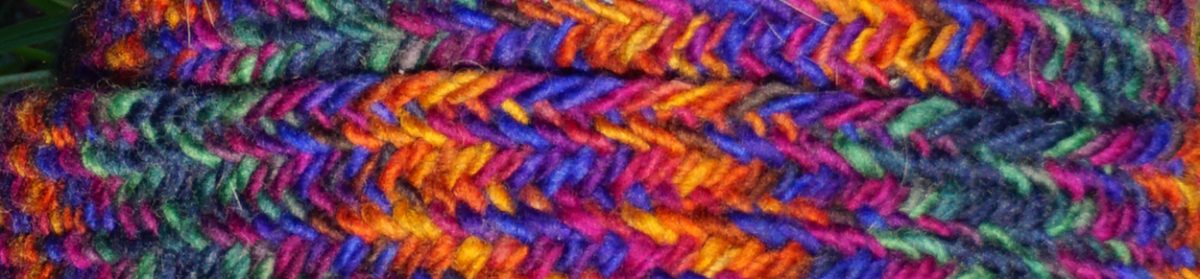
NOW: Nazca band with Birds & Flowers Am1931,1123.21.a

The Nazca were masters of figural nalbinding. Today’s Nalbound Object of the Week is a fragment of a brightly colored band with birds alternating with flowers coming out of it and flowers growing out of both sides as well. I had the honor of examining this one in person in October of 2019.

Am1931,1123.21.a is fragmentary. We don’t know the full extent of the original piece.
© The Trustees of the British Museum (CC BY-NC-SA 4.0)

Object: Band with Birds & many Flowers

Description: Starting with a red band worked in the round that is approximately 1 inch (2.5 cm) wide, with the tails and wings of the bird integral on both sides, the breast, head, and beaks of the birds are worked out of the center of one side. There is a flower worked out of the center of the band for each bird to sip from between each bird. Flowers also extend from both sides of the band making the total width just under 3 inches (just under 8 cm) on average. Putting the pieces together, I measured the central band as 37 cm long.1

Dated to: 100-400 CE2

Find location: Nazca, Peru3

Material: 2 ply Z-spun S-plied Camelid wool.4 Further investigation may reveal that some of the yarns or plies of yarns come from other sources as they do not have the same texture as the majority.

Stitch(es) used: Z-crossed Cross-knit Looping5 (specific crossing determined by Anne Marie Decker during examination in October 2019)

Gauge: Approximately 19 stitches to the inch and 28 rows to the inch (approx 8 stitches and 11 rows per cm)

Inventory number: Am1931,1123.21.a

Current location: The British Museum Textile Centre

Link to museum catalog or other data: https://www.britishmuseum.org/collection/object/E_Am1931-1123-21-a

Some sources in which more information can be found:

Pardo, Cecilia and Jago Cooper, ed. Peru: A Journey in Time. British Museum 2021. ISBN 9780714124926. Pgs. 92-93.

Photographs (if permissions allow):

This is a zoomed in and cropped version of the British Museum’s image of Am1931,1123.21.a showing one of the birds on the band and associated flowers.
The British Museum’s online catalog has a beautiful zoom function. Go to the site to see more details.
© The Trustees of the British Museum (CC BY-NC-SA 4.0)
The fragment in the British Museum may have been part of a larger piece similar to this 2nd century BCE Nazca Border Fragment 
Accession Number: 31.20.1
Photo credit: The Metropolitan Museum of Art – Public Domain

Please note that sharing to other venues will likely be intermittent. If you wish to receive these each week, please remember to follow the blog.

  1. Length: 8 centimetres Width: 39 centimetres according to https://www.britishmuseum.org/collection/object/E_Am1931-1123-21-a Accessed 14 June 2024 ↩︎
  2. https://www.britishmuseum.org/collection/object/E_Am1931-1123-21-a Accessed 14 June 2024 ↩︎
  3. https://www.britishmuseum.org/collection/object/E_Am1931-1123-21-a Accessed 14 June 2024 ↩︎
  4. Plies determined by Anne Marie Decker during October 2019 examination. Camelid wool according to https://www.britishmuseum.org/collection/object/E_Am1931-1123-21-a Accessed 14 June 2024 ↩︎
  5. Cross-knit Loop stitch according to https://www.britishmuseum.org/collection/object/E_Am1931-1123-21-a Accessed 14 June 2024 ↩︎

NOW: Purple tongued sock 1936-1897

Since the purple fragment went over so well last week, I thought that I would share this purple Roman Era Egyptian sock as this week’s Nalbound Object of the Week. It was excavated from the Christian burial grounds of Oxyrhynchus, present-day al-Bahnasa, by the Egypt Exploration Fund in the 1896-71 excavation season.

Accession number 1936-1897. The purple sock from Oxyrhynchus. Left side, showing the increases along the multi-toe. © Victoria and Albert Museum, London. Non-commercial online use, up to 768 pixels, and for up to 5 years

Object: Purple tongued sock

Description: A piece dyed2 purple (red and blue) split-toed sock for the left foot with a tongue and lacing loops closure, currently sewn through the tongue, and knit/purl ribbed patterning on the upper ankle cuff. Measurements on the online catalog record, length approximately 21.5cm, width approximately 8.4cm, and height approximately 10cm,3 reflect a sock that would fit a US Children’s size 3, Women’s 4.5.

Dated to: 50 AD – 220 AD4

Find location: The Christian burial grounds of Late Roman Era Oxyrhynchus.5 The present-day city of al-Bahnasa in Egypt.

Material: S2Z plied wool.6 Originally a light natural color, the sock was piece dyed red and blue, resulting in a purple sock.

Stitch(es) used: S-crossed Cross-knit Looping variant of nalbinding.7 Gauge is reported as 9 stitches per inch by 12 rows per inch8 or 3-4 stitches by 5 rows to the centimeter.9

Inventory number:  ACCESSION NUMBER 1936-1897

Current location: V&A Museum

Link to museum catalog or other data: https://collections.vam.ac.uk/item/O128867/textile-fragment-unknown/

Some sources in which more information can be found:

Burnham, Dorothy K. “Coptic Knitting: An Ancient Technique” in Textile History, Vol. 3 December 1972. edited by K. G. Ponting and Dr S. D. Chapman. The Pasold Research Fund LTD, England, 1972; pgs. 116-124. No ISBN/ISSN provided. DOI: 10.1179/004049672793692237

De Moor, Antoine, Cäcilia Fluck, M. Van Strydonck, and M. Boudin. “Radiocarbon dating of Late Roman woolen socks from Egypt,” In Textiles, tools and techniques of the 1st millennium AD from Egypt and neighbouring countries. Proceedings of the 8th conference of the research group ‘Textiles from the Nile Valley,’ Antwerp, 4-6 October 2013, ed. Antoine De Moor, Cäcilia Fluck, and Petra Linscheid, p. 131-136. Tielt: Lannoo Publishers, 2015. ISBN 9789401432405.

Kendrick, A. F. Catalogue of Textiles From Burying-Grounds in Egypt: Vol. II. Period of Transition and of Christian Emblems. Victoria and Albert Museum, Department of Textiles. London: Publ. under the Authority of His Majesty’s Stationery Office, 1921. No ISBN.

Köstner, Barbara. “Roman and Late Roman nalbinding socks from Egypt: Bringing ‘Egyptian fashion’ to the North” in Excavating, analysing, reconstructing: Textiles of the first millennium AD from Egypt and neighbouring countries. Proceedings of the 9th conference of the research group ‘Textiles from the Nile Valley’, Antwerp, 27-29 November 2015. ed. by Antoine De Moor, Cäcilia Fluck, and Petra Linscheid. Tielt: Lannoo Publishers, 2017. ISBN 9789401443999.

Photographs:

There are a few additional photos in the museum’s online catalog entry.

Accession number 1936-1897. The purple sock from Oxyrhynchus. Right side. This gives a clearer view of the lacing loops. © Victoria and Albert Museum, London. Non-commercial online use, up to 768 pixels, and for up to 5 years

Please note that sharing to other venues will likely be intermittent. If you wish to receive these each week, please remember to follow the blog.
Patrons on Patreon receive early access previews, occasional extra details, and priority requests.

  1. Kendrick, Catalogue of Textiles From Burying-Grounds in Egypt: Vol. II. Period of Transition and of Christian Emblems. 1921. pg. 88. ↩︎
  2. The sock appears to have been dyed after it was created instead of dying the wool and then nalbinding the sock. The interior of the yarn is still a light natural color and the red and blue appear to be on the surface only. ↩︎
  3. https://collections.vam.ac.uk/item/O128867/textile-fragment-unknown/Accessed 14 May 2024. ↩︎
  4. De Moor, et. al.”Radiocarbon dating of Late Roman woolen socks from Egypt,” 2013 and https://collections.vam.ac.uk/item/O128867/textile-fragment-unknown/ Accessed 14 May 2024. ↩︎
  5. https://collections.vam.ac.uk/item/O128867/textile-fragment-unknown/ Accessed 14 May 2024. ↩︎
  6. Spin and Ply determined by personal examination on 15 October 2019. Material https://collections.vam.ac.uk/item/O128867/textile-fragment-unknown/ Accessed 14 May 2024. ↩︎
  7. Stitch determined by personal examination on 15 October 2019. ↩︎
  8. Gauge https://collections.vam.ac.uk/item/O128867/textile-fragment-unknown/ Accessed 14 May 2024. ↩︎
  9. Köstner, “Roman and Late Roman nalbinding socks from Egypt: Bringing ‘Egyptian fashion’ to the North” 2015. Pg. 190. ↩︎

NOW: Pair of Red Socks from Oxryhyncus 2085&A-1900

Our next Nalbound Object of the Week can be found on display in the V&A Museum in London. A rare example of a complete pair of Late Roman Era1 (formerly dated to the Coptic Era2) nalbound socks from the burial grounds of the Greek colony of Oxryhyncus in Egypt. By the 5th century, Oxryhyncus was a notable monastic center.3

The socks after being placed on conservation mounts to support the fabric. (Conservation mounts are not intended to be the equivalent shape as the feet upon which they were intended to be worn as that would strain the fabric.) © Victoria and Albert Museum, London use of Content is permitted up to 5 years from first day of publication as per V&A Websites Terms & Conditions.

Object: Pair of Red socks from Oxryhyncus

Pre-conservation showing standard proportions. © Victoria and Albert Museum, London use of Content is permitted up to 5 years from first day of publication as per V&A Websites Terms & Conditions.

Description: A complete pair of red socks on red conservation mounts. The socks have split toes to accommodate wearing with thonged sandals. The ankles have an overlapping slit and the remains of attached ties for closure.

The conservation mounts and foreshortening of photographs tend to cause these socks to look much thinner and longer than they actually are. The conservation mounts are rounder than a foot which narrows the profile. They are intended to be supportive of the fabric more than providing a foot shape that would stress the fabric. As can be seen in the photographs prior to conservation, the proportions are well within the average ratios for this type of sock and would have fit a normal human foot quite nicely.

Dated to: 250-420 CE4 Cal. years (95.4%)5

Find location: Oxryhyncus (modern Behneseh), Egypt6

Material: S3Z 3-ply Wool7

Nalbinding Stitch(es) used: S-crossed8 Cross-knit Looping, F1B1 U (specific determination confirmed by Anne Marie Decker)

A pair of madder red socks confirming a theory regarding a particular construction detail on the Oxryhyncus socks. Completed by Anne Maire Decker on 17 August 2020. Not to gauge.

Inventory number: Accession number 2085&A-19009

Current location: V&A South Kensington, UK

Link to museum catalog or other data: https://collections.vam.ac.uk/item/O107787/pair-of-socks-unknown/

Some sources in which more information can be found:

Burnham, Dorothy K. “Coptic Knitting: An Ancient Technique” in Textile History, Vol. 3 December 1972. edited by K. G. Ponting and Dr S. D. Chapman. The Pasold Research Fund LTD, England, 1972; pgs. 116-124. No ISBN/ISSN provided. DOI: 10.1179/004049672793692237

De Moor, Antoine, Cäcilia Fluck, M. Van Strydonck, and M. Boudin. “Radiocarbon dating of Late Roman woolen socks from Egypt,” In Textiles, tools and techniques of the 1st millennium AD from Egypt and neighbouring countries. Proceedings of the 8th conference of the research group ‘Textiles from the Nile Valley,’ Antwerp, 4-6 October 2013, ed. Antoine De Moor, Cäcilia Fluck, and Petra Linscheid, p. 131-136. Tielt: Lannoo Publishers, 2015. ISBN 9789401432405.

Kendrick, A. F. Catalogue of Textiles From Burying-Grounds in Egypt: Vol. II. Period of Transition and of Christian Emblems. Victoria and Albert Museum, Department of Textiles. London: Publ. under the Authority of His Majesty’s Stationery Office, 1921. No ISBN.

Köstner, Barbara. “Roman and Late Roman nalbinding socks from Egypt: Bringing ‘Egyptian fashion’ to the North” in Excavating, analysing, reconstructing: Textiles of the first millennium AD from Egypt and neighbouring countries. Proceedings of the 9th conference of the research group ‘Textiles from the Nile Valley’, Antwerp, 27-29 November 2015. ed. by Antoine De Moor, Cäcilia Fluck, and Petra Linscheid. Tielt: Lannoo Publishers, 2017. ISBN 9789401443999.

Köstner, Barbara. “Wearing socks in sandals: The height of Roman fashion?” in Small Finds & Ancient Social Practices in the Northwest Provinces of the Roman Empire edited by Stefanie Hoss and Alissa Whitmore. Oxford & Philadelphia: Oxbow Books, 2016. Pages 16-27. ISBN 978-1-78570-256-3.

Levey, S. M. “Illustrations of the History of Knitting Selected from the Collection of the Victoria and Albert Museum” in Textile History, Vol. I No. 2 (December 1969): pgs. 183-205. ed. by K. G. Ponting. Great Britain: David & Charles Ltd., 1969. Also available in the combined Vol 1. Nos 1-3 set published in 1971 as ISBN 0-7153-5166-4.

Turnau, Irena. History of Knitting Before Mass Production. Translated by and Agnieszka Szonert. Warsaw: Institute of the Archaeology and Ethnology Polish Academy of Sciences, 1991. ISBN 83-900213-2-3.

Photographs:

The socks on display in the V&A. Photo credit: Anne Marie Decker 15 October 2019
A view of the toes and slits. Also note how the angle at which the photos are taken affects the perception of length. Photo credit: Anne Marie Decker 15 October 2019.
A side view showing better proportions. Photo credit: Anne Marie Decker 15 October 2019.
Anne Marie Decker taking photographs of the pair of red socks. Photo credit: Ruth Decker 15 October 2019.

Please note that sharing to other venues will likely be intermittent. If you wish to receive these each week, please remember to follow the blog.
Patrons on Patreon receive early access previews, occasional extra details, and priority requests.

  1. De Moor et. al. “Radiocarbon dating of Late Roman woolen socks from Egypt,” 2015. Pg. 136 ↩︎
  2. The dating to Coptic Era was based on older art historical dating methods. It generally referred to what are now defined as Late Roman Egypt (3rd−4th centuries) and Byzantine Egypt (4th−7th centuries), but differed in exact dating by author. While still used colloquially, the term has lost favor in academia in large part due to its imprecision. ↩︎
  3. https://collections.vam.ac.uk/item/O107787/pair-of-socks-unknown/ Accessed 21 January 2024. ↩︎
  4. https://collections.vam.ac.uk/item/O107787/pair-of-socks-unknown/ Accessed 21 January 2024. ↩︎
  5. De Moor et. al. “Radiocarbon dating of Late Roman woolen socks from Egypt,” 2015. Pg. 134. ↩︎
  6. https://collections.vam.ac.uk/item/O107787/pair-of-socks-unknown/ Accessed 21 January 2024. ↩︎
  7. https://collections.vam.ac.uk/item/O107787/pair-of-socks-unknown/ Accessed 21 January 2024 specifies 3-ply wool. Barbara Köstner lists S3Z in “Roman and Late Roman nalbinding socks from Egypt: Bringing ‘Egyptian fashion’ to the North” 2017, pg. 192. ↩︎
  8. https://collections.vam.ac.uk/item/O107787/pair-of-socks-unknown/ Accessed 21 January 2024. The museum record only states “Nålbindning (sewing stitches)” “sometimes called knotless netting or single needle knitting.” It does not specify the specific stitch variant used. Barbara Köstner does specify S crossed in “Roman and Late Roman nalbinding socks from Egypt: Bringing ‘Egyptian fashion’ to the North” 2017, pg. 193. ↩︎
  9. https://collections.vam.ac.uk/item/O107787/pair-of-socks-unknown/ Accessed 21 January 2024. ↩︎

NOW: Dura-Europos Patterned Fragment 1933.483

The patterned fragment from Dura-Europos has always fascinated me, so today it too joins the Nalbound Object of the Week collection. The fragment was excavated by the Yale-French Excavations at Dura-Europos sometime between 1928–37. It is only 5 7/8 by 6 11/16 in. (15 × 17 cm). Given the standard ratios of socks of this type and analysis of the fragment itself, what remains is 3/4 of the original circumference of the sock ankle.

Anne Marie Decker’s theoretical reconstruction of what the Dura-Europos patterned fragment may have looked like when the sock was whole based on standard ratios found in examinations of socks worked in Cross-knit Looping found in Egypt and surrounding regions. The fragment itself is in the background.

Object: Patterned fragment from Dura-Europos

Description: The patterned heel cup and ankle of a fancy Cross-knit Looping sock. The pattern consists of a vertical column of knit wales followed by a purl background with two pomegranate shapes placed one over the other (one is missing). Then another vertical column, a tree of life pattern that goes up the center back of the sock, and another vertical column. This is followed by another purl background with two pomegranates and ending with a final vertical column. The fragment has a few perpendicular stitches on the bottom right that are the remains of the mid-foot section. On the same side, a few lacing loops are preserved indicating that this sock likely had a tongue flap and lacing closure similar to that seen in the contemporaneous sock from Egypt currently in the V&A collections in London.

Dated to: pre-256 CE1

Find location: Dura-Europos, in modern day Syria

Material: Wool

Stitch(es) used: Z-crossed Cross-knit Looping,  F1B1 O & B1F1 O, knit & purl stitch patterned

Inventory number: Accession Number 1933.483

Current location: Yale University Art Gallery

Link to museum catalog or other data: https://artgallery.yale.edu/collections/objects/5962

Some sources in which more information can be found:

Rutt, Richard. A History of Hand Knitting. London: B T Batsford Ltd, 1987 ISBN 0713451181; reprinted Loveland, Colorado: Interweave Press, 1989 ISBN 0-934026-35-1, Library of Congress Catalog Number 87-46353; pgs. 28-30.

Pfister, Rudolf and Bellinger, Louisa. “The textiles: Knitting,” Rostovtzeff, M.I., et al. The excavations at Dura-Europos Final Report IV, Part II. New Haven: Yale University Press, 1945, 54-5.

Photograph:

1933.483 Patterned fragment from Dura Europos. Cropped and rotated to show original orientation. Original Photo Credit: The Yale University Art Gallery – Public Domain CC0 1.0 Deed

Please note that sharing to other venues will likely be intermittent. If you wish to receive these each week, please remember to follow the blog.
Patrons on Patreon receive early access previews, occasional extra details, and priority requests.

  1. The Yale Univeristy Art Gallery dates the fragment to c. AD 200-256 https://artgallery.yale.edu/collections/objects/5962. Dura Europos was sacked and never reoccupied, so we are fairly certain the sock pre-dates 256 CE when that occurred. The only other example of a sock with lacing loops in the corpus has been carbon dated to a very similar timeframe. ↩︎

Case Study 8 of Archaeological Puzzles in a Museum

I’m excited to announce the “Archaeological Puzzles in a Museum” online exhibition at the National Museum of Denmark is now online!

https://en.natmus.dk/museums-and-palaces/the-national-museum-of-denmark/exhibitions/classical-and-near-eastern-antiquities/archaeological-puzzles-in-a-museum/

I contributed Case study 8, and a bit for the catalog, on the fringed nalbound sock in their collection. The sock is one of 112 textile fragments from Roman, Byzantine, and Early Medieval Arab Egypt currently in the National Museum of Denmark. The case study includes some beautiful professional photographs of the sock!

This is the same sock I was honored to examine in 2019. Initial results of that examination were included in“Fringed and patterned: decorative elements in Romano-Coptic nalbound socks” presented at the Textiles from the Nile Valley study group conference on the 27th of October 2019. More in depth information and the current status of my research on this sock was presented in “A fringe study in footwear: lessons learned from a sock in a box” at the Reconstructing Textiles and Their History: Egyptian Fabrics from the 1st Millennium AD online workshop that occurred on March 26th, 2022.

The exhibition has twelve downloadable PDFs that include the Introduction, a Catalog of 30 fabrics from the collection, and eight Case Studies that go deeper into a variety of topics.

The online exhibition is the result of the RECONTEXT research project entitled “Reconstructing the history of Egyptian textiles from the 1st Millennium AD at the National Museum of Denmark” which involved research carried out by historians, art historians, archaeologists and ancient fabric conservators. The project included analyses of textile fibers, weaving and looping techniques, as well as complete photography of the entire collection. Fingers crossed that we will be able to continue research on this collection.

Pre-opening of “Archaeological puzzles in a museum”

I’m really looking forward to being able to share this with you all. After some delays, the online exhibition that I referenced in my post on the Reconstructing Textiles and their history workshop last May is happening.

On Wednesday, 15 March 2023, from 15:15-16:00 Copenhagen time (10:15-11:00 am EDT), the Centre for Textile Research will be hosting their bi-weekly lecture in person and on Zoom. This week’s is the pre-opening of the “Archaeological puzzles in a museum” online exhibition, presented by Dr. Maria Joanna Mossakowska, that will be opening at the National Museum of Denmark end of this month. For three minutes near the end, I will be presenting on my case study of the fringed nalbound sock in their collection.

The Zoom link and further details are available here: https://ctr.hum.ku.dk/courses_activities_and_facilities/activities-and-events/2023/ctr-lectures-spring-2023/

The exhibition will be covering the systematic research done within the RECONTEXT research project entitled “Reconstructing the history of Egyptian textiles from the 1st Millennium AD at the National Museum of Denmark” on the 112 textile fragments from Roman, Byzantine, and Early Medieval Arab Egypt in the NMD, comprising the richest ensemble in Denmark.

Per the linked announcement above “RECONTEXT involved research carried out by historians, art historians, archaeologists and ancient fabric conservators. The project also included analyses of textile fibers and weaving techniques, as well as professional photographic documentation of the entire collection. The results of these investigations are presented in the exhibition entitled Archeaological Puzzles in a Museum / Arkæologiske puslespil på et museum, which will be available for the public in March 2023 on the NMD website (https://natmus.dk/). The exhibition includes general information on what a collection of Egyptian textiles is, how it is created, and the methods of reconstructing its history and the objects that form it. It presents 30 selected fabrics, arranged according to the four stages of the collection’s history. For the visitor who wishes to go deeper into various topics, eight Case studies were prepared.”

Case Study 8 is on the fringed brown sock in the NMD collection. This is the same sock I was honored to examine in 2019 and presented the current status of my research on in “A fringe study in footwear: lessons learned from a sock in a box” at the Reconstructing Textiles and Their History: Egyptian Fabrics from the 1st Millennium AD online workshop that occurred on March 26th, 2022.

Lily helped keep me company during the presentation. It was announced that the online exhibition should be available for viewing by the 1st of April!

Papua Koteka with nalbound covers

CW: male genitalia

Festive Koteka from Papua New Guinea on display in The Icelandic Phallological Museum in Reykjavik, Iceland. Photo taken by Anne Marie Decker August 30, 2022.

Traditional forms of nalbinding are used for a wide variety of purposes around the world. One area with a strong continuous tradition of nalbinding is the highlands of Papua New Guinea and West Papua, Indonesia. While one is most likely to be familiar with the Bilums from the region, another usage of nalbinding is found covering some Koteka.

A Koteka is a traditional penis sheath worn by some ethnic groups of Papua; mainly in the highlands. One may also see the koteka referred to as a horim. While often made of a particular gourd, the ones of most interest to this blog are the ones that have an outer layer of nalbound textile.

I have not yet had the opportunity to travel to Papua to see the amazing amount and variety of nalbinding that their traditions have and continue to produce. I do hope to make it to their annual Bilum Festival and Gala someday. And yet, Papuan nalbinding has been collected by colonizers and purchased by modern tourists for centuries and thus found its way into some of the most unexpected places. So much so, that when I once again find nalbinding where I didn’t expect it, I’m not surprised to often find that the example in question is Papuan.

On my most recent trip to Iceland, where I was honored to be able to examine the mitten from Arneiðarstaðir in Iceland, I also took the opportunity to go to several other museums. I picked up a new nalbinding needle at the Saga Museum. But having entirely forgotten about nalbound koteka covers, I was rather pleased and surprised to find nalbinding in The Icelandic Phallological Museum. Probably the last place I expected to find nalbinding. Even more so than finding nalbinding in a Ripley’s Believe it or Not.

“Penis Sheath From The Forests Of New Guinea” https://www.ripleys.com/weird-news/penis-sheath/

The Festive Koteka in The Icelandic Phallological Museum uses both the Simple Looping variant (often called Blanket or Buttonhole Stitch) and a spaced and staggered Cross-Knit Looping variant. The Danai tribe Koteka shown in the Ripley’s Believe it or Not! video has the Simple Looping variant on the sheath itself and what looks like a compound variant (undetermined) in the strap.

Online workshop 26 March 2022: RECONSTRUCTING TEXTILES AND THEIR HISTORY: Egyptian Fabrics from the 1st Millennium AD at the National Museum of Denmark

I’m honored to be included in the Reconstructing Textiles and Their History: Egyptian Fabrics from the 1st Millennium AD online workshop coming up on Saturday March 26th, 2022. I will be presenting “A fringe study in footwear: lessons learned from a sock in a box” on the current status of my research into the fringed brown nalbound sock* in the National Museum of Denmark at 7am Eastern Daylight Time (noon Copenhagen time) .

The online workshop will include research on a good number of the fabrics in the Egyptian collection of the National Museum of Denmark as well as on objects from other collections directly related to the fabrics in Copenhagen. It looks like a very interesting program! These presentations are expected to be published in the “catalog” (PDF format) of the online exhibition on history of the Copenhagen collection available in May 2022 on the National Museum of Denmark’s website.

If you’d like to join us, the online workshop is open to the public. However, you will need to register by 24 March in order to get the Zoom link. With her permission, I’ve set up a Google form to collect email addresses to send to Dr. Mossakowska-Gaubert for registration here: https://forms.gle/jpkyxomMvVuVQSDAA

For a PDF version of the program, click the download button.

This workshop and the subsequent online exhibition are organized in the framework of the project RECONTEXT: Reconstructing the history of Egyptian textiles from the 1st Millennium AD at the National Museum of Denmark. You can read more about this year long project at: https://ctr.hum.ku.dk/research-programmes-and-projects/recontext-reconstructing-the-history-of-egyptian-textiles-from-the-1st-millennium-ad–at-the-national-museum-of-denmark/ The stated aim of the project “is to establish a history of the Egyptian textiles collection at the National Museum of Denmark: reconstructing the way the objects are acquired, their provenance, as well as their original look and shape.” As per the CTR’s website: “RECONTEXT is funded by two Danish foundations: Aage og Johanne Louis-Hansens Fond and Beckett-Fonden, and hosted by the Centre for Textile Research (CTR) – Saxo Institute: University of Copenhagen. It is conducted in close collaboration with the National Museum of Denmark.”

Links to more events at the Centre for Textile Research can be found here: https://ctr.hum.ku.dk/courses_activities_and_facilities/activities-and-events/

But it looks like… NESAT XIV 2021

I was honored to be able to present “But it looks like… methods for differentiating non-woven looped structures” at this year’s North European Symposium for Archeological Textiles (NESAT) conference. There were soo many very interesting papers, posters, and excellent discussions. I posted the abstract a few weeks ago, but I’m pleased to announce that my recording of the presentation is now uploaded and available for viewing on YouTube: https://youtu.be/pNqq2Z7vwgQ. Additional supplementary content, including short demonstration videos and other structural details, is available on my “But it looks like…” page at: https://nalbound.com/but-it-looks-like

But it looks like… methods for differentiating non-woven looped structures as presented at NESAT XIV on August 25th, 2021.

NESAT XIV was originally planned for May of 2020 in Oulu, Finland. Restrictions on travel due to COVID-19 led to delays, but we were finally able to hold the conference online via Zoom the week of August 23rd-26th, 2021. The presentations were pre-recorded and the scheduled sessions allowed for some excellent discussions. We got to learn about many amazing textiles and some very fascinating advances in textile science. A few of the videos are being made public and links to them are located here: https://www.nesatxiv.org/public-videos

Conference proceedings are planned to be published in 2022 in Monographs of the Archaeological Society of Finland. I am looking forward to some excellent papers being included.

The Textile Museum in Washington D.C.

The Textile Museum is working to put images of its collection online. Luckily that now includes multiple Islamic Era Egyptian socks. Beautiful photos of the blue and white cotton knitted socks and several compound nalbound socks.

The pilot site does not yet have their complete textile collection, but it does have several stunning examples of blue and white stranded knitting (interlooping) and four nalbound (interconnected looping) socks to add to the list of the Egyptian corpus. There is also one slip-stitch crochet sock that is going to require additional investigation into its provenance.* The catalog data is not necessarily up to date, which is not surprising given the volume and speed with which they are entering the records. They also have several Andean artifacts of interest as well.

Note: The pilot site doesn’t seem to react well to Facebook. So if you are viewing it there, you may get the same sock repeated. Try viewing it via WordPress or a different browser.

Knitted socks: Open loop stranded stockinette

Tube: two blues and white Arabic writing
https://collections-gwu.zetcom.net/en/collection/item/1259

Sock: alternating leaves zigzag. Heel missing and some damage https://collections-gwu.zetcom.net/en/collection/item/1443

Sock: solidly patterned in a large gauge
https://collections-gwu.zetcom.net/en/collection/item/3360

Sock: zigzag and writing stripes
https://collections-gwu.zetcom.net/en/collection/item/6216

Sock: two blues & white entirely patterned sock, diamonds, triangles, writing, eight pointed star
https://collections-gwu.zetcom.net/en/collection/item/8239/

Tube: vertical stranded stripes with bands of horizontal S and writing
https://collections-gwu.zetcom.net/en/collection/item/9443/

Child’s sock with deer
https://collections-gwu.zetcom.net/en/collection/item/10958

Fragment: white with writing on bands https://collections-gwu.zetcom.net/en/collection/item/10840

Fragment: white with bands of alternating horizontal hearts and scrolls
https://collections-gwu.zetcom.net/en/collection/item/10885

Sock: bands of multiple diamonds. Missing most of the foot
https://collections-gwu.zetcom.net/en/collection/item/13430

Sock: bands of writing
https://collections-gwu.zetcom.net/en/collection/item/13698

Sock toe: two color bands, both dark blue and white and dark and light blue
https://collections-gwu.zetcom.net/en/collection/item/15064

Tube: Bands of opposing hearts vertical
https://collections-gwu.zetcom.net/en/collection/item/15399

Tube: bands of overlapping circles
https://collections-gwu.zetcom.net/en/collection/item/17230

Nalbound socks: Compound nalbinding

Fragment: Toe and Instep cream colored: https://collections-gwu.zetcom.net/en/collection/item/21310

Sock: Cream with two stripes of blue near heel, potentially repair? https://collections-gwu.zetcom.net/en/collection/item/11119

Sock: Cream with brown toe and stripes near heel. Reddish and green? remnants at the cuff. Clear repair with blue fabric at heel partially remaining. https://collections-gwu.zetcom.net/en/collection/item/7021

Sock: Two toes, cream with pink & blue toes and a pink and blue roped edge https://collections-gwu.zetcom.net/en/collection/item/4595

Crochet sock: Front Loop Only Slip Stitch Crochet

The technique and shaping both belie the listed dating. https://collections-gwu.zetcom.net/en/collection/item/19973
*This would not be the only time that a slip-stitch crochet sock was slipped into a lot as a nalbound object. Such miss-identifications and resultant dating assumptions based on said miss-identification severely complicate research into the history and transmission of both crochet and nalbinding. Further discussions at https://nalbound.com/2019/05/03/nalbindings-myriad-of-variant-possibilities-and-the-dangers-of-insufficient-understanding-of-other-looped-textile-techniques/ and https://loopholes.blog/2019/04/crochetedness-nalboundness/ and https://www.mkb.ch/de/blog/2019/q1/sockenforscher.html

Andean Cross-Knit Looping variant

Nazca fringe band: https://collections-gwu.zetcom.net/en/collection/item/50046

Nazca Faces:
1. https://collections-gwu.zetcom.net/en/collection/item/49784
2. https://collections-gwu.zetcom.net/en/collection/item/49696
3. https://collections-gwu.zetcom.net/en/collection/item/49611
4. https://collections-gwu.zetcom.net/en/collection/item/49546

Nazca Bird & Flowers:
In the Cotsen Textile Traces Study Collection
https://collections-gwu.zetcom.net/en/collection/item/47959

Nazca Birds & Beans:
https://collections-gwu.zetcom.net/en/collection/item/48993

Nazca Beans:
https://collections-gwu.zetcom.net/en/collection/item/14862

People with Fans:
1. https://collections-gwu.zetcom.net/en/collection/item/47772
2. https://collections-gwu.zetcom.net/en/collection/item/48676

Nazca, a really nice small fragment so the photo blows it up really nicely:
https://collections-gwu.zetcom.net/en/collection/item/50471

Sihuas simple looping bag:
https://collections-gwu.zetcom.net/en/collection/item/49780

One of several lovely forgeries: (Clearly crochet)
https://collections-gwu.zetcom.net/en/collection/item/59128

And of course a large number of other fascinating textiles.