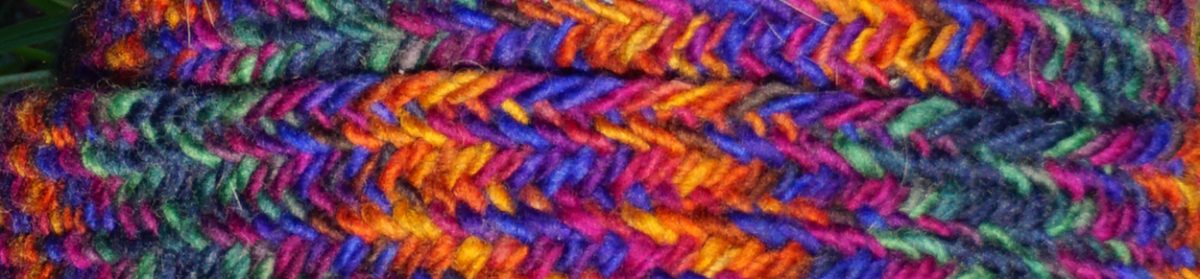

Inca Wig Cap. Object number: 41-52-30/2948
Courtesy of the Peabody Museum of Archaeology and Ethnology, Harvard University. https://peabody.harvard.edu/
Request reproduction rights from https://peabody.harvard.edu/rights-and-reproductions
Another type of nalbound objects we see quite frequently in museums are wig caps from Inca era Peru. Thus, this week’s Nalbound Object of the Week is an Inca wig cap. The skull cap portion is made using S-crossed Simple Looping.
Object: Inca Wig Cap
Description: A light colored skull cap with a narrower dark brown and a larger brown stripe around it with around 120 braids hanging from the lower edge. These 3 strand braids have multicolored, red, green, blue, white, brown, wrappings on their bottom half. Overall dimensions are 37 x 9 7/16 in. (94 x 24 cm).
Dated to: Late Horizon (1476-1532 CE), Inca1
Find location: South Coast of Nazca Province, Ica Region, Peru2
Material: The cap is made of three colors of z-2s cotton. The braids of dark colored human hair. The wraps around the braids are camelid yarn.3
Stitch(es) used: S-crossed Simple Looping4
Inventory number: Object Number 41-52-30/2948
Current location: Peabody Museum of Archaeology & Ethnology, Harvard University
Link to museum catalog or other data: https://collections.peabody.harvard.edu/objects/details/80239?ctx=ea4365b61d31e770c135b438be9348327e400170&idx=0#

Courtesy of the Peabody Museum of Archaeology and Ethnology, Harvard University. https://peabody.harvard.edu/
Request reproduction rights from https://peabody.harvard.edu/rights-and-reproductions
Please note that sharing to other venues will likely be intermittent. If you wish to receive these each week, please remember to follow the blog.
Patrons on Patreon receive early access previews, occasional extra details, and priority requests.
- https://collections.peabody.harvard.edu/objects/details/80239?ctx=ea4365b61d31e770c135b438be9348327e400170&idx=0# Accessed 22 July 2024 ↩︎
- https://collections.peabody.harvard.edu/objects/details/80239?ctx=ea4365b61d31e770c135b438be9348327e400170&idx=0# Accessed 22 July 2024 ↩︎
- https://collections.peabody.harvard.edu/objects/details/80239?ctx=ea4365b61d31e770c135b438be9348327e400170&idx=0# Accessed 22 July 2024 ↩︎
- Peabody Museum identifies this as Simple Looping https://collections.peabody.harvard.edu/objects/details/80239?ctx=ea4365b61d31e770c135b438be9348327e400170&idx=0# Accessed 22 July 2024. That the Simple Looping is S-crossed was determined by Anne Marie Decker based on the photograph provided. ↩︎