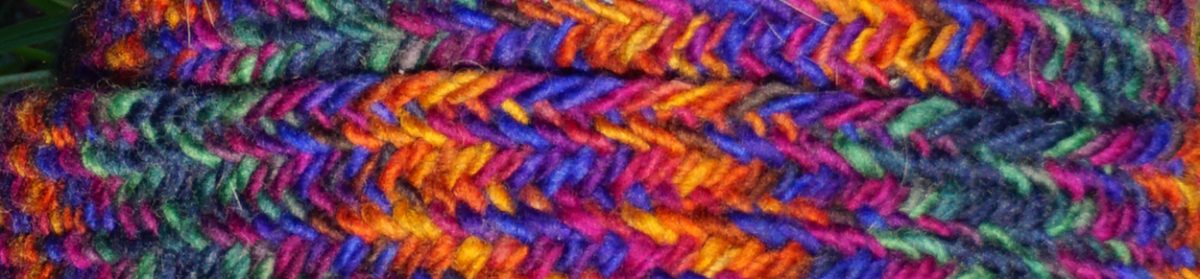
NOW: Wari Four-cornered Hat 1983.497.7

Sometimes nalbinding is combined with other techniques to make a artifact. My sincere thanks to Niina-Hannele Nuutinen for bringing this particular artifact to my attention. Generally the four-cornered hats of the Wari, from 8th-10th c. Peru, are knotted. This one is knotted with pile sides, but the top is Simple Looping. So this week’s Nalbound Object of the week is actually only partially nalbound.

1983.497.7 Wari four-cornered hat with Simple Looping top.
Credit: The Metropolitan Museum of Art – Public Domain CC0

Object: Wari Four-cornered Hat with Simple Looping top

Description: A four-cornered brightly colored hat made with knotted pile in a lozenge pattern. The four corners have colored tassels. The top is Simple Looping worked in four differently colored bands from the sides of the hat to the top. The hat is 5 1/2 inches high and 5 3/4 inches wide (14 × 14.6 cm).1

Dated to: 8th–10th century2

Find location: The Wari culture was centered in the central Peruvian highland valley of Ayacucho. Wari pile hats with provenance come from the south or central coast of Peru.3 The exact provenance of this hat is unspecified.

Material: camelid hair4

Stitch(es) used: Larkshead Knotting with supplementary pile sides5 with Z-crossed Simple Looping, F1 O, in for the top (Top stitch determination by Anne Marie Decker from photographs)

Inventory number: 1983.497.7

Current location: The Metropolitan Museum of Art, New York, USA

Link to museum catalog or other data: https://www.metmuseum.org/art/collection/search/314624

Some sources in which more information can be found:

Frame, Mary. Andean Four-Cornered Hats: Ancient Volumes: From the Collection of Arthur M. Bullowa. New York: The Metropolitan Museum of Art, 1990, pp. 18–19, pl. 8.

Please note that sharing to other venues will likely be intermittent. If you wish to receive these each week, please remember to follow the blog.
Patrons on Patreon receive early access previews, occasional extra details, and priority requests.

  1. https://www.metmuseum.org/art/collection/search/314624 Accessed 9 June 2024. Mary Frame gives different measurements, h. 15.2 cm; c. 50.2, in Andean Four-Cornered Hats: Ancient Volumes: From the Collection of Arthur M. Bullowa. ↩︎
  2. https://www.metmuseum.org/art/collection/search/314624 Accessed 9 June 2024 ↩︎
  3. Frame, Andean Four-Cornered Hats: Ancient Volumes: From the Collection of Arthur M. Bullowa pg. 10 ↩︎
  4. https://www.metmuseum.org/art/collection/search/314624 Accessed 9 June 2024 ↩︎
  5. Frame, Andean Four-Cornered Hats: Ancient Volumes: From the Collection of Arthur M. Bullowa pg. 28 ↩︎

NOW: Purple & White cap with Bird MAK/AS/P.70

Continuing the purple theme, this week’s Nalbound Object of the Week returns to Peru with another figural topped hat. This time we have a single bird topping a purple and white/natural striped child’s cap made of wool and cotton.

One of five photos, and an omnidirectional option, available on the Krzysztof Babraj (Archaeological Museum in Kraków‘s online catalog entry for this cap.
Photo: Małopolski Instytut Kultury w Krakowie – Public Domain

Object: Purple & White cap with Bird

Description: A small purple cap with two white/cream stripes of equal thickness that has a bird worked also in Simple Looping perched on top.

Dated to: 1000–1476 CE (Chancay culture)1

Find location: Necropolis of Ancon, Peru2

Material: wool and cotton3

Stitch(es) used: S-Crossed Simple Looping,4 B1 U, worked from the top to the brim (stitch determined from photograph by Anne Marie Decker)

Inventory number: MAK/AS/P.70 (received as a gift from the collection of Władysław Kluger from 1876.)

Current location: Krzysztof Babraj (Archaeological Museum in Kraków)

Link to museum catalog or other data: https://muzea.malopolska.pl/en/objects-list/661

Photographs (if permissions allow): There is an omnidirectional view on the museum’s website where you can rotate the hat.

ECHO Historical Textile posted some beautiful photos of the cap (conserved? reconstructed?) on display that is clearly visibly purple and has less damage to the bird.

Please note that sharing to other venues will likely be intermittent. If you wish to receive these each week, please remember to follow the blog.
Patrons on Patreon receive early access previews, occasional extra details, and priority requests.

  1. https://muzea.malopolska.pl/en/objects-list/661 Accessed 27 May 2024 ↩︎
  2. https://muzea.malopolska.pl/en/objects-list/661 Accessed 27 May 2024 ↩︎
  3. https://muzea.malopolska.pl/en/objects-list/661 Accessed 27 May 2024. It says wool and cotton, but does not specify the animal from which the “wool” was obtained. ↩︎
  4. The museum catalog currently misidentifies the technique as “crochet, handsewing,” but the photos clearly show that it is S-crossed Simple Looping. ↩︎

NOW: Cap with Puppies 1964.52.1

The collection of Peruvian nalbinding is full of beautiful figural work. This week’s Nalbound Object of the Week is one of my favorites: a small cap with a dog nursing her puppies.1

A small dark brown cap/fascinator with a light brown edge and a striped mother dog nursing her three striped puppies.
Photo: The Textile Museum – Public Domain

Object: Peruvian cap with puppies

Description: The cap is a slightly ovaloid shape just under 6 inches in diameter (5.5 x 5.75 inches) and 1.5 inches high (3.81 H x 14.60 W x 13.97 D cm).2 On top of the cap is a striped “dog” nursing three striped “puppies” worked in 3 dimensional figural nalbinding.

We know of several other caps from Peru in this time frame with figural work on them. One in purple and white stripes with a chicken head. Another in red and yellows with two birds on top.

Dated to: 1000-15003

Find location: Peru, probably coastal4

Material: camelid5 (meaning unspecified fiber off the alpaca or llama or other variety of camelid animals6)

Stitch(es) used: S-crossed Simple Looping, B1 U, (museum record says Cross-knit Looping,7 but image shows a surface texture of Simple Looping or possibly Pierced Looping)

Inventory number: Accession Number: 1964.52.1

Current location: The Textile Museum

Link to museum catalog or other data: https://collections-gwu.zetcom.net/en/collection/item/165/

Some sources in which more information can be found:

Rogers, George (Author). “Calendar” in The Textile Museum Bulletin, The Textile Museum Bulletin, Washington, D.C., 1990, vol. Spring, p. 8.

The Textile Museum. An Introduction to Textile Terms, Washington DC: The Textile Museum, 1997.

Please note that sharing to other venues will likely be intermittent. If you wish to receive these each week, please remember to follow the blog.
Patrons on Patreon receive early access previews, occasional extra details, and priority requests.

  1. Looping in An Introduction to Textile Terms, Washington DC: The Textile Museum, 1997. ↩︎
  2. Dimensions: https://collections-gwu.zetcom.net/en/collection/item/165/ ↩︎
  3. Date: https://collections-gwu.zetcom.net/en/collection/item/165/ ↩︎
  4. Geography: https://collections-gwu.zetcom.net/en/collection/item/165/ ↩︎
  5. Materials: https://collections-gwu.zetcom.net/en/collection/item/165/ ↩︎
  6. An interesting article regarding the difficulties in identifying between the 4 types of camelids in South America in the archeological record can be found in Paloma Diaz-Maroto, Alba Rey-Iglesia, Isabel Cartajena, Lautaro Núñez, Michael V Westbury, Valeria Varas, Mauricio Moraga, Paula F Campos, Pablo OrozcoterWengel, Juan Carlos Marin, Anders J Hansen (2021) Ancient DNA reveals the lost domestication history of South American camelids in Northern Chile and across the Andes eLife 10:e63390 at https://doi.org/10.7554/eLife.63390/ ↩︎
  7. Structure: https://collections-gwu.zetcom.net/en/collection/item/165/, but the diagram in An Introduction to Textile Terms, Washington DC: The Textile Museum, 1997 for Looping, which is illustrated with this cap, shows alternating rows of S- and Z-crossed Simple Looping, not Cross-knit Looping. ↩︎