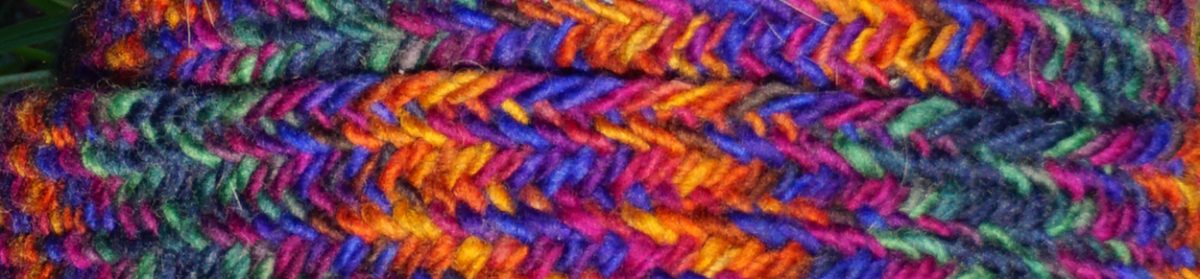
Just before I left for Ghana, I received formal notice that my presentation proposal, submitted in September, has been accepted. I will be presenting “Knee-length nalbound stockings from medieval Scandinavia: Two previously unexamined examples” (abstract below) in the DISTAFF (Discussion, Interpretation, and Study of Textile Arts, Fabrics, and Fashion) and MEDATS (Medieval Dress and Textile Society) sponsored session “For Dress and Textiles (1): Tools and Techniques” at the upcoming (May 8-10, 2025) International Congress on Medieval Studies in Kalamazoo, Michigan.
K’zoo, as it is often affectionately called, is a three day conference that takes place every year on the Western Michigan University campus. Around 1500 presentations, workshops, and demonstrations will occur. Given my lack of a time machine, we will have to select only a few of the around 500 sessions offered to attend. Mom and I tend to focus on those sessions that are textile related. But if there are no textile session offered in a particular time slot, we have found that we often enjoy the environmental sciences presentations.
This year, in addition to presenting in the Tools and Techniques session, I will also be participating in the DISTAFF sponsored Medieval Dress and Textile Arts Display and Demonstration immediately following. Looks like I need to get to nalbinding. But first, find the right yarn…
Title:
Knee-length nalbound stockings from medieval Scandinavia: Two previously unexamined examples
Abstract:
Over fifty years ago, excavations in the affluent neighborhoods near the Royal Palaces in medieval Nidaros, modern day Trondheim, Norway, and in Helgeandsholmen, Stockholm, Sweden revealed the earliest known knee-length nalbound stockings in Scandinavia. These extraordinary stockings underwent some conservation treatment but had not otherwise been examined in detail. This paper will address the results of recent examinations.
Both stockings exhibit evidence of wear. The toes are damaged or missing. They also share a type of heel, similar to the one on the Uppsala exemplar, that is first seen on socks and stockings of this timeframe. Nalbound knee-length stockings are extremely rare in the pre-Modern Era as most socks made using the technique of nalbinding are ankle length.
The 14th-century wool stocking found under the floorboards in medieval Nidaros is the earliest known example of the Dalby stitch, UOU/OUOO F1, and of what can provisionally be termed three-pass spiral intralacement. It is also the first instantiation of the so-called Russian family of stitches in Kaukonen’s classification system.
The 15th-century wool stocking from Helgeandsholmen is now in three parts, two of which are attached to the conservation mount (the leg and separate midfoot/heel). Examination to identify the specific stitch showed it to be in the two-pass family (Kaukonen’s Finnish family), not three as is the Nidaros stocking.
There is evidence of later re-use of the fabric of the stockings as both have regular holes that are brought into alignment by fold lines and were found with one or more sticks still in them. The area proximal to the holes shows compression, minimal fulling, and retains flexibility. A dark shiny substance appears to be embedded in the fabric more distant from the holes. With a layer of random fibers on the Nidaros stocking, this completely obscures the textile structure in those areas.
Now to plan my trip to Sweden to examine the 15th century knee-length nalbound stockings from Helgeandsholmen in person: https://nalbound.com/2024/07/16/now-helgeandsholmen-stocking/
If you’d like to help sponsor this research, please join me on Patreon. Patrons receive early access previews, occasional extra details, and priority requests.