NOW: Linen child’s sock with blue-green and yellow wool stripes III 15476

This week’s Nalbound Object features a unique child’s sock made primarily of linen, with small amounts of blue/green and yellow wool incorporated in decorative elements. The surviving parts include the toe, midfoot, and heel. It reflects Coptic culture and is housed at the Museum der Kulturen Basel, Switzerland.

Generally, we think of the Egyptian nalbound socks as being wool. Today’s Nalbound Object of the Week, however, is a linen sock. It does have a bit of wool incorporated. Tiny amounts of dark blue/green and yellow wool are both incorporated in the nalbinding and used in apparent remnants of some decorative stitching. The image provided by the museum shows the sole of the sock, giving a clear view of the wedge heel.

©Museum der Kulturen Basel CC BY 4.0

Object: Linen child’s sock with blue/green and yellow wool stripes -III 15476

Description: Only the toe, mid-foot, and heel are remaining on this child’s sock. However, there are several very interesting aspects to this sock. The body is worked in linen. There is a row near the toe tip in a blue/green wool and there are remnants of the ankle being worked in yellow wool. Additionally, there is a full row of each color being used as an embroidery element around the mid-foot. L 15.5 cm, W 8 cm1

Dated to: none provided

Culture: Coptic2

Find location: Egypt3

Material: Linen.4 Museum’s online record does not note, but the blue/green and yellow stripes are wool5 (as confirmed by examination by Anne Marie Decker)

Stitch(es) used: F2 UOO/UUOO,6 Mammen

Gauge: 12 stitches to the inch and 3.5 rows to the inch (as determine by examination by Anne Marie Decker)

Inventory number: III 154767

Current location: Museum der Kulturen Basel, Switzerland

Link to museum catalog or other data: The Museum der Kulturen database does not have permalinks. Search for the Inventory number in https://onlinecollection.mkb.ch/#/query/f901c9da-5de6-4bea-819e-39e4464051be

Some sources in which more information can be found:

Böttcher, Gudrun. “Koptische Nadelbindungstextilien im Museum der Kulturen Basel” in Experimentelle Archäologie in Europa: Bilanz 2004 Heft 3. edited by Corinna Endlich. Oldenburg: Isensee Verlag, 2004: 211-214. ISBN 3-89995-204-9.

Please note that sharing to other venues will likely be intermittent. If you wish to receive these each week, please remember to follow the blog.
Patrons on Patreon receive early access previews, occasional extra details, and priority requests.

  1. Museum der Kulturen Basel dataset published under the license CC BY 4.0 https://onlinecollection.mkb.ch/#/query/f901c9da-5de6-4bea-819e-39e4464051be Accessed 3 November 2026 ↩︎
  2. Museum der Kulturen Basel dataset published under the license CC BY 4.0 https://onlinecollection.mkb.ch/#/query/f901c9da-5de6-4bea-819e-39e4464051be Accessed 3 November 2026 ↩︎
  3. Museum der Kulturen Basel dataset published under the license CC BY 4.0 https://onlinecollection.mkb.ch/#/query/f901c9da-5de6-4bea-819e-39e4464051be Accessed 3 November 2026 ↩︎
  4. Museum der Kulturen Basel dataset published under the license CC BY 4.0 https://onlinecollection.mkb.ch/#/query/f901c9da-5de6-4bea-819e-39e4464051be Accessed 3 November 2026. Böttcher mentions that it is plant based. ↩︎
  5. The remnants of dark green and beige wool are noted on the catalog card at the museum. ↩︎
  6. Böttcher writes it as Stitch Type: III and Stitch Variant: F(L) 2 UOO/UUOO. Böttcher, Gudrun. “Koptische Nadelbindungstextilien im Museum der Kulturen Basel” in Experimentelle Archäologie in Europa: Bilanz 2004 Heft 3. edited by Corinna Endlich. Oldenburg: Isensee Verlag, 2004: 211-214. ISBN 3-89995-204-9. pg 213. ↩︎
  7. Museum der Kulturen Basel dataset published under the license CC BY 4.0 https://onlinecollection.mkb.ch/#/query/f901c9da-5de6-4bea-819e-39e4464051be Accessed 3 November 2026 ↩︎

NOW: Lost Red Sock – 9804 & Found Mate – GT 4498

For today’s Nalbound Object of the Week we get a two for one special. The left sock was in Berlin, but has been missing since World War II. Luckily, they had taken really nice (B&W) photos of it. Given its size, color, gauge, shaping, presumed find location & dealer, and the fact that it is a left sock, we highly suspect that it is the mate to the right sock that is currently located about 600 km away in the Modemuseum in Schloss Ludwigsburg.


Upper: Right sock GT 4498 .
Photo Origin/Rights: Landesmuseum Württemberg / Landesmuseum Württemberg, P. Frankenstein / H. Zwietasch (CC BY-SA)
Photo cropped and combined with:

Lower: Lost Left sock 9804
Photo Credit: Staatliche Museen zu Berlin, Skulpturensammlung und Museum für Byzantinische Kunst / Hietzke-Saalisch, Ruth CC BY-SA 4.0

Object: Left red sock – 9804 & Right1 red sock – GT 4498

Description: Barbara Köstner (now Thomas) noted in her 2015 article “Roman and Late Roman nalbinding socks from Egypt: Bringing ‘Egyptian fashion’ to the North” that these two socks may have been a pair as both shared the same find location, color, dimensions, stitch direction, and density as well as both having been purchased from Robert Forrer in Straßbourg in 1890.2 A conclusion that I came to separately for exactly the same reasons while aggregating information on the Egyptian socks for my presentation “Charting the Nalbinding of the Nile.” While it took until 1979 for the English language publications to recognize that this style of sock was not knitted, GT 4498 was used as the example for exactly why this style of sock cannot be knitted in a German publication in 1954.3
Left sock: Height: 10 cm, Length: 18 cm4
Right sock: Length: 18 cm, Width: 8.5 cm, Height: 9 cm5

Dated to: Left sock: 3rd – 5th century CE, estimated 250-430 CE based on the radiocarbon dating of similar socks in the V&A and the British Museum.6
Right sock: 500-699 CE,7 Coptic8 based on conventional art historical dating which has proven unreliable.

Find location: Left sock: Egypt, presumably Achmim9
Right sock: Achmim10

Material: Left sock: Red wool11
Right sock: S2Z, S3Z12 Wool13

Stitch(es) used: Left sock: S-crossed14 Cross-knit Looping, F1B1 U (confirmed by Anne Marie Decker based on photo)
Right sock: S-crossed15 Cross-knit Looping, F1B1 U (Confirmed by Anne Marie Decker based on photo and diagram published by v. Bültzingslöwen & Lehmann). The museum catalog still misidentifies it as knitted16 even though v. Bültzingslöwen & Lehmann identified it as looped in 1954.

Gauge: Right sock: 4 stitches per centimeter, 5-6 rows per centimeter17

Inventory number:
Left sock: Ident. Nr. 9804
Right sock: GT 4498

Current location:
Left sock: unknown, lost in WWII, but still listed in the collection of the Skulpturensammlung und Museum für Byzantinische Kunst
Right sock: in the Modemuseum in Schloss Ludwigsburg which is a branch museum of Landesmuseum Württemberg

Link to museum catalog or other data:
Left sock: https://id.smb.museum/object/1372869/strumpf
Right sock: https://www.landesmuseum-stuttgart.de/sammlung/sammlung-online/dk-details?dk_object_id=38649

Some sources in which more information can be found:

Fluck, Cäcilia, Petra Linscheid, and Susanne Merz. Textilien aus Ägypten Teil 1: Textilien aus dem Vorbesitz Theodor Graf, Carl Schmidt und dem Ägyptischen Museum Berlin. Staatliche Museen zu Berlin – Preußischer Kulturbesitz. Skulpturensammlung und Museum für Byzantinische Kunst. Bestandskataloge. Band 1. Germany: Dr. Ludwig Reichert Verlag, 2000. ISBN 13: 9783895001321

Köstner, Barbara. “Roman and Late Roman nalbinding socks from Egypt: Bringing ‘Egyptian fashion’ to the North” in Excavating, analysing, reconstructing Textiles of the 1st millennium AD from Egypt and neighbouring countries: Proceeding of the 9th conference of the research group ‘Textiles from the Nile Valley’ Antwerp, 27-29 November 2015, edited by Antoine De Moor, Cäcilia Fluck, and Petra Linscheid. Tielt, Belgium: Lannoo Publishers, 2017. ISBN 978 94 014 4399 9.

v. Bültzingslöwen, Regina, and Dr. E. Lehmann. “Nichtgewebte Textilien vor 1400 / IV. Teil.” Wirkerei- und Strickerei- Technik: Fachzeitschrift für die Fabrikationspraxis und Betriebstechnik der Wirkerei- und Strickerei-Industrie Coberg: August 1954, Nr. 8. Pgs. 41-43.

Photographs (if permissions allow):

Please note that sharing to other venues will likely be intermittent. If you wish to receive these each week, please remember to follow the blog.
Patrons on Patreon receive early access previews, occasional extra details, and priority requests.

  1. Köstner, Barbara. “Roman and Late Roman nalbinding socks from Egypt: Bringing ‘Egyptian fashion’ to the North” in Excavating, analysing, reconstructing Textiles of the 1st millennium AD from Egypt and neighbouring countries: Proceeding of the 9th conference of the research group ‘Textiles from the Nile Valley’ Antwerp, 27-29 November 2015, edited by Antoine De Moor, Cäcilia Fluck, and Petra Linscheid. Tielt, Belgium: Lannoo Publishers, 2017. ISBN 978 94 014 4399 9. pg. 192-193. ↩︎
  2. Köstner, Barbara. “Roman and Late Roman nalbinding socks from Egypt: Bringing ‘Egyptian fashion’ to the North” in Excavating, analysing, reconstructing Textiles of the 1st millennium AD from Egypt and neighbouring countries: Proceeding of the 9th conference of the research group ‘Textiles from the Nile Valley’ Antwerp, 27-29 November 2015, edited by Antoine De Moor, Cäcilia Fluck, and Petra Linscheid. Tielt, Belgium: Lannoo Publishers, 2017. ISBN 978 94 014 4399 9. pg. 174. ↩︎
  3. Based on direction of work and the increases. v. Bültzingslöwen, Regina, and Dr. E. Lehmann. “Nichtgewebte Textilien vor 1400 / IV. Teil.” Wirkerei- und Strickerei- Technik: Fachzeitschrift für die Fabrikationspraxis und Betriebstechnik der Wirkerei- und Strickerei-Industrie Coberg: August 1954, Nr. 8. Pgs. 42-43. ↩︎
  4. https://recherche.smb.museum/detail/1372869/strumpf Accessed February 13, 2026. ↩︎
  5. 18 cm Length. Köstner, Barbara. “Roman and Late Roman nalbinding socks from Egypt: Bringing ‘Egyptian fashion’ to the North” in Excavating, analysing, reconstructing Textiles of the 1st millennium AD from Egypt and neighbouring countries: Proceeding of the 9th conference of the research group ‘Textiles from the Nile Valley’ Antwerp, 27-29 November 2015, edited by Antoine De Moor, Cäcilia Fluck, and Petra Linscheid. Tielt, Belgium: Lannoo Publishers, 2017. ISBN 978 94 014 4399 9. pg. 193. 17 cm Length https://www.landesmuseum-stuttgart.de/sammlung/sammlung-online/dk-details?dk_object_id=38649 Accessed February 18, 2026 ↩︎
  6. https://recherche.smb.museum/detail/1372869/strumpf ↩︎
  7. https://www.landesmuseum-stuttgart.de/sammlung/sammlung-online/dk-details?dk_object_id=38649 Accessed February 18, 2026 ↩︎
  8. Köstner, Barbara. “Roman and Late Roman nalbinding socks from Egypt: Bringing ‘Egyptian fashion’ to the North” in Excavating, analysing, reconstructing Textiles of the 1st millennium AD from Egypt and neighbouring countries: Proceeding of the 9th conference of the research group ‘Textiles from the Nile Valley’ Antwerp, 27-29 November 2015, edited by Antoine De Moor, Cäcilia Fluck, and Petra Linscheid. Tielt, Belgium: Lannoo Publishers, 2017. ISBN 978 94 014 4399 9. pg. 193. ↩︎
  9. https://recherche.smb.museum/detail/1372869/strumpf ↩︎
  10. https://www.landesmuseum-stuttgart.de/sammlung/sammlung-online/dk-details?dk_object_id=38649 Accessed February 18, 2026 ↩︎
  11. https://recherche.smb.museum/detail/1372869/strumpf ↩︎
  12. Köstner, Barbara. “Roman and Late Roman nalbinding socks from Egypt: Bringing ‘Egyptian fashion’ to the North” in Excavating, analysing, reconstructing Textiles of the 1st millennium AD from Egypt and neighbouring countries: Proceeding of the 9th conference of the research group ‘Textiles from the Nile Valley’ Antwerp, 27-29 November 2015, edited by Antoine De Moor, Cäcilia Fluck, and Petra Linscheid. Tielt, Belgium: Lannoo Publishers, 2017. ISBN 978 94 014 4399 9. pg. 192. ↩︎
  13. https://www.landesmuseum-stuttgart.de/sammlung/sammlung-online/dk-details?dk_object_id=38649 Accessed February 18, 2026. Köstner, Barbara. “Roman and Late Roman nalbinding socks from Egypt: Bringing ‘Egyptian fashion’ to the North” in Excavating, analysing, reconstructing Textiles of the 1st millennium AD from Egypt and neighbouring countries: Proceeding of the 9th conference of the research group ‘Textiles from the Nile Valley’ Antwerp, 27-29 November 2015, edited by Antoine De Moor, Cäcilia Fluck, and Petra Linscheid. Tielt, Belgium: Lannoo Publishers, 2017. ISBN 978 94 014 4399 9. pg. 193. ↩︎
  14. Köstner, Barbara. “Roman and Late Roman nalbinding socks from Egypt: Bringing ‘Egyptian fashion’ to the North” in Excavating, analysing, reconstructing Textiles of the 1st millennium AD from Egypt and neighbouring countries: Proceeding of the 9th conference of the research group ‘Textiles from the Nile Valley’ Antwerp, 27-29 November 2015, edited by Antoine De Moor, Cäcilia Fluck, and Petra Linscheid. Tielt, Belgium: Lannoo Publishers, 2017. ISBN 978 94 014 4399 9. pg. 193. ↩︎
  15. Köstner, Barbara. “Roman and Late Roman nalbinding socks from Egypt: Bringing ‘Egyptian fashion’ to the North” in Excavating, analysing, reconstructing Textiles of the 1st millennium AD from Egypt and neighbouring countries: Proceeding of the 9th conference of the research group ‘Textiles from the Nile Valley’ Antwerp, 27-29 November 2015, edited by Antoine De Moor, Cäcilia Fluck, and Petra Linscheid. Tielt, Belgium: Lannoo Publishers, 2017. ISBN 978 94 014 4399 9. pg. 193. Note: Köstner incorrectly calls the stitch Tarim stitch. based on earlier publications that mistakenly thought the Tarim hat was worked in Cross-knit Looping when it is Simple Looping. ↩︎
  16. https://www.landesmuseum-stuttgart.de/sammlung/sammlung-online/dk-details?dk_object_id=38649 Accessed February 18, 2026 ↩︎
  17. Köstner, Barbara. “Roman and Late Roman nalbinding socks from Egypt: Bringing ‘Egyptian fashion’ to the North” in Excavating, analysing, reconstructing Textiles of the 1st millennium AD from Egypt and neighbouring countries: Proceeding of the 9th conference of the research group ‘Textiles from the Nile Valley’ Antwerp, 27-29 November 2015, edited by Antoine De Moor, Cäcilia Fluck, and Petra Linscheid. Tielt, Belgium: Lannoo Publishers, 2017. ISBN 978 94 014 4399 9. pg. 193. ↩︎

NOW: Leicester sock L.A63.1914.0.0

In 2019, my mother and I were able to travel to Leicester for a chance to see this week’s Nalbound Object of the Week; a small child’s sock from 3rd-5th century CE Antinoë/Antinoupolis. It was one of nearly a dozen found during John de Monins Johnson‘s excavations for the Egypt Exploration Fund1 in the 1913-14 season.

Leicester sock L.A63.1914.0.0
Photo credit: Anne Marie Decker 2019

Object: Leicester child’s sock

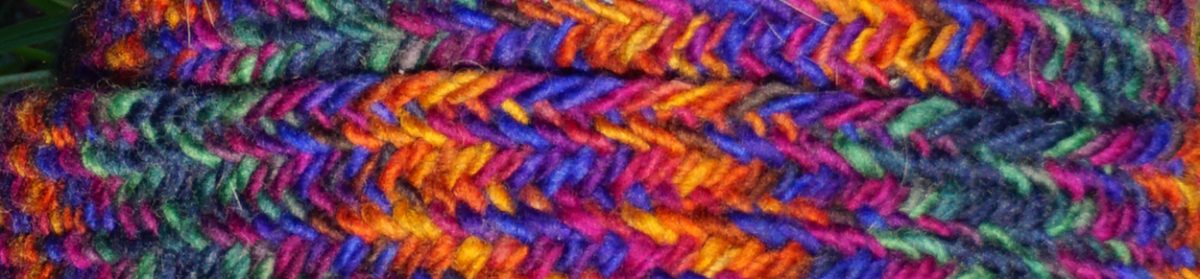
Description: Small child’s left split toed sock in many colors: green, red, purple, yellow, and blue. Comparables can be seen in my Charting the Nalbinding of the Nile presentation from 2019. At 9:39 in the recording linked in https://nalbound.com/2019/04/06/charting-the-nalbinding-of-the-nile /

Note: At the time of the excavations, the socks were presumed to be knitted as the differences between the crossed knitting and cross-knit nalbinding techniques had not yet been described.

Dated to: 300-500 CE2 (possibly earlier around the 3rd-4th centuries based on the radiocarbon dating of other socks found during the same excavation3)

Find location: Excavated from a rubbish pit at Sheikh Abada (ancient Antinoopolis), Egypt4

Material: wool5

Stitch(es) used: S-crossed Cross-knit Looping6

Inventory number: L.A63.1914.0.0

Current location: Leicester Museum and Art Gallery (formerly New Walk)

Link to museum catalog or other data:

Leicester Museum and Art Gallery does not have an online catalog. The sock is noted in their Collections Development Policy 2019-2024, section 3.5.2. “Although intended to be a representative selection, it includes at least one rarity, a Coptic knitted sock from Antinoe, the only example in this country outside of London.” This unfortunately reflects out of date information; the technique having been recognized as nalbinding, not knitting, in the last quarter of the last century and several examples from the same excavation are located in Britain, but outside of London. This does not, however, in any way negate its rarity and importance.

Some sources in which more information can be found:

Köstner, Barbara. “Roman and Late Roman nalbinding socks from Egypt: Bringing ‘Egyptian fashion’ to the North” in Excavating, analysing, reconstructing Textiles of the 1st millennium AD from Egypt and neighbouring countries: Proceeding of the 9th conference of the research group ‘Textiles from the Nile Valley’ Antwerp, 27-29 November 2015, edited by Antoine De Moor, Cäcilia Fluck, and Petra Linscheid. Tielt, Belgium: Lannoo Publishers, 2017. ISBN 978 94 014 4399 9.

O’Connell, Elisabeth R. “John de Monins Johnson’s 1913/14 Egypt Exploration Fund expedition to Antinoupolis (Antinoë)” In Antinoupolis II: Scavi e materiali III, ed. R. Pintaudi, 415–66. Florence: Istituto Papirologico G. Vitelli, 2014.

Pritchard, Frances. “A survey of textiles in the UK from the 1913-14 Egypt Exploration Fund season at Antinoupolis” in Drawing the Threads Together: Textiles and Footwear of the 1st Millenium AD from Egypt. Proceedings of the 7th Meeting of the Study Group ‘Textiles from the Nile Valley”, Antwerp, 7-9 October 2011, edited by Antoine De Moor, Cäcilia Fluck, and Petra Linscheid, 34-55. Tielt: Lannoo, 2013. ISBN 9789401410830.

Rutt, Richard. A History of Hand Knitting. London: B T Batsford Ltd, 1987 ISBN 0713451181

Photographs (if permissions allow):

A photo of the bottom of the sock was published illustrating everyday life of The Nile Valley AD 395-642 Coptic when The British Museum partnered with other British museums to share Worldtimelines.org.uk which placed 2,000 artifacts from museums around the British Isles in their geographical and chronological context. Unfortunately, Worldtimelines.org.uk is no longer active, but you can see it in the Wayback Machine of the Internet Archive. https://web.archive.org/web/20101228003015/http://worldtimelines.org.uk/world/africa/nile_valley/AD395-642/everyday

A similar photo can be seen in Richard Rutt’s A History of Hand Knitting Fig. 23 on page 32 in the 1987 edition.

The Leicester sock was one of 4 included in the original excavation photographs taken in 1914. I was granted permission by the Griffith Institute to share a modified version of that photo in https://nalbound.com/2019/06/21/have-you-seen-this-sock-part-2/. The Leicester sock is the one on the left, number 1.

The photo from the John de Monins Johnson’s excavation is also included in Elisabeth O’Connell’s article “John de Monins Johnson’s 1913/14 Egypt Exploration Fund expedition to Antinoupolis (Antinoë)” along with the photographs of other finds and a sketch of the dig sites.

Please note that sharing to other venues will likely be intermittent. If you wish to receive these each week, please remember to follow the blog.
Patrons on Patreon receive early access previews, occasional extra details, and priority requests.

  1. Now the Egypt Exploration Society https://www.ees.ac.uk/ ↩︎
  2. https://web.archive.org/web/20101228003015/http://worldtimelines.org.uk/world/africa/nile_valley/AD395-642/everyday ↩︎
  3. British Museum EA53913 was radiocarbon dated to between 100-350 CE. EA53913 was radiocarbon dated to 200-400 CE. ACO Tx2497 in the Royal Museums of Art and History in Brussels was dated to 240-400 CE. See De Moor, Antoine, Cäcilia Fluck, M. Van Strydonck, and M. Boudin. “Radiocarbon dating of Late Roman woolen socks from Egypt,” In Textiles, tools and techniques of the 1st millennium AD from Egypt and neighbouring countries. Proceedings of the 8th conference of the research group ‘Textiles from the Nile Valley,’ Antwerp, 4-6 October 2013,] ed. Antoine De Moor, Cäcilia Fluck, and Petra Linscheid, p. 131-136. Tielt: Lannoo Publishers, 2015. ISBN 9789401432405. ↩︎
  4. https://web.archive.org/web/20101228003015/http://worldtimelines.org.uk/world/africa/nile_valley/AD395-642/everyday ↩︎
  5. Köstner, Table 1, Pgs. 190-191. ↩︎
  6. Köstner, Table 1, Pgs. 190-191. ↩︎