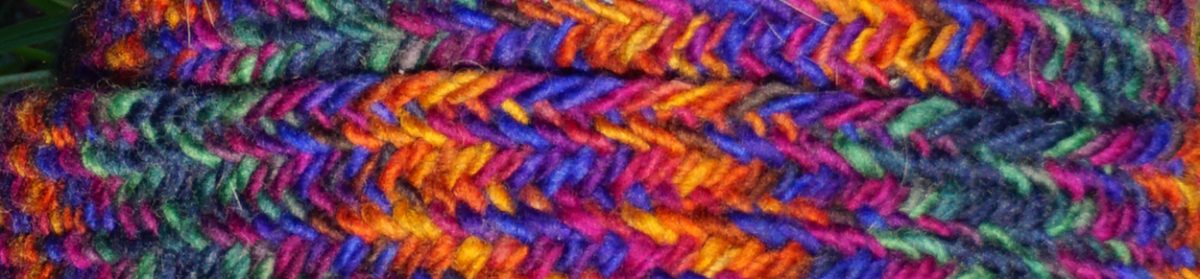
Sometimes nalbinding is combined with other techniques to make a artifact. My sincere thanks to Niina-Hannele Nuutinen for bringing this particular artifact to my attention. Generally the four-cornered hats of the Wari, from 8th-10th c. Peru, are knotted. This one is knotted with pile sides, but the top is Simple Looping. So this week’s Nalbound Object of the week is actually only partially nalbound.
1983.497.7 Wari four-cornered hat with Simple Looping top. Credit: The Metropolitan Museum of Art – Public Domain CC0
Object: Wari Four-cornered Hat with Simple Looping top
Description: A four-cornered brightly colored hat made with knotted pile in a lozenge pattern. The four corners have colored tassels. The top is Simple Looping worked in four differently colored bands from the sides of the hat to the top. The hat is 5 1/2 inches high and 5 3/4 inches wide (14 × 14.6 cm).1
Find location: The Wari culture was centered in the central Peruvian highland valley of Ayacucho. Wari pile hats with provenance come from the south or central coast of Peru.3 The exact provenance of this hat is unspecified.
Stitch(es) used: Larkshead Knotting with supplementary pile sides5 with Z-crossed Simple Looping, F1 O, in for the top (Top stitch determination by Anne Marie Decker from photographs)
Please note that sharing to other venues will likely be intermittent. If you wish to receive these each week, please remember to follow the blog. Patrons on Patreon receive early access previews, occasional extra details, and priority requests.
In the 1750’s, Erik Säterbeck crafted a beautiful pair of long mittens for the Vasa museum at Ornässtugan, commissioned by Jacob Brandberg. Made of brown and white wool, with intricate red embroidery, these mittens were displayed for 200 years before going to the Livrustkammaren’s conservation studio in the 1950s. They are now in Stockholm’s Livrustkammern.
It’s not often that we know the name of the person that nalbound a particular artifact. Especially not for an artifact made in the 18th century. However, this week’s Nalbound Object of the Week is a beautiful pair of long mittens made in the 1750’s by Erik Säterbeck. The mittens were commissioned by Jacob Brandberg to accompany the Morakarlen’s robes made for the Vasa museum he established in the Ornässtugan where Gustav Vasa ostensibly spent the night during his time in Dalarna in the early 1520’s.1 The mittens were on display for around 200 years before they were sent to the Livrustkammaren’s conservation studio in the 1950’s.
Object: Brown and white, embroidered mittens for the Morakarl exhibition.
Description: Long, brown wool mittens, with a wider white cuff embroidered with red thread in a wide band. The mittens are just under 26 inches long, 660 mm, and just under 9 1/2 wide, 240 mm.2
Stitch(es) used: Misidentified as knitted6 in the museum catalog, this pair appears to be made using the Dalby stitch, F1 UOU/OUOO, based on the images.7 (Stitch identification by Anne Marie Decker based on photographs)
Credit: Livrustkammaren, Livrustkammaren/SHM (CC0)Credit: Livrustkammaren, Livrustkammaren/SHM (CC0)A close-up of the red embroidery on the cuff. Credit: Livrustkammaren, Livrustkammaren/SHM (CC0)
Additional photos of the embroidery are on SHM’s site here and here.
Some sources in which more information can be found: There is a literature reference in the online catalog and additional literature references as well as additional photos are included in:
Morakarlen’s garments, including two pairs of nalbound mittens in the upper left. You can clearly see that the embroidery on the white cuff of the brown mittens is red. Credit: Livrustkammaren, Livrustkammaren/SHM (CC BY 4.0)
Please note that sharing to other venues will likely be intermittent. If you wish to receive these each week, please remember to follow the blog. Patrons on Patreon receive early access previews, occasional extra details, and priority requests.
Continuing the purple theme, this week’s Nalbound Object of the Week returns to Peru with another figural topped hat. This time we have a single bird topping a purple and white/natural striped child’s cap made of wool and cotton.
One of five photos, and an omnidirectional option, available on the Krzysztof Babraj (Archaeological Museum in Kraków‘s online catalog entry for this cap. Photo: Małopolski Instytut Kultury w Krakowie – Public Domain
Object: Purple & White cap with Bird
Description: A small purple cap with two white/cream stripes of equal thickness that has a bird worked also in Simple Looping perched on top.
Photographs (if permissions allow): There is an omnidirectional view on the museum’s website where you can rotate the hat.
ECHO Historical Textile posted some beautiful photos of the cap (conserved? reconstructed?) on display that is clearly visibly purple and has less damage to the bird.
Please note that sharing to other venues will likely be intermittent. If you wish to receive these each week, please remember to follow the blog. Patrons on Patreon receive early access previews, occasional extra details, and priority requests.
Since the purple fragment went over so well last week, I thought that I would share this purple Roman Era Egyptian sock as this week’s Nalbound Object of the Week. It was excavated from the Christian burial grounds of Oxyrhynchus, present-day al-Bahnasa, by the Egypt Exploration Fund in the 1896-71 excavation season.
Description: A piece dyed2 purple (red and blue) split-toed sock for the left foot with a tongue and lacing loops closure, currently sewn through the tongue, and knit/purl ribbed patterning on the upper ankle cuff. Measurements on the online catalog record, length approximately 21.5cm, width approximately 8.4cm, and height approximately 10cm,3 reflect a sock that would fit a US Children’s size 3, Women’s 4.5.
Find location: The Christian burial grounds of Late Roman Era Oxyrhynchus.5 The present-day city of al-Bahnasa in Egypt.
Material: S2Z plied wool.6 Originally a light natural color, the sock was piece dyed red and blue, resulting in a purple sock.
Stitch(es) used: S-crossed Cross-knit Looping variant of nalbinding.7 Gauge is reported as 9 stitches per inch by 12 rows per inch8 or 3-4 stitches by 5 rows to the centimeter.9
Some sources in which more information can be found:
Burnham, Dorothy K. “Coptic Knitting: An Ancient Technique” in Textile History, Vol. 3 December 1972. edited by K. G. Ponting and Dr S. D. Chapman. The Pasold Research Fund LTD, England, 1972; pgs. 116-124. No ISBN/ISSN provided. DOI: 10.1179/004049672793692237
De Moor, Antoine, Cäcilia Fluck, M. Van Strydonck, and M. Boudin. “Radiocarbon dating of Late Roman woolen socks from Egypt,” In Textiles, tools and techniques of the 1st millennium AD from Egypt and neighbouring countries. Proceedings of the 8th conference of the research group ‘Textiles from the Nile Valley,’ Antwerp, 4-6 October 2013, ed. Antoine De Moor, Cäcilia Fluck, and Petra Linscheid, p. 131-136. Tielt: Lannoo Publishers, 2015. ISBN 9789401432405.
Kendrick, A. F. Catalogue of Textiles From Burying-Grounds in Egypt: Vol. II. Period of Transition and of Christian Emblems. Victoria and Albert Museum, Department of Textiles. London: Publ. under the Authority of His Majesty’s Stationery Office, 1921. No ISBN.
Köstner, Barbara. “Roman and Late Roman nalbinding socks from Egypt: Bringing ‘Egyptian fashion’ to the North” in Excavating, analysing, reconstructing: Textiles of the first millennium AD from Egypt and neighbouring countries. Proceedings of the 9th conference of the research group ‘Textiles from the Nile Valley’, Antwerp, 27-29 November 2015. ed. by Antoine De Moor, Cäcilia Fluck, and Petra Linscheid. Tielt: Lannoo Publishers, 2017. ISBN 9789401443999.
Photographs:
There are a few additional photos in the museum’s online catalog entry.
Please note that sharing to other venues will likely be intermittent. If you wish to receive these each week, please remember to follow the blog. Patrons on Patreon receive early access previews, occasional extra details, and priority requests.
Kendrick, Catalogue of Textiles From Burying-Grounds in Egypt: Vol. II. Period of Transition and of Christian Emblems. 1921. pg. 88. ↩︎
The sock appears to have been dyed after it was created instead of dying the wool and then nalbinding the sock. The interior of the yarn is still a light natural color and the red and blue appear to be on the surface only. ↩︎
Today’s Nalbound Object of the Week is the Dublin fragment E190:7430. It is a purple nalbound fragment that is not large enough to give any indication of its original size, form, or function. It was found outside a house dated to the 10th century in the excavations of Viking Age Dublin carried out by the National Museum of Ireland from 1962 to 1981. Frances Pritchard had the opportunity to examine the textiles found and published an article in 1992 entitled “Aspects of the Wool Textiles from Viking Age Dublin” which includes most of what is known about this fragment (including the only published photograph). 1
Image of a portion of the Dublin fragment with one row of stitches highlighted in a rainbow progression by Anne Marie Decker. Base photo provided by Frances Pritchard is a slightly tighter image than that published in her article “Aspects of the Wool Textiles from Viking Age Dublin” taken by Jon Bailey, Historic Buildings and Monuments Commission for England.
Object: Dublin fragment
Description: Original size unknown. Current size unknown, but the photo published in Frances Pritchard’s article is scaled 2:1.2 That published photo does not show the complete fragment, so the complete dimensions cannot be calculated. It is the only nalbound example found amongst the hundreds of wool textiles and a good number of silk textiles found during the excavations.3
Color: Dye analysis by Penelope Walton indicates it was dyed with lichen purple4
Dated to: The excavations date to Viking Age Dublin, c. 917 to 1169 CE.
Material: Two-ply Z/S-ply7 wool yarn.8 Diameter calculates to approximately 1-1.5 mm based on the photograph and scale.
Gauge: Row height calculates to roughly 0.75 cm and there are approximately 3.5-4 stitches to the cm based on the photograph and scale. It’s a fairly open worked binding.
Stitch(es) used: The stitch used has not been formally determined by examination as the fragment is currently inaccessible.9 My examination of the photo available leads me to believe that it is the stitch colloquially referred to as half-York, but could better be called Dublin stitch: F2 U/OO.
Further research is indicated. At the time of Frances Pritchard’s article, it was thought that nalbinding was only usual in Scandinavian and Baltic countries of the time and thus probable it was made by a Scandinavian settler, much like the Coppergate Sock found in York.10 Of the other known Viking Era finds in Scandinavia, none use York family style intralacing. The York family style intralacing is found in similar stitches in Egypt, France, Spain, and Greece so far. Thus the nalbound artifacts in the Isles may have more in common with the nalbinding of Southern Europe/North Africa than of Scandinavia.
Link to museum catalog or other data: The National Museum of Ireland does not have online catalog information for this artifact.
Some sources in which more information can be found:
Pritchard, Frances. “Aspects of the Wool Textiles from Viking Age Dublin” in Archaeological Textiles in Northern Europe Report from the 4th NESAT Symposium 1. – 5. May 1990 Copenhagen, edited by Lise Bender Jorgensen & Elisabeth Munksgaard, Tidens Tand, Nr. 5, 1992, pages 93-104. Copenhagen: Kongelige Danske Kunstakademi, 1992. ISBN 87-89730-04-6.
Wallace, Patrick F. Viking Dublin: The Wood Quay Excavations. Irish Academic Press, 2016. ISBN 978-07165-3314-6. (A brief mention of the fragment is found on page 263.)
Photographs: There are no photos in the National Museum of Ireland’s Image Library for this reference or reg number.12 The only known image is the partial one published in Frances Pritchard’s article.
Documenting attempts to determine the stitch variant used:
In 2016, Katherine Walsh, posted to the Nalbinding Facebook group asking if anyone knew which stitch was used to make this fragment.13 Her initial thought was maybe Oslo, but she wasn’t sure. At the time, I suggested Loop & Twist with a carried thread and connecting around the post instead of in between stitches as the fragment shows a very distinctly vertical wale, not the diagonal more commonly found in Loop & Twist. Not long after this, I realized that it was not Loop & Twist, but U/OO F2 instead.
Katherine provided several samples testing out the theory which she later appears to have developed into a small handout entitled “Nalbinding in Fishamble Street.”14
In April 2019, Kathrine posted in the Léine Medieval Crafters Facebook Group showing some further experimentation including the back side of her theoretical construction which clearly shows the “purl” effect of the F2B connection.15 This type of connection to the previous row is sometimes referred to as encircled.16
The Loop & Twist theory unfortunately does not seem to have quite the correct angles to match the image of the Dublin fragment.
Further experimentation led me to believe that the Dublin fragment is most likely U/OO F2. It’s the F2 connection that causes the vertical stacking on the intraconnections. If it is U/OO F2, that is actually quite interesting as it is very similar to the York17 stitch (UU/OOO F2), only off by one loop, which is, in and of itself, and as a family style of intralacing, unusual in the Scandinavian corpus.
Debbie Bradley Lauf seems to have independently come to a similar conclusion. She has noted that a scarf she finished looks similar to the structure of the Dublin fragment. I think the resemblance would be greatly enhanced by working with a two-ply yarn and working in the round instead of flat, but you can see her scarf here: https://www.facebook.com/groups/644499622267562/permalink/3444789742238522/ Sept. 1, 2020.
Please note that sharing to other venues will likely be intermittent. If you wish to receive these each week, please remember to follow the blog. Patrons on Patreon receive early access previews, occasional extra details, and priority requests.
Page 102 of Frances Pritchard’s “Aspects of the Wool Textiles from Viking Age Dublin” in Archaeological Textiles in Northern Europe Report from the 4th NESAT Symposium 1. – 5. May 1990 Copenhagen, edited by Lise Bender Jorgensen & Elisabeth Munksgaard, Tidens Tand, Nr. 5, 1992, pages 93-104. Copenhagen: Kongelige Danske Kunstakademi, 1992. ISBN 87-89730-04-6 contains the photo attributed to Jon Bailey, Historic Buildings and Monuments Commission for England. ↩︎
Pritchard “Aspects of the Wool Textiles from Viking Age Dublin” Pg. 102 ↩︎
Frances Pritchard in personal correspondence in September of 2020. ↩︎
Pritchard “Aspects of the Wool Textiles from Viking Age Dublin” Pg. 102 ↩︎
Frances Pritchard in personal correspondence in September of 2020. ↩︎
Pritchard “Aspects of the Wool Textiles from Viking Age Dublin” Pg. 102 ↩︎
Pritchard “Aspects of the Wool Textiles from Viking Age Dublin” Pg. 93 ↩︎
Frances Pritchard in personal correspondence in September of 2020. ↩︎
Pritchard “Aspects of the Wool Textiles from Viking Age Dublin” Pg. 102 ↩︎
In August of 2019, Emma Boast commented, on another Facebook post inquiring about the Dublin fragment, that she had reached out to the National Museum of Ireland and was “was told they don’t currently know where it is within the collections.” [Emma Boast writing as Bruni Bear at the time, in the comments of: https://www.facebook.com/groups/644499622267562/posts/2583805478336957/]. Confirmed with Frances Pritchard in personal correspondence in September of 2020. ↩︎
Personal correspondence with the Image Library Officer dated 18 March 2024. ↩︎
Primarily demonstrated with Cross-knit Looping, see Looping: 9. Encircled Looping on pages 17 & 18 of Seiler-Baldinger, Annemarie. Textiles A Classification of Techniques. Washington: Smithsonian Inst, 1994. ISBN 1-56098-509-7, Encircled isn’t a stitch per se, but a method of connection to the adjacent row. ↩︎
Having had an excuse to go to Norway, I had to go to Trondheim to see our next Nalbound Object of the Week. Found in a pre-1300 CE context, the Nidaros stocking is one of the earliest knee length nalbound stockings found.
The stocking is laid out horizontally with the upper portion of the foot to the left of the photograph, toe up. The leg still has folds, but likely reached the knee. A high resolution photo is available via the link in the online catalog. Photo: Ole-Aleksander Ulvik, NTNU Vitenskapsmuseet CC BY-SA 4.0
Object: Nidaros Stocking
Description: A nearly complete full stocking from toes to the knee. The sock shows heavy fulling, though if that was intentional or from wear or find circumstances is unknown. There are 4 holes that show evidence of compression near them. The areas away from the holes are a significantly darker color, have a layer of fibers obscuring the nalbinding, and are noticeably stiffer and not flexible.
Find location: Field S of the Søndre Gate 4 dig in medieval Nidaros, modernly Trondheim, Norway. More specifically it was found under the floorboards of a pre-1300 house in the wealthy blocks of the city.3
Stitch(es) used: Further examination is necessary given the condition of the textile. However, the surface texture most closely resembles the stitch known as Dalby, F1 UOU/OUOO.
Some sources in which more information can be found:
In 2020, there was a Facebook post by the Nidaros Archaeological Archive (NIDARK) project with a photograph of the stocking and some information regarding its excavation. I’d share it with you, but within this last year, that post has since disappeared along with all of the rest of the NIDARK Facebook page posts. Nonetheless, that project and its posts led me to this fabulous artifact.
Photographs:
Detail of the cuff of the Nidaros Stocking showing one of the holes. Photo: Anne Marie Decker 2024Examination day is always so exciting! Photo: Anne Marie Decker 2024The Nidaros Stocking was found in excavations under this street. Photo: Anne Marie Decker 2024
Acknowledgements: My sincerest thanks to the NTNU Vitenskapsmuseet and especially to Torkel Johansen, Curator, and Frances Lucas Lukezic, Conservator for their assistance during my study visit.
Please note that sharing to other venues will likely be intermittent. If you wish to receive these each week, please remember to follow the blog. Patrons on Patreon receive early access previews, occasional extra details, and priority requests.
Per discussions with Torkel Johansen, curator at the Institutt for arkeologi og kulturhistorie, NTNU Vitenskapsmuseet during my study visit on 16 April 2024. ↩︎
Per discussions with Torkel Johansen, curator at the Institutt for arkeologi og kulturhistorie, NTNU Vitenskapsmuseet during my study visit on 16 April 2024. ↩︎
Last week I had the distinct pleasure to go visit a well known mitten that rather recently has been placed on display again in the NOREGR – Medieval Stories exhibition at the Historical Museum in Oslo. And thus, the Oslo mitten joins the Nalbound Object of the Week series.
Anne Marie Decker pointing to the Oslo mitten on display in the Historical Museum in Oslo. Photo Anne Marie Decker 18 April 2024
Object: Oslo Mitten
Description: An adult sized mitten made of wool with damage at the base of the thumb and palm areas.
Dated to: 11th century,1 medieval. Ca. 1025-1125 CE2
The exhibition label for the Oslo mitten in the NOREGR – Medieval Stories exhibition at the Historical Museum in Oslo. Photo: Anne Marie Decker 18 April 2024.
Find location: The mitten was found during the 1926 excavation of the old town of Oslo on a layer of wood chips under the wooden flooring of a narrow passage between houses. This part of town was built in the 11th century.3
Stitch(es) used: Nordland published the stitch used as 412 in his classification system5 which most likely translates to the stitch commonly known as Oslo and classified in Hansen’s notation as UO/UOO F1. However, further examination is warranted as the surface texture does not match. The surface texture more closely resembles the Mammen stitch, F2 UOO/UUOO.
Some sources in which more information can be found:
Claßen-Büttner, Ulrike. Nadelbinden – Was ist denn das? Geschichte und Technik einer fast vergessenen Handarbeit. Norderstedt: Books on Demand GmbH, 2012. ISBN 978-3-8482-0124-2.
Claßen-Büttner, Ulrike. Nalbinding – What in the World Is That? History and Technique of an Almost Forgotten Handicraft. Norderstedt: Books on Demand, 2015. ISBN 978-3-7347-7905-3.
Nordland, Odd. Primitive Scandinavian Textiles in Knotless Netting. Studia Norvegica no. 10. Oslo: Oslo University Press, 1961. No ISBN listed in Book.
Photographs:
The museum catalog has 3 very nice zoomable photos. The two color photos are of one side and the black and white of the other.
Oslo Mitten. Photo: Anne Marie Decker 18 April 2024Detail of the thumb of the Oslo Mitten. Photo: Anne Marie Decker 18 April 2024The display case in which the Oslo mitten is currently located in the NOREGR – Medieval Stories exhibition. Photo: Anne Marie Decker 18 April 2024Detail of the cuff of the Oslo Mitten. Photo: Anne Marie Decker 18 April 2024
Please note that sharing to other venues will likely be intermittent. If you wish to receive these each week, please remember to follow the blog. Patrons on Patreon receive early access previews, occasional extra details, and priority requests.
While preparing last week’s Nalbound Object of the Week, I discovered another fascinating piece of nalbinding in the MAK. This week brings us a new (to me) Peruvian cap with figural work on it. In this case, it’s a lizard! You will need to go to the MAK’s online catalog to see a photo, https://sammlung.mak.at/sammlung_online?id=collect-100216, as the MAK’s photos are not CC or public domain.
Object: Cap with Lizard
Description: A brown cap with a row and the central top in cream and brown lizard with cream highlights standing on top.
Please note that sharing to other venues will likely be intermittent. If you wish to receive these each week, please remember to follow the blog. Patrons on Patreon receive early access previews, occasional extra details, and priority requests.
For this week’s Nalbound Object of the Week we get to get to see what is thought to be the earliest archaeological artifact to have its stitch analyzed, a sock from Egypt. Photos of nalbinding from the late 1800’s are rather rare. In this case, we also have the opportunity to see a more recent photo in the online catalog of the MAK in Vienna.
Fig. 28 from Antike Handarbeiten published in 1895.
Object: Sock from Saqqâra, Egypt
Description: A white wool sock with a black/dark brown toe and over the arch worked in a finer black/dark brown wool and a row of red wool at the cuff. The sock has a single wedge style heel and stops at the ankle. Current photos show that it has taken some damage since 1895 as the dark toe is nearly entirely missing and several rows near the cuff also show damage. Otherwise, it is in apparently the same position as it was when the first photograph was taken.
Dated to: 6th century
Find location: Saqqâra, Egypt
Earliest diagrams of nalbinding as analyzed from an artifact. Figs. 30-32 from Antike Handarbeiten published in 1895. Highlights by Anne Marie Decker
Material: Wool
Stitch(es) used: Mammen, F2 UOO/UUOO. Luise Schinnerer diagrammed the stitch found in this sock, but did so in a manner that while it produces the correct final structure, is opposite the direction in which we work this stitch today.
Inventory number: T 564
Current location: Museum für angewandte Kunst MAK (Museum of Applied Arts)
Some sources in which more information can be found:
Schinnerer, Luise. Antike Handarbeiten. Mit einer histor. Einleitung von Alois Riegl. Wien: Waldheim, 1895. [No ISBN]
Collin, Maria; ‘Sydda vantar’ in Fataburen; 1917; pgs. 71-78.
Noever, Peter ed. Verletzliche Beute: spätantike und frühislamische Textilien aus Ägypten = Fragile remnants : Egyptian textiles of late antiquity and early Islam. on the occasion of the “Verletzliche Beute/Fragile remnants exhibition” MAK Vienna, 07.12.2005-05.06.2006 Ostfildern-Ruit: Hatje Cantz, 2005. ISBN 3-7757-1699-8.
Gagneux-Granade, Marguerite, and Anastasia Ozoline. “Quelques objets surprenants en textile non tissé dans les réserves du musée Bénaki” in ΜΟΥΣΕΙΟ ΜΠΕΝΑΚΗ 9, 2009 (Athens 2010): 99-111. doi:http://dx.doi.org/10.12681/benaki.13
Please note that sharing to other venues will likely be intermittent. If you wish to receive these each week, please remember to follow the blog. Patrons on Patreon receive early access previews, occasional extra details, and priority requests.
The famous sock from Uppsala is not the only nalbinding found in Uppsala. This week’s Nalbound Object of the Week are the fragments of what is believed to be another sock. This one found in the Kransen quarter of Uppsala. I was graciously allowed access to examine these fragments at the Statens Historiska Museet in May of 2023. Some of what you see in the box is moss.
Image of the fragments of 34821, cropped to remove excess background. Upphov: Rosengren, Helena, Historiska museet/SHM (CC BY 4.0)
Object: Kransen sock fragments
Description: Nine fragments of what is believed to be a sock.1
Some sources in which more information can be found:
Gustafsson, Jan Helmer, and Ola Ehn. Kransen: ett medeltida kvarter i Uppsala. Uppsala: Upplands fornminnesfören, 1984. ISBN 91-85618-21-7.
Photographs (if permissions allow):
Please note that sharing to other venues will likely be intermittent. If you wish to receive these each week, please remember to follow the blog. Patrons on Patreon receive early access previews, occasional extra details, and priority requests.
Gustafsson, Jan Helmer, and Ola Ehn. Kransen: ett medeltida kvarter i Uppsala. Uppsala: Upplands fornminnesfören, 1984. Pg. 76. ISBN 91-85618-21-7. ↩︎
Gustafsson, Jan Helmer, and Ola Ehn. Kransen: ett medeltida kvarter i Uppsala. Uppsala: Upplands fornminnesfören, 1984. Pg. 8. ISBN 91-85618-21-7. ↩︎