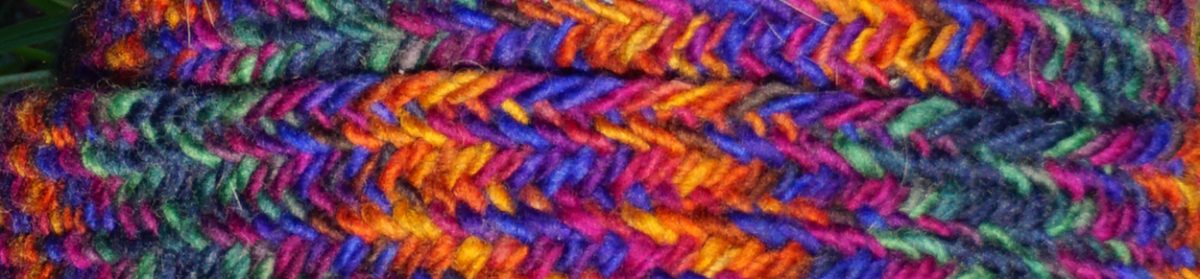
The Nalbound Object of the Week this week is a small fragment of vegetal fiber found in Chile. The fragment has two types of Loop & Twist, both Z-crossed.
Please note that sharing to other venues will likely be intermittent. If you wish to receive these each week, please remember to follow the blog. Patrons on Patreon receive early access previews, occasional extra details, and priority requests.
I hope everyone’s winter holiday season is going well and that the new year be all you need it to be. For this week’s Nalbound Object of the Week we got a viscacha figure/effigy. I love these because viscachas are sooo cute! (I’ve included a picture of a live viscacha below for those of us less familiar with what exactly one looks like.)
Description: Worked in yellow and dark brown yarn, the figure includes the pointed ears, nose, and long tail of a viscacha. Overall: 7.5 x 1 x 1.7 cm (2 15/16 x 3/8 x 11/16 in.)1
Stitch(es) used: Looping.5 S-crossed and Z-crossed Simple Looping depending on which part of the viscacha (as determined by Anne Marie Decker based on the photograph)
Please note that sharing to other venues will likely be intermittent. If you wish to receive these each week, please remember to follow the blog. Patrons on Patreon receive early access previews, occasional extra details, and priority requests.
For a person that has spent a lot of time examining stockings, this is an excellent time of the year. The Museum der Kulturen Basel has the largest collection of Egyptian nalbinding1 and they just recently put their entire collection online. So this week’s Nalbound Object of the Week is one of my favorite of the children’s socks.
Object: Child’s sock with orange, blue and yellow stripes – III 15474
Description: The sock is striped with blue, orange, and yellow stripes and a natural (now cream) base that shows mostly in the wedge heel. It has a relatively short, undifferentiated, toe box with a rather large wedge heel. The ankle is damaged and its true height unknown. Length 17 cm2
Dated to: 4th century ?3 CE (This is a very old art historical based dating. There has been no scientific dating of compound Egyptian nalbound socks. More recent excavations are finding compound nalbound socks in 11th century layers. I would dearly love to have a few of these radiocarbon dated as exactly when compound nalbinding began cannot be determined without solid dating.)
Some sources in which more information can be found:
Böttcher, Gudrun. “Koptische Nadelbindungstextilien im Museum der Kulturen Basel” in Experimentelle Archäologie in Europa: Bilanz 2004 Heft 3. edited by Corinna Endlich. Oldenburg: Isensee Verlag, 2004: 211-214. ISBN 3-89995-204-9.
Please note that sharing to other venues will likely be intermittent. If you wish to receive these each week, please remember to follow the blog. Patrons on Patreon receive early access previews, occasional extra details, and priority requests.
That we know of so far because I am certain there are more socks out there in boxes and the backs of drawers that haven’t been opened in a century. ↩︎
Böttcher writes it as Stitch Type: III and Stitch Variant: F(L) 2 UOO/UUOO. Böttcher, Gudrun. “Koptische Nadelbindungstextilien im Museum der Kulturen Basel” in Experimentelle Archäologie in Europa: Bilanz 2004 Heft 3. edited by Corinna Endlich. Oldenburg: Isensee Verlag, 2004: 211-214. ISBN 3-89995-204-9. pg 213. ↩︎
This week’s Nalbound Object of the Week is a striking Peruvian hat worked in Cross-knit Looping in a distinctive chevron pattern. While there are quite a few hats found in Peru, both in Simple Looping and in Cross-knit Looping, this is the first I’ve come across with this Chevron patterning.
Please note that sharing to other venues will likely be intermittent. If you wish to receive these each week, please remember to follow the blog. Patrons on Patreon receive early access previews, occasional extra details, and priority requests.
This week I get to share with you the excitement of finding out about a rare find in a church I once visited. Some regions have preserved many finds, but textiles in Ireland are relatively rare and nalbound ones more so. Thus this week’s Nalbound Object of the Week is the second known nalbound artifact from Ireland. The fragments were found in the 12th century occupational debris. Photos have been published this year in Textiles of Ireland: Archaeology, Craft, Art by Elizabeth Wincott Heckett if you would like to see them. There’s also a nice diagram in 2006 Archeological Monograph on the excavations.
St Audoen’s Church & Visitor center when we visited on April 27, 2014. Photo credit: Anne Marie Decker
Object: Two main fragments. Usage unknown, but possibly a sock or cap.
Description: The larger fragment is 30 cm long by 8 cm high1 showing the remains of 6 rows. The smaller fragment is 6 cm long by 5 cm high2 with remains of 3+ rows. The thickness of both is c. 2mm.3 Original use as a mitten was ruled out as the length of the larger fragment would exceed the circumference appropriate for a mitten and is more suitable for a sock or a piece of a cap.4 There is no evidence of either intentional or wear fulling.5
Find location: Found in the 12th century occupation debris associated with timber structures during excavation of St. Audoen’s church, Cornmarket, Dublin, Ireland.7
Material: A dark brown, naturally colored, coarse, perhaps kemp-like, wool. No dye detected. The yarn has been combed and worsted spun in a medium to loose Z spin then two-plied with an S twist. The yarn is 1.5 mm in diameter.8
Stitch(es) used: uo o/u uoo F1 based on analysis of one of the outermost rows of loops.9 (Korgen)
Inventory number: E497:2428.325
Current location: Still tracking that down. The detailed catalog was lodged with the excavation archive in the Department of the Environment, Heritage and Local Government. Some of the items excavated at St Audoen’s remain there on display in their Visitor’s Centre.
Link to museum catalog or other data: none known
Some sources in which more information can be found:
Wincott Heckett, Elizabeth. “Textiles” in the Archaeological Finds chapter of St Audoen’s Church, Cornmarket, Dublin: Archaeology and Architecture by Mary McMahon. Dublin: The Stationary Office, Government of Ireland, 2006. ISBN 0-7557-7315-2
Wincott Heckett, Elizabeth. Textiles of Ireland: Archaeology, Craft, Art. Edited by Mary Ann Williams. Cork: Cork University Press, 2025. ISBN 9781782055716
There is also an archeological drawing contained the the archeological monograph, St Audoen’s Church, Cornmarket, Dublin: Archaeology and Architecture, by Mary McMahon: Fig. 6.9 on page 74.
If you find this type of content interesting, please remember to follow the blog. You can also give one time donation at the link on this site or join my Patreon to support further research. Patrons on Patreon receive early access previews, occasional extra details, and priority requests.
300 x 80mm. Wincott Heckett, Elizabeth. “Textiles” in the Archaeological Finds chapter of St Audoen’s Church, Cornmarket, Dublin: Archaeology and Architecture by Mary McMahon. Dublin: The Stationary Office, Government of Ireland, 2006. ISBN 0-7557-7315-2 page 74 and republished in Wincott Heckett, Elizabeth. Textiles of Ireland: Archaeology, Craft, Art. Edited by Mary Ann Williams. Cork: Cork University Press, 2025. ISBN 9781782055716. pg. 230 ↩︎
60 x 50mm. Wincott Heckett, Elizabeth. “Textiles” in the Archaeological Finds chapter of St Audoen’s Church, Cornmarket, Dublin: Archaeology and Architecture by Mary McMahon. Dublin: The Stationary Office, Government of Ireland, 2006. ISBN 0-7557-7315-2 page 74 and republished in Wincott Heckett, Elizabeth. Textiles of Ireland: Archaeology, Craft, Art. Edited by Mary Ann Williams. Cork: Cork University Press, 2025. ISBN 9781782055716. pg. 230 ↩︎
Wincott Heckett, Elizabeth. “Textiles” in the Archaeological Finds chapter of St Audoen’s Church, Cornmarket, Dublin: Archaeology and Architecture by Mary McMahon. Dublin: The Stationary Office, Government of Ireland, 2006. ISBN 0-7557-7315-2 page 75 and republished in Wincott Heckett, Elizabeth. Textiles of Ireland: Archaeology, Craft, Art. Edited by Mary Ann Williams. Cork: Cork University Press, 2025. ISBN 9781782055716. pg. 232 ↩︎
The figural work found in the decorative borders made by the Nazca people is stunningly beautiful and detailed. This week’s Nalbound Object of the Week is a beautiful sample of their cross-knit looped borders. This fragment has three very distinct figures. The Art Institute of Chicago’s website has very nice closeups of both sides and a very good zoom function if you’d like to see more.
Nazca. Fragment of a Decorative Border, 100 BCE-200 CE. The Art Institute of Chicago® CC0 Public Domain
Object: Fragment of a Decorative Border 1956.405
Description: A border fragment with three figures. The figures are about 2.5 inches tall. The piece is 11.4 × 6.7 cm (4 1/2 × 2 5/8 in.)1
Stitch(es) used: The band’s ground support is plain weave and the extension supports are simple looping. The ground is encased in the decorative cross-knit looping6
Some sources in which more information can be found:
Sawyer, Alan R. Early Nasca Needlework. London: Laurence King Publishing, 1997. pg. 149, fig. 119 and 120 (ill.).
Melo, Alipio, María José Murillo, and Danitza Willka. “The Heartbeat of Andean Weaving,” in On Loss and Absence: Textiles of Mourning and Survival, eds. Isaac Facio, Nneka Kai, L Vinebaum, and Anne Wilson, exh. cat. Chicago: Art Institute of Chicago, 2025. pg. 164, fig. 3 (ill.).
Photographs (if permissions allow):
Please note that sharing to other venues will likely be intermittent. If you wish to receive these each week, please remember to follow the blog. Patrons on Patreon receive early access previews, occasional extra details, and priority requests.
This week’s Nalbound Object of the Week is an Egyptian Sock that is currently located in the National Museum of Ireland. Early online photos of the sock were taken at such an angle that the toe split was not visible. This led to mistaken impression that this sock was the only adult cross-knit looping (Coptic stitch) nalbound sock with a single toe box. I was lucky enough to come across this sock on display in April of 2014, so I had seen in person that it did have a split toe to accommodate sandals. In fact, out of the 49 or so cross-knit looped nalbound Egyptian socks we have images of and are whole enough to tell, only the tiniest baby socks for not yet mobile infants do not have split toes.
Description: A now light brown wool sock for the left foot with a split at the ankle and ties still remaining. There is a decorative welt around the ankle where the heel cup shifts to the ankle. Height 9cm, width 8cm, Length 22 cm.1 The sock arrived at the National Museum of Ireland as part of the distributions the Egypt Exploration Fund in 1914.2
Rose-Beers, Kristine. (2023). The Threads that Bind: Evidence of the Early Codex Structure in Chester Beatty’s Papyri. DOI 10.1515/9783110781304-009.
Photographs: There are two additional views of the sock available on the National Museum of Ireland’s website. The view that obscures the split toe can be seen on The Global Egyptian Museum.org site.
Please note that sharing to other venues will likely be intermittent. If you wish to receive these each week, please remember to follow the blog. Patrons on Patreon receive early access previews, occasional extra details, and priority requests.
Generally when we talk about nalbinding from the Southwest United States, we are talking about socks or shoe-socks or possibly leggings. This week’s Nalbound Object of the Week is unusual in that it is a cap. When the excavations were published in 1919, it was the only textile cap to have been found in the Southwest.
Description: A natural colored cap worked from the center down.
Dated to: No date provided, but the Cliff-dweller culture is believed to come after the Basket-maker culture. Estimate Pueblo III (1150–1350).
Find location: Cliffhouse 22 / Ruin 2 in Sayodneechee Canyon (“Where the red rocks run under” in Navajo)3
“At g, just outside one of the rooms and beneath 8 inches of closely packed rubbish, lay a cap of yucca yarn.”4
Material: Sometimes referred to as made of yucca cord5 (narrow leaf yucca), but there is also a mention that the cap is likely apocynum (Dogbane/Indian Hemp) fiber6
Stitch(es) used: Z-crossed Simple Looping7 called coiled work without foundation8 in the excavation report. “Near the edge there are 9 coils and 5 loops to the inch, the stitches nearer the top are deeper and wider spaced.”9
Some sources in which more information can be found:
Kidder, Alfred Vincent, and Samuel J. Guernsey. Archeological Explorations in Northeastern Arizona. Smithsonian institution. Bureau of American Ethnology Bulletin 65. Washington D.C.: U.S. Government Printing Office, 1919. https://repository.si.edu/items/14df4b65-e141-4ea1-b541-3b2ac24e7fdf Accessed 13 November 2025.
Photographs (if permissions allow): There is a nice color photo of the cap on the Peabody Museum’s site.
Please note that sharing to other venues will likely be intermittent. If you wish to receive these each week, please remember to follow the blog. Patrons on Patreon receive early access previews, occasional extra details, and priority requests.
Kidder, Alfred Vincent, and Samuel J. Guernsey. Archeological Explorations in Northeastern Arizona. Smithsonian institution. Bureau of American Ethnology Bulletin 65. Washington D.C.: U.S. Government Printing Office, 1919. https://repository.si.edu/items/14df4b65-e141-4ea1-b541-3b2ac24e7fdf pg. 94 ↩︎
Kidder, Alfred Vincent, and Samuel J. Guernsey. Archeological Explorations in Northeastern Arizona. Smithsonian institution. Bureau of American Ethnology Bulletin 65. Washington D.C.: U.S. Government Printing Office, 1919. https://repository.si.edu/items/14df4b65-e141-4ea1-b541-3b2ac24e7fdf pg. 19 ↩︎
As determined by Anne Marie Decker based on the diagram in Kidder & Guernsey’s explorations and examination of the picture provided. ↩︎
Kidder, Alfred Vincent, and Samuel J. Guernsey. Archeological Explorations in Northeastern Arizona. Smithsonian institution. Bureau of American Ethnology Bulletin 65. Washington D.C.: U.S. Government Printing Office, 1919. https://repository.si.edu/items/14df4b65-e141-4ea1-b541-3b2ac24e7fdf pg. 100 ↩︎
This week’s Nalbound Object of the Week is a beautiful cross-knit looping example. A border of warriors and their sacrifice, originally intended to be attached to a piece of fabric. If you go to the The Art Institute of Chicago’s website there is a very good zoom function and some close-ups showing the underlying support worked in Simple Looping.
Nazca. Warrior Fragments, 100 BCE-200 CE. The Art Institute of Chicago® CC0 Public Domain
Object: Border of warriors
Description: A border of warriors and a sacrifice. The figures are about 2.5 inches tall. More details on The Art Institute of Chicago’s website.
Some sources in which more information can be found:
Sawyer, Alan R. Early Nasca Needlework. London: Laurence King Publishing, 1997. pg. 148, color fig. 117.
Photographs (if permissions allow):
Please note that sharing to other venues will likely be intermittent. If you wish to receive these each week, please remember to follow the blog. Patrons on Patreon receive early access previews, occasional extra details, and priority requests.
Nalbinding isn’t the only corpus that is spread out across many institutions. Recently a number of museums have added to their online collection databases and we are now able to see quite a few more blue and white knitted artifacts from Egypt.
In 2019 I had the opportunity to go to the Museum der Kulturen Basel to study the nalbinding they have in their collection. While there, they shared a few pieces of their blue and white knitting with me as well. As they were putting it away, I got hints that they had an extensive collection. The Museum der Kulturen Basel has just recently put their collection online and there are some amazing pieces. Their database does not have permalinks to individual artifacts, so you will need to search via the Object Number for more details on each piece: https://www.mkb.ch/en/museum/sammlung.html
Please note that sharing to other venues will likely be intermittent. If you wish to receive these each week, please remember to follow the blog. Patrons on Patreon receive early access previews, occasional extra details, and priority requests.