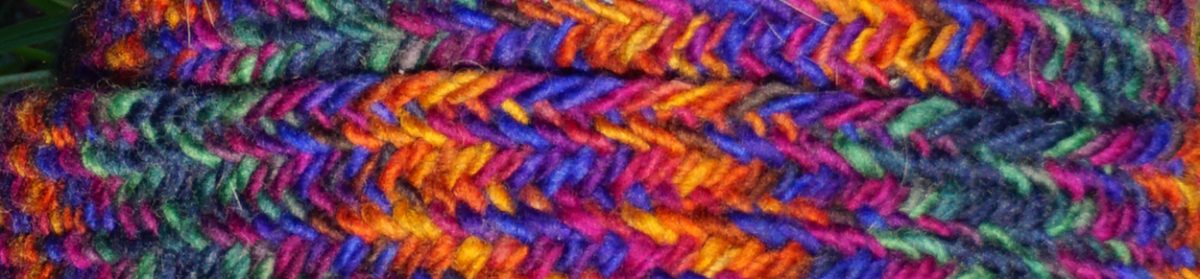
NOW: Leicester sock L.A63.1914.0.0

In 2019, my mother and I were able to travel to Leicester for a chance to see this week’s Nalbound Object of the Week; a small child’s sock from 3rd-5th century CE Antinoë/Antinoupolis. It was one of nearly a dozen found during John de Monins Johnson‘s excavations for the Egypt Exploration Fund1 in the 1913-14 season.

Leicester sock L.A63.1914.0.0
Photo credit: Anne Marie Decker 2019

Object: Leicester child’s sock

Description: Small child’s left split toed sock in many colors: green, red, purple, yellow, and blue. Comparables can be seen in my Charting the Nalbinding of the Nile presentation from 2019. At 9:39 in the recording linked in https://nalbound.com/2019/04/06/charting-the-nalbinding-of-the-nile /

Note: At the time of the excavations, the socks were presumed to be knitted as the differences between the crossed knitting and cross-knit nalbinding techniques had not yet been described.

Dated to: 300-500 CE2 (possibly earlier around the 3rd-4th centuries based on the radiocarbon dating of other socks found during the same excavation3)

Find location: Excavated from a rubbish pit at Sheikh Abada (ancient Antinoopolis), Egypt4

Material: wool5

Stitch(es) used: S-crossed Cross-knit Looping6

Inventory number: L.A63.1914.0.0

Current location: Leicester Museum and Art Gallery (formerly New Walk)

Link to museum catalog or other data:

Leicester Museum and Art Gallery does not have an online catalog. The sock is noted in their Collections Development Policy 2019-2024, section 3.5.2. “Although intended to be a representative selection, it includes at least one rarity, a Coptic knitted sock from Antinoe, the only example in this country outside of London.” This unfortunately reflects out of date information; the technique having been recognized as nalbinding, not knitting, in the last quarter of the last century and several examples from the same excavation are located in Britain, but outside of London. This does not, however, in any way negate its rarity and importance.

Some sources in which more information can be found:

Köstner, Barbara. “Roman and Late Roman nalbinding socks from Egypt: Bringing ‘Egyptian fashion’ to the North” in Excavating, analysing, reconstructing Textiles of the 1st millennium AD from Egypt and neighbouring countries: Proceeding of the 9th conference of the research group ‘Textiles from the Nile Valley’ Antwerp, 27-29 November 2015, edited by Antoine De Moor, Cäcilia Fluck, and Petra Linscheid. Tielt, Belgium: Lannoo Publishers, 2017. ISBN 978 94 014 4399 9.

O’Connell, Elisabeth R. “John de Monins Johnson’s 1913/14 Egypt Exploration Fund expedition to Antinoupolis (Antinoë)” In Antinoupolis II: Scavi e materiali III, ed. R. Pintaudi, 415–66. Florence: Istituto Papirologico G. Vitelli, 2014.

Pritchard, Frances. “A survey of textiles in the UK from the 1913-14 Egypt Exploration Fund season at Antinoupolis” in Drawing the Threads Together: Textiles and Footwear of the 1st Millenium AD from Egypt. Proceedings of the 7th Meeting of the Study Group ‘Textiles from the Nile Valley”, Antwerp, 7-9 October 2011, edited by Antoine De Moor, Cäcilia Fluck, and Petra Linscheid, 34-55. Tielt: Lannoo, 2013. ISBN 9789401410830.

Rutt, Richard. A History of Hand Knitting. London: B T Batsford Ltd, 1987 ISBN 0713451181

Photographs (if permissions allow):

A photo of the bottom of the sock was published illustrating everyday life of The Nile Valley AD 395-642 Coptic when The British Museum partnered with other British museums to share Worldtimelines.org.uk which placed 2,000 artifacts from museums around the British Isles in their geographical and chronological context. Unfortunately, Worldtimelines.org.uk is no longer active, but you can see it in the Wayback Machine of the Internet Archive. https://web.archive.org/web/20101228003015/http://worldtimelines.org.uk/world/africa/nile_valley/AD395-642/everyday

A similar photo can be seen in Richard Rutt’s A History of Hand Knitting Fig. 23 on page 32 in the 1987 edition.

The Leicester sock was one of 4 included in the original excavation photographs taken in 1914. I was granted permission by the Griffith Institute to share a modified version of that photo in https://nalbound.com/2019/06/21/have-you-seen-this-sock-part-2/. The Leicester sock is the one on the left, number 1.

The photo from the John de Monins Johnson’s excavation is also included in Elisabeth O’Connell’s article “John de Monins Johnson’s 1913/14 Egypt Exploration Fund expedition to Antinoupolis (Antinoë)” along with the photographs of other finds and a sketch of the dig sites.

Please note that sharing to other venues will likely be intermittent. If you wish to receive these each week, please remember to follow the blog.
Patrons on Patreon receive early access previews, occasional extra details, and priority requests.

  1. Now the Egypt Exploration Society https://www.ees.ac.uk/ ↩︎
  2. https://web.archive.org/web/20101228003015/http://worldtimelines.org.uk/world/africa/nile_valley/AD395-642/everyday ↩︎
  3. British Museum EA53913 was radiocarbon dated to between 100-350 CE. EA53913 was radiocarbon dated to 200-400 CE. ACO Tx2497 in the Royal Museums of Art and History in Brussels was dated to 240-400 CE. See De Moor, Antoine, Cäcilia Fluck, M. Van Strydonck, and M. Boudin. “Radiocarbon dating of Late Roman woolen socks from Egypt,” In Textiles, tools and techniques of the 1st millennium AD from Egypt and neighbouring countries. Proceedings of the 8th conference of the research group ‘Textiles from the Nile Valley,’ Antwerp, 4-6 October 2013,] ed. Antoine De Moor, Cäcilia Fluck, and Petra Linscheid, p. 131-136. Tielt: Lannoo Publishers, 2015. ISBN 9789401432405. ↩︎
  4. https://web.archive.org/web/20101228003015/http://worldtimelines.org.uk/world/africa/nile_valley/AD395-642/everyday ↩︎
  5. Köstner, Table 1, Pgs. 190-191. ↩︎
  6. Köstner, Table 1, Pgs. 190-191. ↩︎

NOW: Inca Wig Cap 41-52-30/2948

Inca Wig Cap. Object number: 41-52-30/2948
Courtesy of the Peabody Museum of Archaeology and Ethnology, Harvard University. https://peabody.harvard.edu/
Request reproduction rights from https://peabody.harvard.edu/rights-and-reproductions

Another type of nalbound objects we see quite frequently in museums are wig caps from Inca era Peru. Thus, this week’s Nalbound Object of the Week is an Inca wig cap. The skull cap portion is made using S-crossed Simple Looping.

Object: Inca Wig Cap

Description: A light colored skull cap with a narrower dark brown and a larger brown stripe around it with around 120 braids hanging from the lower edge. These 3 strand braids have multicolored, red, green, blue, white, brown, wrappings on their bottom half. Overall dimensions are 37 x 9 7/16 in. (94 x 24 cm).

Dated to: Late Horizon (1476-1532 CE), Inca1

Find location: South Coast of Nazca Province, Ica Region, Peru2

Material: The cap is made of three colors of z-2s cotton. The braids of dark colored human hair. The wraps around the braids are camelid yarn.3

Stitch(es) used: S-crossed Simple Looping4

Inventory number: Object Number 41-52-30/2948

Current location: Peabody Museum of Archaeology & Ethnology, Harvard University

Link to museum catalog or other data: https://collections.peabody.harvard.edu/objects/details/80239?ctx=ea4365b61d31e770c135b438be9348327e400170&idx=0#

Inca Wig Cap. Object number: 41-52-30/2948
Courtesy of the Peabody Museum of Archaeology and Ethnology, Harvard University. https://peabody.harvard.edu/
Request reproduction rights from https://peabody.harvard.edu/rights-and-reproductions

Please note that sharing to other venues will likely be intermittent. If you wish to receive these each week, please remember to follow the blog.
Patrons on Patreon receive early access previews, occasional extra details, and priority requests.

  1. https://collections.peabody.harvard.edu/objects/details/80239?ctx=ea4365b61d31e770c135b438be9348327e400170&idx=0# Accessed 22 July 2024 ↩︎
  2. https://collections.peabody.harvard.edu/objects/details/80239?ctx=ea4365b61d31e770c135b438be9348327e400170&idx=0# Accessed 22 July 2024 ↩︎
  3. https://collections.peabody.harvard.edu/objects/details/80239?ctx=ea4365b61d31e770c135b438be9348327e400170&idx=0# Accessed 22 July 2024 ↩︎
  4. Peabody Museum identifies this as Simple Looping https://collections.peabody.harvard.edu/objects/details/80239?ctx=ea4365b61d31e770c135b438be9348327e400170&idx=0# Accessed 22 July 2024. That the Simple Looping is S-crossed was determined by Anne Marie Decker based on the photograph provided. ↩︎

NOW: Helgeandsholmen stocking

For today’s Nalbound Object of the Week I must tell you of the surprise I got the day I was examining the medieval Nidaros Stocking. That same day, Niina-Hannele Nuutinen brought my attention to a mid-15th century knee-length stocking from Helgeandsholmen in Stockholm, Sweden. Excavated between 1978-1980, it was recently sent to Stockholm’s Archaeological Collection from the Statens Historiska Museet. While ankle length socks are well represented, knee-length nalbound stockings are rare in the archaeological record.

Mid-15th century CE nalbound knee-length stocking. UP0717-78 HELGEANDS 21539, 21542, & 22691 Stockholm stadsmuseet collection
Photo credit: Medeltidsmuseet – used with permission

Object: Helgeandsholmen stocking

Description: “The thickness suggests that it was used as a lining inside a boot. On closer inspection, it can be seen that the stocking consists of three parts and that it has been folded together several times before being pierced by something – hence the light spots and the many holes and depressions. The lower end of the sock also has tar on it, indicating that it has probably been reused as a tar swab.”1

Dated to: mid-15th century CE, “mitten av 1400-talet.”2

Find location: At the turn of 2024, Stockholm’s archaeological collections received textiles from the excavation on Helgeandsholmen (1978-1980) from the Statens Historiska Museet. This previously unknown nalbound sock was among the textiles.3

Material: likely wool

Stitch(es) used: unknown

Inventory number: UP0717-78 HELGEANDS 21539, 21542, & 22691

Current location: Stockholm Stadsmuseet collections shared with their sister museum Medeltidsmuseet, Stockholm

Link to museum catalog or other data: no specific entry in the online catalog yet https://digitalastadsmuseet.stockholm.se/fotoweb/

Some sources in which more information can be found:

https://www.facebook.com/share/p/ozfDLTBooGZrAwrv/?mibextid=oFDknk

Photographs:

Ingela Andersson Lindberg had the opportunity to examine the stocking on May 21st this year and has graciously coordinated with the museum to allow me to share these photos with you.

Please note that sharing to other venues will likely be intermittent. If you wish to receive these each week, please remember to follow the blog.
Patrons on Patreon receive early access previews, occasional extra details, and priority requests.

  1. Translated from https://www.facebook.com/share/p/ozfDLTBooGZrAwrv/?mibextid=oFDknk 6 May 2024. ↩︎
  2. https://www.facebook.com/share/p/ozfDLTBooGZrAwrv/?mibextid=oFDknk Accessed 6 May 2024. ↩︎
  3. https://www.facebook.com/share/p/ozfDLTBooGZrAwrv/?mibextid=oFDknk Accessed 6 May 2024. ↩︎

NOW: Nazca band with Birds & Flowers Am1931,1123.21.a

The Nazca were masters of figural nalbinding. Today’s Nalbound Object of the Week is a fragment of a brightly colored band with birds alternating with flowers coming out of it and flowers growing out of both sides as well. I had the honor of examining this one in person in October of 2019.

Am1931,1123.21.a is fragmentary. We don’t know the full extent of the original piece.
© The Trustees of the British Museum (CC BY-NC-SA 4.0)

Object: Band with Birds & many Flowers

Description: Starting with a red band worked in the round that is approximately 1 inch (2.5 cm) wide, with the tails and wings of the bird integral on both sides, the breast, head, and beaks of the birds are worked out of the center of one side. There is a flower worked out of the center of the band for each bird to sip from between each bird. Flowers also extend from both sides of the band making the total width just under 3 inches (just under 8 cm) on average. Putting the pieces together, I measured the central band as 37 cm long.1

Dated to: 100-400 CE2

Find location: Nazca, Peru3

Material: 2 ply Z-spun S-plied Camelid wool.4 Further investigation may reveal that some of the yarns or plies of yarns come from other sources as they do not have the same texture as the majority.

Stitch(es) used: Z-crossed Cross-knit Looping5 (specific crossing determined by Anne Marie Decker during examination in October 2019)

Gauge: Approximately 19 stitches to the inch and 28 rows to the inch (approx 8 stitches and 11 rows per cm)

Inventory number: Am1931,1123.21.a

Current location: The British Museum Textile Centre

Link to museum catalog or other data: https://www.britishmuseum.org/collection/object/E_Am1931-1123-21-a

Some sources in which more information can be found:

Pardo, Cecilia and Jago Cooper, ed. Peru: A Journey in Time. British Museum 2021. ISBN 9780714124926. Pgs. 92-93.

Photographs (if permissions allow):

This is a zoomed in and cropped version of the British Museum’s image of Am1931,1123.21.a showing one of the birds on the band and associated flowers.
The British Museum’s online catalog has a beautiful zoom function. Go to the site to see more details.
© The Trustees of the British Museum (CC BY-NC-SA 4.0)
The fragment in the British Museum may have been part of a larger piece similar to this 2nd century BCE Nazca Border Fragment 
Accession Number: 31.20.1
Photo credit: The Metropolitan Museum of Art – Public Domain

Please note that sharing to other venues will likely be intermittent. If you wish to receive these each week, please remember to follow the blog.

  1. Length: 8 centimetres Width: 39 centimetres according to https://www.britishmuseum.org/collection/object/E_Am1931-1123-21-a Accessed 14 June 2024 ↩︎
  2. https://www.britishmuseum.org/collection/object/E_Am1931-1123-21-a Accessed 14 June 2024 ↩︎
  3. https://www.britishmuseum.org/collection/object/E_Am1931-1123-21-a Accessed 14 June 2024 ↩︎
  4. Plies determined by Anne Marie Decker during October 2019 examination. Camelid wool according to https://www.britishmuseum.org/collection/object/E_Am1931-1123-21-a Accessed 14 June 2024 ↩︎
  5. Cross-knit Loop stitch according to https://www.britishmuseum.org/collection/object/E_Am1931-1123-21-a Accessed 14 June 2024 ↩︎

NOW: Pech Bag 26-42-20/C9921

For this Nalbound Object of the Week, we look to the Pech people of Northeastern Honduras. Now in the Ethnographic collections of the Peabody Museum of Archaeology and Ethnology, Harvard University, we find this lovely open worked nalbound bag in alternating light and darker brown stripes.

Pech Bag. Object number: 26-42-20/C9921
Courtesy of the Peabody Museum of Archaeology and
Ethnology, Harvard University. https://peabody.harvard.edu/ Request reproduction rights from https://peabody.harvard.edu/rights-and-reproductions

Object: Pech Bag

Description: The bag starts at the base in the lighter brown and is worked for three rows with some increases visible. Followed by two rows of the darker brown and then three, three, three, and two alternating. The bag is recorded as being 19 5/16 inches high by 14 15/16 inches wide with a thickness of 1 5/16 inches (49 x 38 x 3.4cm). The opening shows no signs of decreasing the row height or otherwise finishing the mouth of the bag. The fabric builds in an clockwise S type spiral implying it was likely worked with the fabric suspended above while being worked.

Dated to: No date provided.1 The bag is part of the Ethnographic collections, so possibly collected sometime within the last one hundred and fifty years.

Culture: The Pech people, formerly known as Paya2

Find location (Continent, current country, original culture): Plaintain River, Honduras3

Material: The online catalog only describes the material as fiber.4 It may possibly Maguey (Agave sisalana f. armata) or Aechmea as both are noted as being used by the Pech to make bags.5

Stitch(es) used: B2 U/OU as read from the technical front of the work with crosses up. (Stitch determination by Anne Marie Decker based on .TIFF photograph provided by the museum for research purposes.) Given that the clockwise S type spiral direction of work reads right to left in that orientation combined with the B2 connection, this bag was likely worked with the fabric above the hands instead of suspended below. (If worked dependent (unlikely), then this would likely be indicative of being worked left-handed.) So in working, with the fabric suspended and growing down, the direction of work would read left to right, as is most frequent and the stitch would be worked as F2 O/UO crosses down.

Object number: 26-42-20/C9921

Current location: Peabody Museum of Archaeology & Ethnology, Harvard University

Link to museum catalog or other data: https://collections.peabody.harvard.edu/objects/172889

Some sources in which more information can be found:

Lentz, David. “Medicinal and other economic plants of the Paya of Honduras” in Economic Botany. 47. pgs. 358-370. DOI: 10.1007/BF02907349.

Minority Rights Group: Pech in Honduras

Photos of related items:

We can just see the same stitch used in this recent photo of “Assorted Pech crafts in Honduras” dated 27 August 2013. Photo credit: Leigh Thelmadatter (CC BY-SA 3.0)
And the same stitch used in this recent photo of “Pech woven carrying baskets” dated 27 August 2013. Photo credit: Leigh Thelmadatter (CC BY-SA 3.0)

Please note that sharing to other venues will likely be intermittent. If you wish to receive these each week, please remember to follow the blog.
Patrons on Patreon receive early access previews, occasional extra details, and priority requests.

  1. https://collections.peabody.harvard.edu/objects/172889 Accessed 24 June 2024. ↩︎
  2. Paya https://collections.peabody.harvard.edu/objects/172889 Accessed 24 June 2024. ↩︎
  3. https://collections.peabody.harvard.edu/objects/172889 Accessed 24 June 2024. ↩︎
  4. Online catalog is no more descriptive. https://collections.peabody.harvard.edu/objects/172889 Accessed 24 June 2024. ↩︎
  5. See Lentz, David. “Medicinal and other economic plants of the Paya of Honduras” in Economic Botany. 47. pg. 369. DOI: 10.1007/BF02907349. ↩︎

NOW: Estonian Fringed Mitten with Embroidery ERM 7952/ab

Today’s Nalbound Object of the Week is from the islands off Estonia. It’s a lovely white mitten with a large extended cuff decorated with both embroidery and fringe. It was collected in 1912, but was made in 1762 CE.

Photo Credit: kindad, nõelkindad, ERM 7952/ab, Eesti Rahva Muuseum, http://www.muis.ee/en_GB/museaalview/556524 (CC0 1.0)

Object: Fringed Mitten with Embroidery

Description: A white wool mitten with a rounded oval tip that increases smoothly to an extended cuff. At the wrist there is red, blue, and yellow alternating fringe sewn into the underside of the mitten. There is also embroidery at the wrist consisting of a wavy blue line forming rough triangles between two lines of red running stitches with blue lacing around the red. According to the online catalog, the mitten is 36 cm long,1 which is just over 14 inches.

Dated to: 17622

Find location: The mitten was collected in the summer of 1912 by Richard Willems and Paul Ruus from Timofei Tänav, called Tähve, (1837-1914) at the Marti farm in the village of Külasema in Muhu Parish, Estonia, but was noted as being manufactured at Jaagu farm in Sõrve parish on Saaremaa, Estonia.3

Material: 2 ply (Z-spun, S-plied) Wool4

Stitch(es) used: unspecified. I suspect Finnish 2+2 F2, UUOO/UUOOO F2, but would need to analyze more.

Inventory number: ERM 7952/ab

Current location: Eesti Rahva Muuseum

Link to museum catalog or other data: https://opendata.muis.ee/object/556524

Photographs: Larger versions of the photos are available from the museum’s online catalog.

Please note that sharing to other venues will likely be intermittent. If you wish to receive these each week, please remember to follow the blog.
Patrons on Patreon receive early access previews, occasional extra details, and priority requests.

  1. https://opendata.muis.ee/object/556524 Accessed 16 June 2024 ↩︎
  2. https://opendata.muis.ee/object/556524 Accessed 16 June 2024 ↩︎
  3. https://opendata.muis.ee/object/556524 Accessed 16 June 2024 ↩︎
  4. The museum catalog simply notes Wool https://opendata.muis.ee/object/556524 Accessed 16 June 2024. Analysis of the photographs by this author shows that it is 2 Z-spun yarns plied S. ↩︎

NOW: Wari Four-cornered Hat 1983.497.7

Sometimes nalbinding is combined with other techniques to make a artifact. My sincere thanks to Niina-Hannele Nuutinen for bringing this particular artifact to my attention. Generally the four-cornered hats of the Wari, from 8th-10th c. Peru, are knotted. This one is knotted with pile sides, but the top is Simple Looping. So this week’s Nalbound Object of the week is actually only partially nalbound.

1983.497.7 Wari four-cornered hat with Simple Looping top.
Credit: The Metropolitan Museum of Art – Public Domain CC0

Object: Wari Four-cornered Hat with Simple Looping top

Description: A four-cornered brightly colored hat made with knotted pile in a lozenge pattern. The four corners have colored tassels. The top is Simple Looping worked in four differently colored bands from the sides of the hat to the top. The hat is 5 1/2 inches high and 5 3/4 inches wide (14 × 14.6 cm).1

Dated to: 8th–10th century2

Find location: The Wari culture was centered in the central Peruvian highland valley of Ayacucho. Wari pile hats with provenance come from the south or central coast of Peru.3 The exact provenance of this hat is unspecified.

Material: camelid hair4

Stitch(es) used: Larkshead Knotting with supplementary pile sides5 with Z-crossed Simple Looping, F1 O, in for the top (Top stitch determination by Anne Marie Decker from photographs)

Inventory number: 1983.497.7

Current location: The Metropolitan Museum of Art, New York, USA

Link to museum catalog or other data: https://www.metmuseum.org/art/collection/search/314624

Some sources in which more information can be found:

Frame, Mary. Andean Four-Cornered Hats: Ancient Volumes: From the Collection of Arthur M. Bullowa. New York: The Metropolitan Museum of Art, 1990, pp. 18–19, pl. 8.

Please note that sharing to other venues will likely be intermittent. If you wish to receive these each week, please remember to follow the blog.
Patrons on Patreon receive early access previews, occasional extra details, and priority requests.

  1. https://www.metmuseum.org/art/collection/search/314624 Accessed 9 June 2024. Mary Frame gives different measurements, h. 15.2 cm; c. 50.2, in Andean Four-Cornered Hats: Ancient Volumes: From the Collection of Arthur M. Bullowa. ↩︎
  2. https://www.metmuseum.org/art/collection/search/314624 Accessed 9 June 2024 ↩︎
  3. Frame, Andean Four-Cornered Hats: Ancient Volumes: From the Collection of Arthur M. Bullowa pg. 10 ↩︎
  4. https://www.metmuseum.org/art/collection/search/314624 Accessed 9 June 2024 ↩︎
  5. Frame, Andean Four-Cornered Hats: Ancient Volumes: From the Collection of Arthur M. Bullowa pg. 28 ↩︎

NOW: Morakarlen’s Brown Exhibition Mittens

In the 1750’s, Erik Säterbeck crafted a beautiful pair of long mittens for the Vasa museum at Ornässtugan, commissioned by Jacob Brandberg. Made of brown and white wool, with intricate red embroidery, these mittens were displayed for 200 years before going to the Livrustkammaren’s conservation studio in the 1950s. They are now in Stockholm’s Livrustkammern.

It’s not often that we know the name of the person that nalbound a particular artifact. Especially not for an artifact made in the 18th century. However, this week’s Nalbound Object of the Week is a beautiful pair of long mittens made in the 1750’s by Erik Säterbeck. The mittens were commissioned by Jacob Brandberg to accompany the Morakarlen’s robes made for the Vasa museum he established in the Ornässtugan where Gustav Vasa ostensibly spent the night during his time in Dalarna in the early 1520’s.1 The mittens were on display for around 200 years before they were sent to the Livrustkammaren’s conservation studio in the 1950’s.

Credit: Livrustkammaren, Livrustkammaren/SHM (CC0)

Object: Brown and white, embroidered mittens for the Morakarl exhibition.

Description: Long, brown wool mittens, with a wider white cuff embroidered with red thread in a wide band. The mittens are just under 26 inches long, 660 mm, and just under 9 1/2 wide, 240 mm.2

Dated to: 1750’s CE3

Find location: Ornässtugan,4 Sweden

Material: brown and white wool5

Stitch(es) used: Misidentified as knitted6 in the museum catalog, this pair appears to be made using the Dalby stitch, F1 UOU/OUOO, based on the images.7 (Stitch identification by Anne Marie Decker based on photographs)

A close-up of the red embroidery on the cuff.
Credit: Livrustkammaren, Livrustkammaren/SHM (CC0)

Additional photos of the embroidery are on SHM’s site here and here.

Inventory number: 19207_LRK and 19208_LRK

Current location: Livrustkammern, Stockholm, Sweden

Link to museum catalog or other data: https://samlingar.shm.se/object/AFAE0473-2929-411A-A72F-7EE307B6A2AA

See also https://samlingar.shm.se/media/71766506-FB55-48D9-8F38-49FCFC684BCF

Some sources in which more information can be found: There is a literature reference in the online catalog and additional literature references as well as additional photos are included in:

Photographs:

Morakarlen’s garments, including two pairs of nalbound mittens in the upper left. You can clearly see that the embroidery on the white cuff of the brown mittens is red. Credit: Livrustkammaren, Livrustkammaren/SHM (CC BY 4.0)
Credit: Livrustkammaren, Livrustkammaren/SHM (CC0)

Please note that sharing to other venues will likely be intermittent. If you wish to receive these each week, please remember to follow the blog.
Patrons on Patreon receive early access previews, occasional extra details, and priority requests.

  1. https://samlingar.shm.se/object/AFAE0473-2929-411A-A72F-7EE307B6A2AA and https://kuragehistoria.com/2019/03/14/de-markliga-allmogedrakterna-i-ornasstugan/ both Accessed 3 June 2024 ↩︎
  2. https://samlingar.shm.se/object/AFAE0473-2929-411A-A72F-7EE307B6A2AA Accessed 3 June 2024 ↩︎
  3. https://samlingar.shm.se/object/AFAE0473-2929-411A-A72F-7EE307B6A2AA Accessed 3 June 2024 ↩︎
  4. https://samlingar.shm.se/object/AFAE0473-2929-411A-A72F-7EE307B6A2AA Accessed 3 June 2024 ↩︎
  5. https://samlingar.shm.se/object/AFAE0473-2929-411A-A72F-7EE307B6A2AA Accessed 3 June 2024 ↩︎
  6. “Stickad” https://samlingar.shm.se/object/AFAE0473-2929-411A-A72F-7EE307B6A2AA Accessed 3 June 2024 ↩︎
  7. https://samlingar.shm.se/media/3A307160-92C5-424B-BE42-2F23080D153D and https://samlingar.shm.se/media/11D6D624-8F96-48AB-BBBB-6A4559126F32 Accessed 3 June 2024 ↩︎

NOW: Purple & White cap with Bird MAK/AS/P.70

Continuing the purple theme, this week’s Nalbound Object of the Week returns to Peru with another figural topped hat. This time we have a single bird topping a purple and white/natural striped child’s cap made of wool and cotton.

One of five photos, and an omnidirectional option, available on the Krzysztof Babraj (Archaeological Museum in Kraków‘s online catalog entry for this cap.
Photo: Małopolski Instytut Kultury w Krakowie – Public Domain

Object: Purple & White cap with Bird

Description: A small purple cap with two white/cream stripes of equal thickness that has a bird worked also in Simple Looping perched on top.

Dated to: 1000–1476 CE (Chancay culture)1

Find location: Necropolis of Ancon, Peru2

Material: wool and cotton3

Stitch(es) used: S-Crossed Simple Looping,4 B1 U, worked from the top to the brim (stitch determined from photograph by Anne Marie Decker)

Inventory number: MAK/AS/P.70 (received as a gift from the collection of Władysław Kluger from 1876.)

Current location: Krzysztof Babraj (Archaeological Museum in Kraków)

Link to museum catalog or other data: https://muzea.malopolska.pl/en/objects-list/661

Photographs (if permissions allow): There is an omnidirectional view on the museum’s website where you can rotate the hat.

ECHO Historical Textile posted some beautiful photos of the cap (conserved? reconstructed?) on display that is clearly visibly purple and has less damage to the bird.

Please note that sharing to other venues will likely be intermittent. If you wish to receive these each week, please remember to follow the blog.
Patrons on Patreon receive early access previews, occasional extra details, and priority requests.

  1. https://muzea.malopolska.pl/en/objects-list/661 Accessed 27 May 2024 ↩︎
  2. https://muzea.malopolska.pl/en/objects-list/661 Accessed 27 May 2024 ↩︎
  3. https://muzea.malopolska.pl/en/objects-list/661 Accessed 27 May 2024. It says wool and cotton, but does not specify the animal from which the “wool” was obtained. ↩︎
  4. The museum catalog currently misidentifies the technique as “crochet, handsewing,” but the photos clearly show that it is S-crossed Simple Looping. ↩︎

NOW: Purple tongued sock 1936-1897

Since the purple fragment went over so well last week, I thought that I would share this purple Roman Era Egyptian sock as this week’s Nalbound Object of the Week. It was excavated from the Christian burial grounds of Oxyrhynchus, present-day al-Bahnasa, by the Egypt Exploration Fund in the 1896-71 excavation season.

Accession number 1936-1897. The purple sock from Oxyrhynchus. Left side, showing the increases along the multi-toe. © Victoria and Albert Museum, London. Non-commercial online use, up to 768 pixels, and for up to 5 years

Object: Purple tongued sock

Description: A piece dyed2 purple (red and blue) split-toed sock for the left foot with a tongue and lacing loops closure, currently sewn through the tongue, and knit/purl ribbed patterning on the upper ankle cuff. Measurements on the online catalog record, length approximately 21.5cm, width approximately 8.4cm, and height approximately 10cm,3 reflect a sock that would fit a US Children’s size 3, Women’s 4.5.

Dated to: 50 AD – 220 AD4

Find location: The Christian burial grounds of Late Roman Era Oxyrhynchus.5 The present-day city of al-Bahnasa in Egypt.

Material: S2Z plied wool.6 Originally a light natural color, the sock was piece dyed red and blue, resulting in a purple sock.

Stitch(es) used: S-crossed Cross-knit Looping variant of nalbinding.7 Gauge is reported as 9 stitches per inch by 12 rows per inch8 or 3-4 stitches by 5 rows to the centimeter.9

Inventory number:  ACCESSION NUMBER 1936-1897

Current location: V&A Museum

Link to museum catalog or other data: https://collections.vam.ac.uk/item/O128867/textile-fragment-unknown/

Some sources in which more information can be found:

Burnham, Dorothy K. “Coptic Knitting: An Ancient Technique” in Textile History, Vol. 3 December 1972. edited by K. G. Ponting and Dr S. D. Chapman. The Pasold Research Fund LTD, England, 1972; pgs. 116-124. No ISBN/ISSN provided. DOI: 10.1179/004049672793692237

De Moor, Antoine, Cäcilia Fluck, M. Van Strydonck, and M. Boudin. “Radiocarbon dating of Late Roman woolen socks from Egypt,” In Textiles, tools and techniques of the 1st millennium AD from Egypt and neighbouring countries. Proceedings of the 8th conference of the research group ‘Textiles from the Nile Valley,’ Antwerp, 4-6 October 2013, ed. Antoine De Moor, Cäcilia Fluck, and Petra Linscheid, p. 131-136. Tielt: Lannoo Publishers, 2015. ISBN 9789401432405.

Kendrick, A. F. Catalogue of Textiles From Burying-Grounds in Egypt: Vol. II. Period of Transition and of Christian Emblems. Victoria and Albert Museum, Department of Textiles. London: Publ. under the Authority of His Majesty’s Stationery Office, 1921. No ISBN.

Köstner, Barbara. “Roman and Late Roman nalbinding socks from Egypt: Bringing ‘Egyptian fashion’ to the North” in Excavating, analysing, reconstructing: Textiles of the first millennium AD from Egypt and neighbouring countries. Proceedings of the 9th conference of the research group ‘Textiles from the Nile Valley’, Antwerp, 27-29 November 2015. ed. by Antoine De Moor, Cäcilia Fluck, and Petra Linscheid. Tielt: Lannoo Publishers, 2017. ISBN 9789401443999.

Photographs:

There are a few additional photos in the museum’s online catalog entry.

Accession number 1936-1897. The purple sock from Oxyrhynchus. Right side. This gives a clearer view of the lacing loops. © Victoria and Albert Museum, London. Non-commercial online use, up to 768 pixels, and for up to 5 years

Please note that sharing to other venues will likely be intermittent. If you wish to receive these each week, please remember to follow the blog.
Patrons on Patreon receive early access previews, occasional extra details, and priority requests.

  1. Kendrick, Catalogue of Textiles From Burying-Grounds in Egypt: Vol. II. Period of Transition and of Christian Emblems. 1921. pg. 88. ↩︎
  2. The sock appears to have been dyed after it was created instead of dying the wool and then nalbinding the sock. The interior of the yarn is still a light natural color and the red and blue appear to be on the surface only. ↩︎
  3. https://collections.vam.ac.uk/item/O128867/textile-fragment-unknown/Accessed 14 May 2024. ↩︎
  4. De Moor, et. al.”Radiocarbon dating of Late Roman woolen socks from Egypt,” 2013 and https://collections.vam.ac.uk/item/O128867/textile-fragment-unknown/ Accessed 14 May 2024. ↩︎
  5. https://collections.vam.ac.uk/item/O128867/textile-fragment-unknown/ Accessed 14 May 2024. ↩︎
  6. Spin and Ply determined by personal examination on 15 October 2019. Material https://collections.vam.ac.uk/item/O128867/textile-fragment-unknown/ Accessed 14 May 2024. ↩︎
  7. Stitch determined by personal examination on 15 October 2019. ↩︎
  8. Gauge https://collections.vam.ac.uk/item/O128867/textile-fragment-unknown/ Accessed 14 May 2024. ↩︎
  9. Köstner, “Roman and Late Roman nalbinding socks from Egypt: Bringing ‘Egyptian fashion’ to the North” 2015. Pg. 190. ↩︎