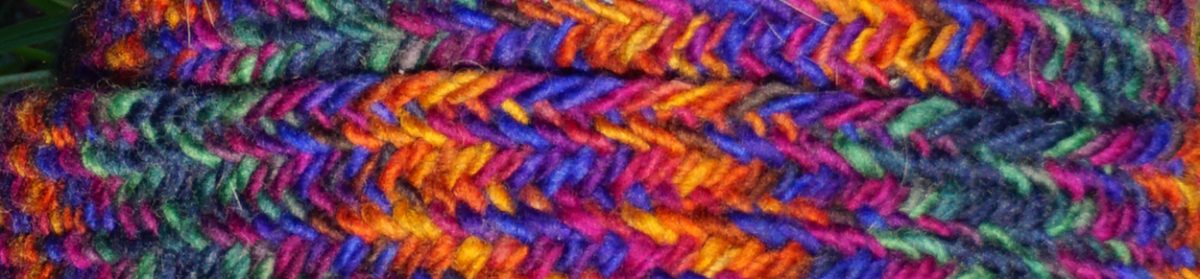
NOW: Chevron patterned hat – 46-77-30/10427

This week’s Nalbound Object of the Week is a striking Peruvian hat worked in Cross-knit Looping in a distinctive chevron pattern. While there are quite a few hats found in Peru, both in Simple Looping and in Cross-knit Looping, this is the first I’ve come across with this Chevron patterning.

Cap, looped, circular. Object number: 46-77-30/10427
Courtesy of the Peabody Museum of Archaeology and Ethnology, Harvard University. https://peabody.harvard.edu/
Request reproduction rights from https://peabody.harvard.edu/rights-and-reproductions

Object: Chevron patterned hat

Description: A dark brown and tan chevron patterned hat broken into 4 quarters with alternating chevrons. Overall: 16 x 17 cm (6 5/16 x 6 11/16 in.)1

Dated to: Chancay? culture2

Find location: Zapallan, Peru3

Material: camelid4

Stitch(es) used: Z-crossed5 Cross-knit Looping6

Object number: 46-77-30/10427

Current location: Peabody Museum of Archaeology & Ethnology, Harvard University

Link to museum catalog or other data: https://collections.peabody.harvard.edu/objects/details/90463?ctx=3895f836dffa87d819a31a9db21ff30320b3e15c&idx=72

Please note that sharing to other venues will likely be intermittent. If you wish to receive these each week, please remember to follow the blog.
Patrons on Patreon receive early access previews, occasional extra details, and priority requests.

  1. https://collections.peabody.harvard.edu/objects/details/90463?ctx=3895f836dffa87d819a31a9db21ff30320b3e15c&idx=72 ā†©ļøŽ
  2. https://collections.peabody.harvard.edu/objects/details/90463?ctx=3895f836dffa87d819a31a9db21ff30320b3e15c&idx=72. Chancey culture would put this hat in the Late Intermediate Period, 1000 CE – 1476 CE, https://en.wikipedia.org/wiki/Periodization_of_pre-Columbian_Peru ā†©ļøŽ
  3. https://collections.peabody.harvard.edu/objects/details/90463?ctx=3895f836dffa87d819a31a9db21ff30320b3e15c&idx=72 ā†©ļøŽ
  4. https://collections.peabody.harvard.edu/objects/details/90463?ctx=3895f836dffa87d819a31a9db21ff30320b3e15c&idx=72 ā†©ļøŽ
  5. As determined from the photograph by Anne Marie Decker ā†©ļøŽ
  6. https://collections.peabody.harvard.edu/objects/details/90463?ctx=3895f836dffa87d819a31a9db21ff30320b3e15c&idx=72 ā†©ļøŽ

NOW: Fragment from St. Audoen’s church, Dublin – E497:2428.325

This week I get to share with you the excitement of finding out about a rare find in a church I once visited. Some regions have preserved many finds, but textiles in Ireland are relatively rare and nalbound ones more so. Thus this week’s Nalbound Object of the Week is the second known nalbound artifact from Ireland. The fragments were found in the 12th century occupational debris. Photos have been published this year in Textiles of Ireland: Archaeology, Craft, Art by Elizabeth Wincott Heckett if you would like to see them. There’s also a nice diagram in 2006 Archeological Monograph on the excavations.

St Audoen’s Church & Visitor center when we visited on April 27, 2014. Photo credit: Anne Marie Decker

Object: Two main fragments. Usage unknown, but possibly a sock or cap.

Description: The larger fragment is 30 cm long by 8 cm high1 showing the remains of 6 rows. The smaller fragment is 6 cm long by 5 cm high2 with remains of 3+ rows. The thickness of both is c. 2mm.3 Original use as a mitten was ruled out as the length of the larger fragment would exceed the circumference appropriate for a mitten and is more suitable for a sock or a piece of a cap.4 There is no evidence of either intentional or wear fulling.5

Dated to: 12th century6 CE

Find location: Found in the 12th century occupation debris associated with timber structures during excavation of St. Audoen’s church, Cornmarket, Dublin, Ireland.7

Material: A dark brown, naturally colored, coarse, perhaps kemp-like, wool. No dye detected. The yarn has been combed and worsted spun in a medium to loose Z spin then two-plied with an S twist. The yarn is 1.5 mm in diameter.8

Stitch(es) used: uo o/u uoo F1 based on analysis of one of the outermost rows of loops.9 (Korgen)

Inventory number: E497:2428.325

Current location: Still tracking that down. The detailed catalog was lodged with the excavation archive in the Department of the Environment, Heritage and Local Government. Some of the items excavated at St Audoen’s remain there on display in their Visitor’s Centre.

Link to museum catalog or other data: none known

Some sources in which more information can be found:

Wincott Heckett, Elizabeth. “Textiles” in the Archaeological Finds chapter of St Audoen’s Church, Cornmarket, Dublin: Archaeology and Architecture by Mary McMahon. Dublin: The Stationary Office, Government of Ireland, 2006. ISBN 0-7557-7315-2

Wincott Heckett, Elizabeth. Textiles of Ireland: Archaeology, Craft, Art. Edited by Mary Ann Williams. Cork: Cork University Press, 2025. ISBN 9781782055716

Photographs:

There are two photos by Peter Maloney Ā© The Estate of Elizabeth Wincott Heckett included in Textiles of Ireland: Archaeology, Craft, Art: Fig. 15.1 on page 228 and Fig. 15.2 on page 231.

There is also an archeological drawing contained the the archeological monograph, St Audoen’s Church, Cornmarket, Dublin: Archaeology and Architecture, by Mary McMahon: Fig. 6.9 on page 74.

If you find this type of content interesting, please remember to follow the blog. You can also give one time donation at the link on this site or join my Patreon to support further research.
Patrons on Patreon receive early access previews, occasional extra details, and priority requests.

  1. 300 x 80mm. Wincott Heckett, Elizabeth. “Textiles” in the Archaeological Finds chapter of St Audoen’s Church, Cornmarket, Dublin: Archaeology and Architecture by Mary McMahon. Dublin: The Stationary Office, Government of Ireland, 2006. ISBN 0-7557-7315-2 page 74 and republished in Wincott Heckett, Elizabeth. Textiles of Ireland: Archaeology, Craft, Art. Edited by Mary Ann Williams. Cork: Cork University Press, 2025. ISBN 9781782055716. pg. 230 ā†©ļøŽ
  2. 60 x 50mm. Wincott Heckett, Elizabeth. “Textiles” in the Archaeological Finds chapter of St Audoen’s Church, Cornmarket, Dublin: Archaeology and Architecture by Mary McMahon. Dublin: The Stationary Office, Government of Ireland, 2006. ISBN 0-7557-7315-2 page 74 and republished in Wincott Heckett, Elizabeth. Textiles of Ireland: Archaeology, Craft, Art. Edited by Mary Ann Williams. Cork: Cork University Press, 2025. ISBN 9781782055716. pg. 230 ā†©ļøŽ
  3. Wincott Heckett, Elizabeth. “Textiles” in the Archaeological Finds chapter of St Audoen’s Church, Cornmarket, Dublin: Archaeology and Architecture by Mary McMahon. Dublin: The Stationary Office, Government of Ireland, 2006. ISBN 0-7557-7315-2 page 75 and republished in Wincott Heckett, Elizabeth. Textiles of Ireland: Archaeology, Craft, Art. Edited by Mary Ann Williams. Cork: Cork University Press, 2025. ISBN 9781782055716. pg. 232 ā†©ļøŽ
  4. Ibid. pg. 75, and republished in Ibid. pg. 233 ā†©ļøŽ
  5. Ibid. pg. 75, and republished in Ibid. pg. 231 ā†©ļøŽ
  6. Ibid. pg. 74, and republished in Ibid. pg. 229 ā†©ļøŽ
  7. Ibid. pg. 74, and republished in Ibid. pg. 229 ā†©ļøŽ
  8. Ibid. pg. 75, and republished in Ibid. pg. 232 ā†©ļøŽ
  9. Ibid. pg. 75, and republished in Ibid. pg. 232 ā†©ļøŽ

NOW: Border fragment with three figures – 1956.405

The figural work found in the decorative borders made by the Nazca people is stunningly beautiful and detailed. This week’s Nalbound Object of the Week is a beautiful sample of their cross-knit looped borders. This fragment has three very distinct figures. The Art Institute of Chicago’s website has very nice closeups of both sides and a very good zoom function if you’d like to see more.

Nazca. Fragment of a Decorative Border, 100 BCE-200 CE. The Art Institute of ChicagoĀ®
CC0 Public Domain

Object: Fragment of a Decorative Border 1956.405

Description: A border fragment with three figures. The figures are about 2.5 inches tall. The piece is 11.4 Ɨ 6.7 cm (4 1/2 Ɨ 2 5/8 in.)1

Dated to: 100 BCE-200 CE2

Culture: Nazca3

Find location: Possibly Coyungo, Nasca Valley, south coast, Peru4

Material: Cotton (plain woven ground), Camelid wool5

Stitch(es) used: The band’s ground support is plain weave and the extension supports are simple looping. The ground is encased in the decorative cross-knit looping6

Inventory number: 1956.405

Current location: The Art Institute of ChicagoĀ®

Link to museum catalog or other data: https://www.artic.edu/artworks/3000/fragment-of-a-decorative-border

Some sources in which more information can be found:

Sawyer, Alan R. Early Nasca Needlework. London: Laurence King Publishing, 1997. pg. 149, fig. 119 and 120 (ill.).

Melo, Alipio, MarĆ­a JosĆ© Murillo, and Danitza Willka. ā€œThe Heartbeat of Andean Weaving,ā€ in On Loss and Absence: Textiles of Mourning and Survival, eds. Isaac Facio, Nneka Kai, L Vinebaum, and Anne Wilson, exh. cat. Chicago: Art Institute of Chicago, 2025. pg. 164, fig. 3 (ill.).

Photographs (if permissions allow):

Please note that sharing to other venues will likely be intermittent. If you wish to receive these each week, please remember to follow the blog.
Patrons on Patreon receive early access previews, occasional extra details, and priority requests.

  1. The Art Institute of ChicagoĀ® https://www.artic.edu/artworks/3000/fragment-of-a-decorative-border ā†©ļøŽ
  2. The Art Institute of ChicagoĀ® https://www.artic.edu/artworks/3000/fragment-of-a-decorative-border ā†©ļøŽ
  3. The Art Institute of ChicagoĀ® https://www.artic.edu/artworks/3000/fragment-of-a-decorative-border ā†©ļøŽ
  4. The Art Institute of ChicagoĀ® https://www.artic.edu/artworks/3000/fragment-of-a-decorative-border ā†©ļøŽ
  5. The Art Institute of ChicagoĀ® https://www.artic.edu/artworks/3000/fragment-of-a-decorative-border ā†©ļøŽ
  6. The Art Institute of ChicagoĀ® https://www.artic.edu/artworks/3000/fragment-of-a-decorative-border ā†©ļøŽ

Z-twist yarns

The recent examination highlights the challenge of sourcing Z-twist yarns, essential for reconstructing specific textile artifacts. Manufacturers often lack detailed spin and ply information. The yarn’s twist direction affects fabric texture and handling, with Z-twist enabling tighter, smoother fabrics for many nalbinding stitches, while S-twist suits other stitches stitches and contemporary knitting techniques.

So my most recent examinations brought up an interesting issue. It can be hard to find Z-twist yarns; at all. Not just the specific weight, number of plies, and spinning method (worsted spun instead of woollen1) one might look for when trying to reconstruct an artifact, but just even any Z-twist yarns. When searching online you find that manufacturers often are not providing information on their spin and ply directions. Additionally, even if the photograph is close enough to look, you can’t trust the image hasn’t been reversed because it looks better for marketing purposes.

By Yarn_twist.png: PKMderivative work: Dfred (talk) – Yarn_twist.png, Public Domain, https://commons.wikimedia.org/w/index.php?curid=6991339

So why is this important? The final twist direction of a yarn has an impact on how it lays in the final textile. Even the act of winding on and off a ball can affect the yarn twist and have an effect on the final resulting fabric.2 This is markedly more noticeable the more a technique spirals when being worked. Looped textiles inherently spiral the yarn either as they wrap the yarn around the needle or hook, or as the yarn is pulled through the stitches. That wrapping/spiraling can either tighten the twist or loosen it. In the case of single ply, it can loosen it enough the yarn falls apart.

Not all nalbound artifacts are worked in Z-twist yarns, but a significant number are. And combined with certain stitches, Z-twist can help make a tighter, smoother fabric which can be easier to work as the yarn is less likely to split. Other stitches (those ending the stitch on the reverse of the working thread instead of on the technical front or vice versa for left handed) spiral in the other direction and are better suited to S-twist yarns. This is also why S-twist yarns are generally more suited to the wrap direction found in how knitting is currently taught in the Western world and Z-twist yarns are generally more suited to the wraps of modern crochet.

I am clearly not the only person that has noticed this. There are a variety of useful articles on the effect of twist on a fabric available.3 In fact, I have recently run across a website dedicated to yarn substitutions called YarnSub that includes twist direction in its database (although it has some issues in its comparisons matching number of plies to z-ply instead of keeping the twist separate from the number of plies and also includes cabled yarns where the final twist is Z). Here is the search for Z-twist yarns: https://yarnsub.com/search?q=z+plied

I used to get some nice naturally dyed Z-spun yarn from Juuliorg out of Estonia. They are currently on an extended vacation, but the mill is still open.

I have also used some Z-spun yarn from Ullcentrum: https://www.ullcentrum.com/en/yarns-tools/wool-yarn/z-plied-2-ply/

I’ve also run across several other suppliers. Unfortunately, current conditions are restricting postal service here to the US. So while I may not be able to get any soon, perhaps you may find these useful.

Filter on Z-tvinnat: https://bavensspinnhus.se/produkter

So have you found a favorite Z-twist yarn? I would love to hear about it.

Please remember to follow the blog for more interesting nalbinding content.
Your support is greatly appreciated and helps fund future research.
Patrons on Patreon receive early access previews, occasional extra details, and priority requests.

Footnotes:

  1. The difference between worsted spun and woolen spun yarns is in the preparation and drafting of the fiber. Worsted spun yarns the fibers are combed and drafted so that the fibers all align. This makes for a smooth hard-wearing, but not lofty yarn. For woolen spun yarn, the fibers are carded and drafting is from a rolag or fold so that the fibers are intentionally jumbled. This makes for a lofty yarn that holds a lot of air, but it tends to not be as strong and more likely to pill and full/shrink. ā†©ļøŽ
  2. Here is an interesting blog post demonstrating the effect: https://peggyosterkamp.com/2021/08/use-your-s-z-identifier-tool-to-add-or-subtract-twist-to-yarns/ Accessed 11/30/2025 ā†©ļøŽ
  3. https://wildwoollys.com/blogs/articles/what-is-z-twist-yarn-and-should-you-care Accessed 11/26/2025
    https://spinoffmagazine.com/twist-direction-s-vs-z-twist/ Accessed 11/26/2025
    https://sweetgeorgiayarns.com/twist-and-shout-why-twist-direction-matters-in-your-making/ Accessed 11/26/2025
    And even how twist direction was used to create patterns in woven textiles: https://brankaontextiles.com/z-s-directions-spinning-textile-how-ancient-women-once-wove-monochrome-patterns-with-light-and-shadows-in-the-beholders-eye/ Accessed 11/26/2025 ā†©ļøŽ

NOW: Light brown Egyptian Sock – (A&I)1914:205

This week’s Nalbound Object of the Week is an Egyptian Sock that is currently located in the National Museum of Ireland. Early online photos of the sock were taken at such an angle that the toe split was not visible. This led to mistaken impression that this sock was the only adult cross-knit looping (Coptic stitch) nalbound sock with a single toe box. I was lucky enough to come across this sock on display in April of 2014, so I had seen in person that it did have a split toe to accommodate sandals. In fact, out of the 49 or so cross-knit looped nalbound Egyptian socks we have images of and are whole enough to tell, only the tiniest baby socks for not yet mobile infants do not have split toes.

Woolen Sock (A&I)1914:205 Ā© National Museum of Ireland CC BY-NC-SA 4.0

Object: Woolen Sock

Description: A now light brown wool sock for the left foot with a split at the ankle and ties still remaining. There is a decorative welt around the ankle where the heel cup shifts to the ankle. Height 9cm, width 8cm, Length 22 cm.1 The sock arrived at the National Museum of Ireland as part of the distributions the Egypt Exploration Fund in 1914.2

Dated to: Graeco-Roman Period:  Roman Period3

Find location :  el-Sheikh Ibada/Antinoopolis, Egypt4

Material: Wool5

Stitch(es) used: S-crossed Cross-knit Looping (as determined from photographs by Anne Marie Decker)

Inventory number: (A&I)1914:205

Current location: National Museum of Ireland

Link to museum catalog or other data: https://www.museum.ie/collections/collection/antiquity-203733/?return=%2Fcollections%2Fcollection%2F%3Fterm%3Dsock

Some sources in which more information can be found:

https://www.globalegyptianmuseum.org/record.aspx?id=2619

Rose-Beers, Kristine. (2023). The Threads that Bind: Evidence of the Early Codex Structure in Chester Beatty’s Papyri. DOI 10.1515/9783110781304-009.

Photographs:
There are two additional views of the sock available on the National Museum of Ireland’s website. The view that obscures the split toe can be seen on The Global Egyptian Museum.org site.

Please note that sharing to other venues will likely be intermittent. If you wish to receive these each week, please remember to follow the blog.
Patrons on Patreon receive early access previews, occasional extra details, and priority requests.

  1. https://www.globalegyptianmuseum.org/record.aspx?id=2619 ā†©ļøŽ
  2. https://www.globalegyptianmuseum.org/record.aspx?id=2619 ā†©ļøŽ
  3. https://www.globalegyptianmuseum.org/record.aspx?id=2619 ā†©ļøŽ
  4. https://www.globalegyptianmuseum.org/record.aspx?id=2619 and https://www.museum.ie/collections/collection/antiquity-203733/?return=%2Fcollections%2Fcollection%2F%3Fterm%3Dsock ā†©ļøŽ
  5. https://www.museum.ie/collections/collection/antiquity-203733/?return=%2Fcollections%2Fcollection%2F%3Fterm%3Dsock ā†©ļøŽ

NOW: Arizona Cliff-dweller skullcap – 14-5-10/A1260

Generally when we talk about nalbinding from the Southwest United States, we are talking about socks or shoe-socks or possibly leggings. This week’s Nalbound Object of the Week is unusual in that it is a cap. When the excavations were published in 1919, it was the only textile cap to have been found in the Southwest.

Looped cap. Plate 34. a.1

Object: Skull-cap

Description: A natural colored cap worked from the center down.

Dated to: No date provided, but the Cliff-dweller culture is believed to come after the Basket-maker culture. Estimate Pueblo III (1150–1350).

Find location: Cliffhouse 22 / Ruin 2 in Sayodneechee Canyon (“Where the red rocks run under” in Navajo)3

“At g, just outside one of the rooms and beneath 8 inches of closely packed rubbish, lay a cap of yucca yarn.”4

Material: Sometimes referred to as made of yucca cord5 (narrow leaf yucca), but there is also a mention that the cap is likely apocynum (Dogbane/Indian Hemp) fiber6

Stitch(es) used: Z-crossed Simple Looping7 called coiled work without foundation8 in the excavation report. “Near the edge there are 9 coils and 5 loops to the inch, the stitches nearer the top are deeper and wider spaced.”9

Object number: 14-5-10/A1260

Current location: Peabody Museum of Archaeology & Ethnology, Harvard University

Link to museum catalog or other data: https://collections.peabody.harvard.edu/objects/details/169386

Some sources in which more information can be found:

Kidder, Alfred Vincent, and Samuel J. Guernsey. Archeological Explorations in Northeastern Arizona. Smithsonian institution. Bureau of American Ethnology Bulletin 65. Washington D.C.: U.S. Government Printing Office, 1919. https://repository.si.edu/items/14df4b65-e141-4ea1-b541-3b2ac24e7fdf Accessed 13 November 2025.

Photographs (if permissions allow): There is a nice color photo of the cap on the Peabody Museum’s site.

The glass plate of the picture published in the Archeological Explorations in Northeastern Arizona is also in the Peabody: https://collections.peabody.harvard.edu/objects/details/500065

Please note that sharing to other venues will likely be intermittent. If you wish to receive these each week, please remember to follow the blog.
Patrons on Patreon receive early access previews, occasional extra details, and priority requests.

  1. Kidder, Alfred Vincent, and Samuel J. Guernsey. Archeological Explorations in Northeastern Arizona. Smithsonian institution. Bureau of American Ethnology Bulletin 65. Washington D.C.: U.S. Government Printing Office, 1919. https://repository.si.edu/items/14df4b65-e141-4ea1-b541-3b2ac24e7fdf pg. 94 ā†©ļøŽ
  2. https://collections.peabody.harvard.edu/objects/details/169386 ā†©ļøŽ
  3. Kidder, Alfred Vincent, and Samuel J. Guernsey. Archeological Explorations in Northeastern Arizona. Smithsonian institution. Bureau of American Ethnology Bulletin 65. Washington D.C.: U.S. Government Printing Office, 1919. https://repository.si.edu/items/14df4b65-e141-4ea1-b541-3b2ac24e7fdf pg. 19 ā†©ļøŽ
  4. Ibid., Figure pg. 20. Quote pg. 24 ā†©ļøŽ
  5. Ibid., pg. 100 ā†©ļøŽ
  6. Ibid., pg. 117 ā†©ļøŽ
  7. As determined by Anne Marie Decker based on the diagram in Kidder & Guernsey’s explorations and examination of the picture provided. ā†©ļøŽ
  8. Kidder, Alfred Vincent, and Samuel J. Guernsey. Archeological Explorations in Northeastern Arizona. Smithsonian institution. Bureau of American Ethnology Bulletin 65. Washington D.C.: U.S. Government Printing Office, 1919. https://repository.si.edu/items/14df4b65-e141-4ea1-b541-3b2ac24e7fdf pg. 100 ā†©ļøŽ
  9. Ibid., pg. 117 ā†©ļøŽ

NOW: Border of warriors – 1956.1267.3a-h

This week’s Nalbound Object of the Week is a beautiful cross-knit looping example. A border of warriors and their sacrifice, originally intended to be attached to a piece of fabric. If you go to the The Art Institute of Chicago’s website there is a very good zoom function and some close-ups showing the underlying support worked in Simple Looping.

Nazca. Warrior Fragments, 100 BCE-200 CE. The Art Institute of ChicagoĀ®
CC0 Public Domain

Object: Border of warriors

Description: A border of warriors and a sacrifice. The figures are about 2.5 inches tall. More details on The Art Institute of Chicago’s website.

Dated to: 100 BCE–200 CE1

Culture: Nazca2

Find location: South coast, Peru3

Material: Cotton (ground), Camelid wool4

Stitch(es) used: Simple Looping for the ground support, cross-knit looping and cross-knit loop stitch embroidery5

Inventory number: 1956.1267.3a-h

Current location: The Art Institute of ChicagoĀ®

Link to museum catalog or other data: https://www.artic.edu/artworks/148858/warrior-fragments

Some sources in which more information can be found:

Sawyer, Alan R. Early Nasca Needlework. London: Laurence King Publishing, 1997. pg. 148, color fig. 117.

Photographs (if permissions allow):

Please note that sharing to other venues will likely be intermittent. If you wish to receive these each week, please remember to follow the blog.
Patrons on Patreon receive early access previews, occasional extra details, and priority requests.

  1. The Art Institute of ChicagoĀ® https://www.artic.edu/artworks/148858/warrior-fragments ā†©ļøŽ
  2. The Art Institute of ChicagoĀ® https://www.artic.edu/artworks/148858/warrior-fragments ā†©ļøŽ
  3. The Art Institute of ChicagoĀ® https://www.artic.edu/artworks/148858/warrior-fragments ā†©ļøŽ
  4. The Art Institute of ChicagoĀ® https://www.artic.edu/artworks/148858/warrior-fragments ā†©ļøŽ
  5. The Art Institute of ChicagoĀ® https://www.artic.edu/artworks/148858/warrior-fragments ā†©ļøŽ

Blue and white knit stockings

Nalbinding isn’t the only corpus that is spread out across many institutions. Recently a number of museums have added to their online collection databases and we are now able to see quite a few more blue and white knitted artifacts from Egypt.

So in addition to the ones in The Textile Museum that I posted about in 2020: https://nalbound.com/2020/10/06/the-textile-museum/ I wanted to share a few others that I’ve found or had brought to my attention.

Here are three pieces from the Detroit Institute of the Arts:


The Staatliche Museen zu Berlin, Museum für Islamische Kunst has four pieces:


In 2019 I had the opportunity to go to the Museum der Kulturen Basel to study the nalbinding they have in their collection. While there, they shared a few pieces of their blue and white knitting with me as well. As they were putting it away, I got hints that they had an extensive collection. The Museum der Kulturen Basel has just recently put their collection online and there are some amazing pieces. Their database does not have permalinks to individual artifacts, so you will need to search via the Object Number for more details on each piece: https://www.mkb.ch/en/museum/sammlung.html

This bit of blue and white knitting isn’t in an online catalog, but the article in which it was published is online: https://ejournals.epublishing.ekt.gr/index.php/benaki/article/view/1765/1754

Do you have links to other blue & white knitting from Egypt?

Edit: Thank you Geeske for reminding me of this one in the V&A: https://collections.vam.ac.uk/item/O128882/sock-unknown/

Please note that sharing to other venues will likely be intermittent. If you wish to receive these each week, please remember to follow the blog.
Patrons on Patreon receive early access previews, occasional extra details, and priority requests.

#WWNIPday – Grand Canyon edition

I hope everyone had an excellent Worldwide Nalbinding in Public Day! I know I did. In our planning of this particular research trip, where exactly we would be today was a bit amorphous as we planned to explore a variety of small museums around the Four Corners region searching for nalbinding and basketry of the Cliff Dweller and Ancestral Pueblos peoples.

It turns out, the Grand Canyon is a glorious location to nalbind in public.

Holly Dawn Hewlett filmed Anne Marie Decker Nalbinding in Public at the Grand Canyon on the 10th anniversary of International Nalbinding in Public Day.

#wwnipday #internationalnaalbindingday

1 Sept – Worldwide Nalbind in Public Day

I am looking forward to nalbinding in public this coming September 1st on the tenth anniversary of Worldwide Nalbind in Public day. Exciting plans are beginning to form. Find your string and get your needle ready.

The International Nalbinding Day or Worldwide Nalbind in Public Day was started in 2016. I missed the first few years, but here’s a review of what I’ve been up to for the last few.

In 2024, I had the pleasure of nalbinding in two venues: online on Zoom in our weekly Nalbinding Get Togethers with friends on three continents and later at a wedding in a beautiful venue. Facebook has also kind enough to remind me of where I was nalbinding on previous Nalbind in Public days.

Prior years:

In 2023, I went to the Susquehanna museum and Lockhouse.

Three years ago, I was examining the nalbound mitten from Iceland

Four years ago, Hurricane Ida put laid to my plans, so I shot a few videos for the public instead: Nalbinding: Simple Mammen/Korgen Start

Five years ago, I worked on a modern pair of socks inspired by my examinations of Roman Era Egyptian ones.

Six years ago, I was nalbinding on a train to Paris as we made our way home after examining the Mammen Pennants, the Egyptian sock in the National Museum of Denmark and three pairs of Egyptian nalbound socks in the MusƩe DobrƩe in Nantes, France.

A person wearing a headscarf and glasses is sitting on a train, holding a needle and yarn, ready for nalbinding.

It’s been an adventure.  Where will you be?

If you wish to contribute to future research and resources, please join me on Patreon. Your support is most greatly appreciated!
Patrons on Patreon receive early access previews, occasional extra details, and priority requests.